

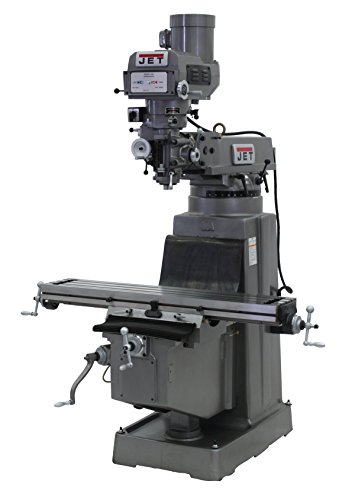
Want DEAD-SIMPLE DRO accuracy and fewer headaches? Meet my top 8 picks — from heavy hitters to bench-friendly champs.
Precision doesn’t have to be painful. I once spent a day chasing a misaligned cut until I realized the DRO was the missing piece. Lesson learned: a good readout saves time and temper.
I pulled together eight JET mills that ship with, or are commonly paired with, ACU-RITE readouts. Short list: rugged production machines, smart mid-range workhorses, and compact combos for light work. I’ll tell you which one I’d pick for different shop needs.
Top Milling Picks


JET 10x50 Variable-Speed Mill, Powerfeeds
I appreciate the solid construction and precision features that make this mill ideal for long production runs and tough jobs. The combination of ACU-RITE DRO and X/Y powerfeeds gives excellent repeatability and ease of use.
Purpose and overview
I see this machine as a shop-level workhorse designed for heavy milling tasks where stability and repeatability matter. It pairs a large 10" x 50" table with variable speed capability, X and Y powerfeeds, and a factory-fitted ACU-RITE 203 DRO so you can take on production and precision work without adding aftermarket DROs.
Key features and benefits
The build quality is the standout — Meehanite castings, hardened and ground ways, and chrome lead screws all add up to a mill that resists chatter and keeps cuts consistent. The ACU-RITE 203 DRO simplifies setup and reduces human error when doing repeated operations.
Practical insights and limitations
In my experience, this is the mill I’d choose when surface finish and repeatability are priorities. That said, the machine’s footprint and weight mean you'll need a proper foundation, forklift for delivery, and likely three-phase power for some configurations. If you’re running a small shop or light prototyping, it could be overkill.
Who it’s best for
If you run a commercial shop, training lab, or serious hobbyist garage with space and budget, this mill rewards you with long-term reliability and capability. For occasional hobbyists, consider a smaller, less expensive machine unless you specifically need the bed size and rigidity.
JET 10x50 Variable-Speed Mill, Heavy-Duty
I consider this model a top pick for shops that need a reliable, production-capable mill with modern conveniences. It pairs a large work envelope with robust components and useful accessories.
High-level view
I view this JTM-1050VS2 configuration as a top choice for professional shops that need a versatile, repeatable milling platform. The variable-speed head and heavy-duty table let you tackle a wide range of jobs from dies and fixtures to larger production pieces.
Core strengths
This mill’s certified Meehanite castings and precision bearings reduce vibration and extend tool life. The included DRO and powerfeeds are noticeably helpful during production runs, cutting setup time and minimizing operator variability.
Practical notes
I recommend planning for delivery logistics — the machine’s weight and footprint are non-trivial. Also, consider sound management and electrical supply when installing. For shops that check those boxes, this mill is a dependable, long-term asset.
JET JTM-4VS 3-Axis Mill with Powerfeeds
I like this mill when quill-axis DRO control matters — the 3-axis readout including the quill is a big help for depth-critical work. The variable speed head and powerfeeds make setup and repeatability straightforward.
Why I'd pick this mill
When I need the extra control of a quill readout for slotting, drilling, or depth-critical milling, this model stands out. The built-in 3-axis ACU-RITE DRO (third axis on the quill) means I can set and repeat depths precisely without extra gauges.
Standout features
Variable-speed functionality eliminates the need to swap belts for many operations and makes it easier to dial in feeds for different materials. Combined with X and Y powerfeeds, the result is a mill that handles repetitive production tasks comfortably.
Real-world notes
I’d recommend this machine for precision prototyping shops, toolrooms, and users who value quill-readout control. It's a bit pricier and bulkier than basic step-pulley mills, but the gains in usability and accuracy justify that for many users.
JET Step-Pulley Mill with ACU-RITE 203 DRO
I find this model strikes a strong balance between price, durability, and features. The included DRO and X-axis powerfeed make it useful in teaching shops and light production environments.
What this mill is for
I see this jet model as an excellent mid-sized mill for vocational shops, makerspaces, and small commercial shops that need a dependable machine without a huge price tag. It’s a step-pulley design, which keeps the controls simple and durable.
Notable features
The unit ships with an ACU-RITE 203 DRO and an X-axis powerfeed, so you get accurate positioning and easier table movement for repetitive cuts. The built-in coolant tank and one-shot lubrication lower the day-to-day maintenance work.
Practical perspective
I’ve seen this model used in a high school robotics shop with very good results — it holds up to heavy use and student learning curves. If you prefer electronic speed control instead of step pulleys, look for a variable-speed alternate, but for robustness and serviceability this machine scores highly.
JET JTM-2 Mill with ACU-RITE DRO, Powerfeeds
I appreciate this model as a capable, mid-weight mill that brings useful factory features without excessive complexity. The combination of powerfeeds and DRO makes it practical for a variety of shop tasks.
Where this mill fits
I recommend this JTM-2 variant to shops that want a rugged, all-around milling machine with factory-installed DRO and powerfeeds. It’s designed to be a workhorse for general machining, fixture work, and moderate production tasks.
Key capabilities
The machine’s three-stage power downfeed and high-precision spindle bearings help deliver consistent cuts. An internal coolant tank is built into the base, which is a useful convenience when performing longer machining cycles that require fluid.
Practical considerations
I’ve found this model to be a strong daily driver — not the absolute largest JET, but rigid and feature-rich enough for many shops. If you prefer electronic speed control and more modern ergonomics, compare the variable-speed siblings; otherwise this version offers good value and longevity.
JET JTM-2 Mill With 3-Axis DRO, Powerfeeds
I find this mill a great compromise between capability and cost for a mid-sized shop. The included DRO and powerfeeds add practical value and speed up repetitive setups.
Intended users and utility
I recommend this mill to small shops and serious hobbyists who want a capable machine without jumping to the largest models. It offers a 3-axis ACU-RITE DRO and X/Y powerfeeds, which are especially useful for repetitive work and complex setups.
Important features
Meehanite castings and a heavy-duty splined motor drive give the machine solid mechanical foundations. The internal coolant tank is convenient for wet cutting, though you should budget for a coolant pump if you plan to rely on coolant frequently.
Practical considerations
If you need the absolute top-of-line capacity, consider the largest JET models, but for many shops this machine offers a sensible feature set. Expect serviceability and a 2-year manufacturer warranty to back up the investment.
JET JVM-836-1 Step-Pulley Mill, ACU-RITE 203 DRO
I view this mill as a straightforward, dependable tool for routine shop work. It focuses on fundamentals — a honed milling head, good bearings, and useful ram travel — without unnecessary bells and whistles.
Overview and intended use
I recommend this model for shops or hobbyists who want a no-nonsense milling machine that emphasizes mechanical quality. The JVM-836-1 is a step-pulley mill with the ACU-RITE 203 DRO that covers most small-to-medium milling tasks.
What I like about it
The precision-bored head and quality spindle bearings translate into good surface finish and reliable operation. Locks on all movable surfaces help when cutting harder materials or when doing fine finishing passes.
Considerations
If you need modern conveniences like electronic variable-speed control or heavy-duty production throughput, this machine may feel limited. For general fabrication, prototyping, and classroom use, it’s a capable and economical choice.
JET 18-Inch Mill Drill with ACU-RITE 203 DRO
I like this mill-drill when space and budget are limited — it blends drill-press convenience with table milling capability. It's best for light machining tasks and small projects rather than heavy milling.
Who should consider this mill-drill
I recommend this model for hobbyists, small shops, or makers who need milling capability but have limited floor space or budget. It’s a hybrid — a belt-driven drill press with a milling table — so you get flexibility for small parts and lighter operations.
Features and benefits
The machine’s accessory package is generous and helps you get running quickly. A locking collet and positive quick-stop add safety, and the one-piece cast iron column helps with alignment compared to lightweight drill presses.
Limitations and real-world use
In my experience, this machine is excellent for light milling, tapping, and drilling in softer materials or thin sections. If you plan to remove heavy material, work on large plates, or require sub-thousandth accuracy under load, a full-sized mill will serve you better.
Final Thoughts
If I had to pick one all-around champion for a real shop, it would be the JET 10x50 Variable-Speed Mill, Powerfeeds (9.2 out of 10). Why? It’s built for heavy-duty shop work: rock-solid construction, X/Y powerfeeds for repeatability, and the ACU-RITE DRO to keep setups fast and accurate. If you run production or heavy prototyping, this is the mill that will eat the work and keep coming back for more.
For work where depth control and fine feeds matter — fixtures, tooling prototypes, or lots of slotting — I’d reach for the JET JTM-4VS 3-Axis Mill with Powerfeeds (8.9 out of 10). The quill-axis DRO makes depth-critical tasks far easier. It’s the practical choice when precision and repeatability matter but you don’t need the footprint of the 10x50.
FAQs
I find 2-axis DROs cover most layout and basic milling work (X and Y). But if you do depth-critical operations like repetitive plunges, pocketing to a fixed depth, or precise tool changes, a 3-axis (with quill/Z readout) saves time and prevents mistakes. In short: 2-axis is fine for general work; 3-axis is a huge quality-of-life upgrade for depth control.
Absolutely, especially for production or long feeding cuts. Powerfeeds keep travel steady, reduce chatter, and free you from hand-cranking while you watch cut quality. If you do repetitive setups or need surface finish consistency, I always recommend getting X/Y powerfeeds.
Yes — in many cases you can. ACU-RITE units are commonly retrofitted, but check mounting space, travel length, and encoder compatibility. I’d measure travel and look for encoder kits that match your table and quill strokes, and plan for basic wiring and calibration time.
Step-pulley heads require belt changes to alter speed; they’re simple and reliable. Variable-speed heads let you change RPM on the fly, which is nicer for frequent speed tweaks and finishing cuts. For heavy shop work I prefer variable speed for convenience; for school environments or tight budgets, step-pulley models are rugged and predictable.
I’d recommend the JET JTM-2 Mill with ACU-RITE DRO, Powerfeeds (8.5) — it balances capability, footprint, and cost. It gives you factory-installed powerfeeds and a DRO without the bulk of the largest 10x50 machines. Great for small production runs and mixed job work.
Keep things clean and light on coolant near readouts and encoders. I regularly wipe rails, check mounting screws, and verify zeroes before critical jobs. For powerfeeds, inspect gearboxes and couplings for play and keep lubrication per the manual. A quick periodic calibration check saves a lot of headache.
It’s a practical compromise. If your shop needs both drilling convenience and occasional milling but you’re short on space or budget, the 18-inch mill-drill is a smart choice. Don’t expect heavy milling performance — treat it as a light-duty mill with drill-press flexibility.
Grab a set of good parallels, a digital indicator for setup checks, a backlash compensator if your DRO doesn’t handle it well, and decent collets or a quality vise. Those small extras speed setups and let the DRO do what it’s best at: making cuts predictable.






Great roundup — thanks for putting these side-by-side! The JET JTM-1050VS2 (690214) looks like an absolute tank and that 9.2 rating makes sense given the X/Y powerfeeds and ACU-RITE 203 DRO.
Quick question: does the 690214 version ship standard as 230/460V 3ph, or are there single-phase variants? I’m planning a small production area but only have single-phase in the building right now. Any tips on getting 3-phase power or using a phase converter would be super helpful.
Good question, Emily. There are different SKU/configurations for the JTM-1050 series. The heavier production models often come in 230/460V 3-phase. If your shop is single-phase, a rotary phase converter or VFD for specific motors can be an option — but check motor compatibility and vendor specs first. For long production runs, true 3-phase is usually more reliable.
Also ask the seller on Amazon about the exact model number. They often list the voltage in the product title or Q&A. Saved me a headache once — got the single-phase variant by mistake 😅
I run a similar-sized shop and went with a static phase converter initially — cheap but flaky under heavy load. Ended up installing a small service rotary converter. More $$, but way more stable for the powerfeeds.
I’m seriously leaning toward the JET JTM-2 Mill With 3-Axis ACU-RITE 203 DRO (690157). The 3-axis quill DRO appeals to me for precision pocket depths and repeatability.
Any tips on calibrating/zeroing the quill DRO and best practices to keep it accurate? Also, are there known quirks with the ACU-RITE 203 that I should expect? typos incoming lol 😅
I add a small bellows or splash guard around the quill scale and always keep an extra set of batteries/power adapter for the DRO. Small things that save time.
Good choice. For quill DRO calibration: use a precision test indicator and a known gauge block to verify quill travel increments. Re-zero after any tooling changes and periodically check backlash/cup runout. ACU-RITE 203 is generally robust; watch for cable routing to avoid snags and protect the readout from coolant splash.
I’ve been using a JET mill with ACU-RITE 203 for about a year and honestly the DRO changed my workflow. No more guessing depths or scribbling offsets.
Has anyone tried the 3-axis quill DRO on fine feature work? I found it helped a lot with consistent pocket depths across multiple parts. Would recommend for small-batch repeatability.
Agree — saved me tons of time on a run of parts last month. The biggest win was not having to scribble reminders on the mill table 😂
Do you use any software or spreadsheets to log offsets and common setups? I’m trying to standardize tool offsets across machines.
I keep a small template book with common setups and DOF values. Not sexy but it works. Also laminate the pages to keep coolant off them!
Totally — a 3-axis quill DRO can cut setup time for depth-critical work. It shines on repeatable pockets and stepped features where you need exact plunge control.
Long post incoming — buyer beware re: Amazon shipping on large stuff like the JVM-836-1 and JTM series.
I ordered a JVM-836-1 (690177) last winter. The mill arrived with a scratched table and a missing fastener. Took weeks to sort with the shipper and the manufacturer. The machine itself runs fine now — solid bearings and a decent head — but the hassle was not worth it.
If you plan to buy any of these big JET mills through Amazon, consider local dealer pickup or insist on white-glove delivery. Saves a huge headache.
Ugh, same here with a small knee mill from Amazon. Photos saved my warranty claim. Dealers typically bolt-test and set the machine — worth the extra cost.
Pro tip: request the OEM crate to remain until inspection. If it was damaged during transit, carriers are less likely to deny a claim when original packaging is intact.
Sorry you had that experience, Jake — that’s unfortunately common with heavy machinery and marketplace shipping. White-glove or local dealer pickup is a good call. Also photograph everything immediately upon arrival and open claims fast.
Haha, I once got a crate that looked like it fought a bear. Machine was fine but the crate was a war story. 😆
Step pulley vs variable-speed — which would you pick for a training shop? The list includes the Step Pulley Milling Machine JTM-2 (Model JTM-2) and variable-speed JTM-1050 variants.
Step pulleys teach students about gear ratios and manual speed changes, but variable-speed is just convenient. Thoughts?
Old-school step pulleys = character. Variable-speed = less time cursing belts. Depends if you want character or efficiency 😄
For training, step pulleys are pedagogically valuable — students learn basics of spindle speed selection and setup. But for modern production training, also show variable-speed (VFD) machines so students learn RPM selection without manual belt changes. If budget allows, have both styles available.
The JET 18-Inch Mill Drill (JMD-18) is the definition of “not a beast but my garage bestie.” Works great for bolt holes and small plates. Not trying to cut billets, but honest, it saved me on so many weekend projects 😂👍
Exactly — the JMD-18 is a good light-duty combo. Great for hobbyists who want drill-press speed plus some milling capability. For heavier milling, look at the JTM series instead.
Can you run endmills on it safely? I’m worried about deflection on longer tools.
You can, but keep cuts light and watch RPM. Use shorter, rigid tooling to minimize chatter.
Question about the powerfeeds — I’ve used a couple of older JET mills and I’m curious about maintenance and longevity of the X/Y powerfeeds on these newer models (690214, 690140, 690210 etc.).
Do the powerfeeds require frequent lubrication or rebuilds? Are replacement parts readily available from JET? I’m asking because in a high-use environment downtime kills productivity.
Would love a short maintenance checklist if anyone has one.
Also, when you buy the machine, buy a spare feed clutch assembly if you can — they’re cheap compared to lost production days.
Agree with the logbook idea. Preventive maintenance saves lives (and profit).
Powerfeeds are generally low-maintenance but do require periodic lubrication and checking of gear mesh/backlash. Grease the feed worm and check the gearbox oil (if equipped) per the manual. Keep spare drive belts, shear pins, and coupling parts on hand. JET parts are usually available through dealers and OEM channels, but lead times can vary.
I keep a small logbook on each machine: weekly visual check, monthly grease points, quarterly gearbox inspection. It cuts downtime dramatically.
If your shop is tight on space, the JVM-836-1 is simpler and has fewer moving parts in the feed area — less to go wrong imo.
Nice list. I’m torn between the JET JTM-4VS with the 3-axis ACU-RITE (quill readout) and the JTM-2 step pulley model for a school lab. The JTM-4VS sounds fancy with quill DRO, but the JTM-2 is cheaper and simpler.
Anyone here used the quill DRO in a teaching environment? Is it worth the added complexity for students?
For teaching, the quill/3-axis DRO (JTM-4VS) can be a great training tool — students learn to track depth and repeatable plunges. But for basic milling fundamentals, the JTM-2 step-pulley (Model JTM-2) gives durability and lower maintenance costs. It depends on curriculum depth and budget.
We had a JTM-2 at our community makerspace and it was bulletproof for classes. The quill DRO is cool, but beginners often get overwhelmed. Maybe keep one of each if the budget allows.