

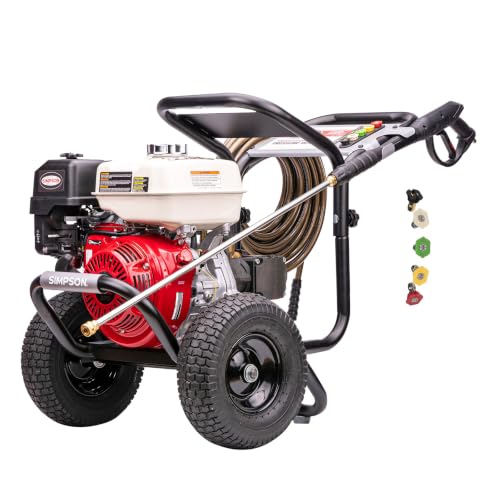
Raw power and reliability for big jobs — not a lightweight weekend toy.
Ever stared at a mildew-streaked driveway and realized a garden hose just isn’t going to cut it? I have — and there’s a strange little thrill when a pressure washer actually makes years of filth disappear. That’s where the Simpson Cleaning PS60869 PowerShot 4000 PSI steps in: a brute-force, no-nonsense machine built for heavy cleanup, paint prep, and large restoration jobs.
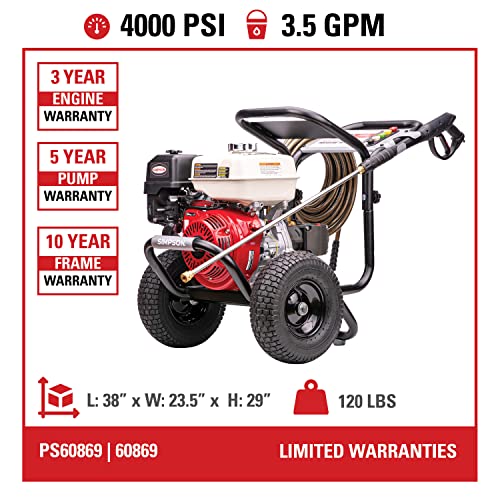
I took this unit to some tough jobs and was impressed by the 4000 PSI/3.5 GPM punch, the commercial AAA triplex pump’s consistency, and the Honda GX270’s reliable starts. It’s clearly made for people who need real power and dependability — just know it’s heavy (about 120 lb), not CARB-compliant for California, and lacks compact storage bells and whistles. If you want a weekend toy, look elsewhere; if you need a workhorse, this one earns its keep.
Simpson PowerShot 4000 PSI Pressure Washer
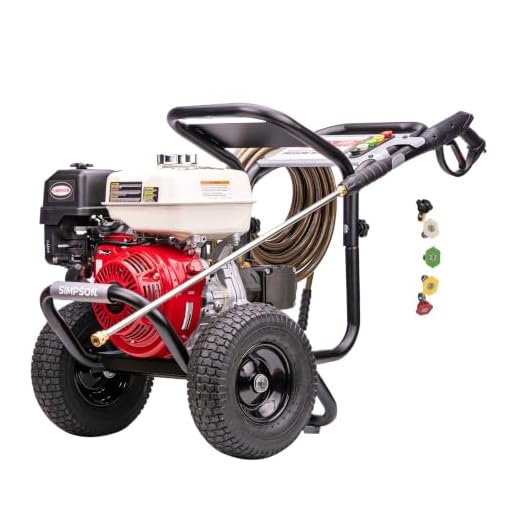
I find this unit excels where power and reliability matter most — it eats through grime, paint prep, and large-scale restoration tasks. If you need a workhorse rather than a compact weekend washer, this is a very practical choice.
Overview
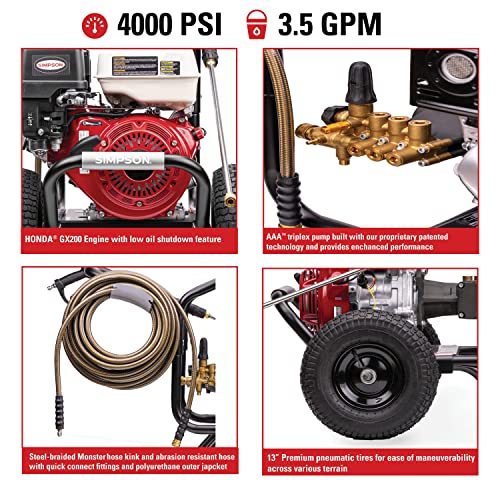
I test and use pressure washers on tough residential and light commercial jobs, and the Simpson PS60869 PowerShot struck me as one of those machines built to last on the job site. It’s heavy, unapologetically powerful, and loaded with the essentials pros expect — a commercial-grade pump, a Honda GX270 engine, and a long, flexible Monster hose. I’ll walk through how it performs day-to-day, what I liked, what annoyed me, and how to get the best out of it.
Key features at a glance
Performance in the real world
I used the PowerShot on a variety of tasks: deck restoration, driveway oil stain removal, prepping siding for repainting, and cleaning heavy equipment. The combination of 4000 PSI and 3.5 GPM gives this machine serious bite — it removes old paint, deeply embedded dirt, and algae much faster than consumer-level models. The pump keeps pressure steady under load, which makes technique much more predictable when I’m using turbular or rotating tips.
Performance table (typical results)
| Task | Recommended Nozzle | Typical Outcome |
|---|---|---|
| Oil stains on driveway | 25°–15° | Significant penetration; often needs two passes with detergent pretreatment |
| Old paint prep (wood siding) | 15°–25° | Removes loose paint; follow with sanding for best finishing |
| Deck restoration | 25° | Cleans timber and removes grime; be cautious of softwood at close range |
| Heavy equipment degrease | 15° + detergent | Rapid removal of caked-on grease when combined with surface cleaner |
What I noticed day-to-day
Maintenance and longevity
I’m the kind of person who prefers preventive maintenance over emergency repairs, and this machine rewards that approach. The pump uses packed plunger technology that responds well to regular oil changes and winterization. The Honda engine is widely serviced, so filters, gaskets, and parts are easy to find at local dealers.
Accessories, what’s included, and extras I recommend
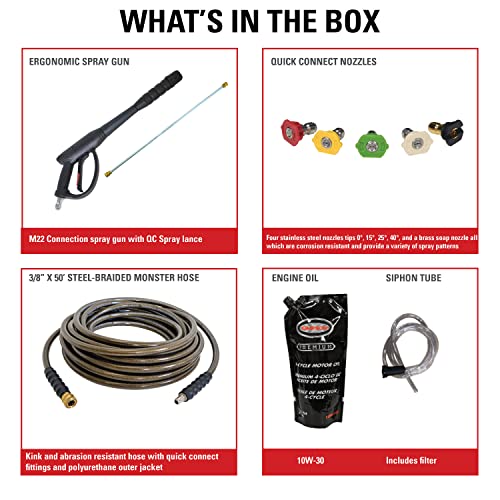
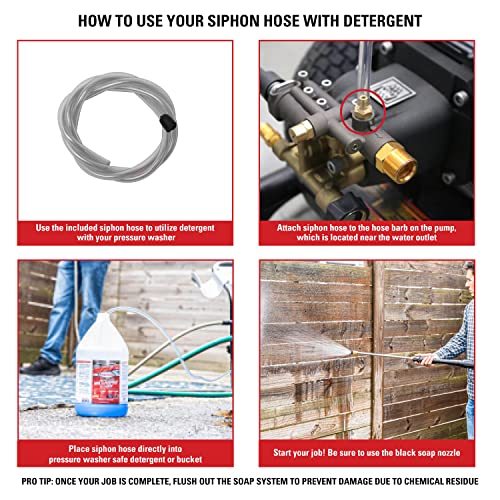
Build, ergonomics, and mobility
This unit is built like a small tank — tubular steel frame, reinforced mounts for engine and pump, and large pneumatic tires that roll smoothly over gravel and uneven ground. That said, the weight shows up when loading and unloading trucks. I usually use a ramp or two-person lift rather than trying to muscle it alone. The handle is fixed and comfortable for pushing, but if you need to move it over stairs or into tight areas frequently, factor that into your workflow.
Prospective buyers should also note the layout: there’s no integrated hose reel or compact onboard storage for the many accessories, so plan to add storage solutions if you want a tidy setup on the truck.
Safety and regulatory notes
Because this is a high-powered commercial-style unit, I always recommend the following safety practices:
Also, the model I used is a 49-state configuration; that means it’s not CARB-compliant for some California air-quality regulations. If you work in regulated areas, verify compliance before purchasing.
Setup checklist (get running fast)
Who this is for
I recommend this model for contractors, landscapers, restoration pros, and serious DIYers who regularly tackle large, stubborn cleaning jobs. If you only need a pressure washer for occasional light-duty tasks such as washing cars or patio furniture, a smaller, lighter model will be more convenient and cost-effective.
Final thoughts
I respect tools that do one thing very well, and this Simpson PowerShot is unapologetically built for high-performance cleaning. It’s not the lightest or most compact option, but it’s reliable, serviceable, and designed to keep running day after day. If your work demands commercial-grade output and you’re prepared for the weight and the storage considerations, this model delivers excellent value.
FAQ
Yes — the system supports soap use via the low-pressure nozzle setting. For heavy degreasing I recommend a pressure washer-specific solvent and a downstream injector or a surface cleaner. Always flush the pump and hose with clean water after detergent use to avoid buildup.
Absolutely. The GX270 is a common commercial engine with widely available parts and service guides. Regular maintenance like oil changes, air filter replacements, and spark plug checks are straightforward and can be done at most small-engine shops.
Yes; the combination of 4000 PSI and 3.5 GPM is effective for fresh and moderately set-in oil stains. For older stains I recommend pretreating with an appropriate degreaser, letting it dwell, then using a 15°–25° nozzle and multiple passes if needed.
It rolls well on rough ground thanks to the pneumatic tires, but at ~120 lb it’s heavy. I often move it short distances by myself, but for loading, unloading, or carrying over obstacles, a second person or a ramp is safer.
Change pump oil after the first run-in period and on the recommended schedule thereafter, inspect seals and hoses regularly, change engine oil per the manual, and winterize the pump by using antifreeze or pump saver products if storing in freezing conditions.
Yes — it removes loose paint and grime efficiently. Be careful with softwood or older boards: use a wider spray angle or back off the pressure to avoid gouging the surface, and follow pressure washing with light sanding as needed to get the best finish.
Wear eye protection, hearing protection, and sturdy footwear. Gloves and long pants help protect against spray and flying debris. If you’re using detergents, add chemical-resistant gloves and avoid inhaling mist.
A hose reel, a surface cleaner for flat areas, a dedicated tool tray or mounting brackets for nozzles, and a small hand truck or ramp for easier transport will make the unit more efficient and extend accessory life.




I’m torn between this and a cheaper 3000 PSI model. Anyone who’s upgraded — was the extra 1000 PSI noticeably helpful?
Upgraded last year — it’s night and day for removing oil stains and flaking paint. Saves time, which equals cost savings on jobs.
If you plan to do delicate surfaces, just be careful — 4000 PSI can etch wood/softer materials if you don’t adjust technique.
The extra PSI and the higher flow rate matter most for large-scale or stubborn jobs (paint prep, thick grime). For occasional driveway cleaning, 3000 PSI might be fine. For contractors, the 4000 PSI is worth the investment.
Haha, I expected a tiny washer when I clicked the link, but this thing is a beast. 😅
For anyone considering: plan for transport logistics before buying.
Good laugh — size surprises happen. Transport planning is practical advice we should emphasize; thanks for the reminder.
And tie-down straps. Never underestimate good straps.
If you have a pickup, fits fine with a ramp. For SUVs, measure first!
Noticed the reviewer called it a ‘grime-eating workhorse’ — spot on. One of the best things is how it holds pressure under continuous load; no dips during long jobs.
Does anyone know the expected pump lifespan with regular maintenance? Ballpark figure?
Glad the phrasing resonated! Holding consistent pressure is one of the strengths of the AAA triplex pump.
Yep — consistent PSI = faster jobs, less rework. That reliability is why pros pick these units.
Minor gripe: the manual could be clearer on winterizing. I had to watch a couple of videos to avoid freezing damage.
Otherwise, ergonomics on the wand and gun are solid.
Any brand recs for pump saver? There’s so many on Amazon.
I use a pump saver product and it worked well for winter storage. Much less drama come spring.
Thanks for flagging that — winterizing instructions are an important usability detail. We’ll add a short how-to tip in the article to help readers.
Fun fact: this Simpson is basically the ‘work mule’ of pressure washers. Not pretty, but it just keeps going.
Pro tip: check oil and belt tensions regularly if you want it to last.
Also, the frame feels sturdy enough that I haven’t worried about drops during transport.
Totally — I bought a small maintenance checklist and it made yearly servicing much simpler.
Does the warranty cover pump failure? Anyone had experience with support/warranty timelines?
Nice metaphor — ‘work mule’ sums it up. Regular maintenance is key with any gas unit, especially one built for heavy use.
Quick maintenance question: how often are you folks changing oil on the GX270? I do every 50 hours per engine recommendations, but curious about real-world habits.
50 hours is a good baseline. Many pros change it every 50–100 hours depending on workload and operating conditions. Check air filter and fuel quality too.
I do 50 hours and inspect more frequently if using in dusty conditions — saved me a repair once.
I go by months if it’s only seasonal use. Untested theory: fresh oil = happier pump.
8.5/10 rating seems fair.
If you live in a place with noise restrictions, remember this is gas-powered — not for quiet suburban mornings. 🏡🔊
But for stripping paint and heavy grime, nothing beats the flow and psi combo here.
Is there any recommended hearing protection for longer jobs? I use over-ear muffs and they’re a lifesaver.
Good point about noise. The Honda engine is smoother than many, but it’s still a gas unit. Electric alternatives are quieter but lack the same sustained power.
The build quality feels pro-level. Frame, wheels, everything feels like it was designed to be moved around a lot.
One sarcastic note: if you’re buying this to ‘lightly clean the patio once a year’ — maybe don’t. 😂
Haha — fair warning. It’s a robust unit best suited to heavier workloads than the occasional light patio clean.
Totally — my neighbor has a tiny electric model for light jobs; no need to go big unless you need big power.
Does anyone know how the 5 QC nozzle tips hold up? I’m worried about losing/bending the tips during transport.
The quick-connect tips are generally durable but can get dinged if tossed around. I recommend a small hard case or a tip holder mounted to the frame to keep them secure.
I mounted a magnetic strip inside my truck toolbox and stick them there — saves a lot of time and they stay protected.
FYI, ordering a spare set is cheap insurance. I keep an extra 0-degree and soap tip in my kit.
Also label them with a tiny colored dot so you don’t mix them up when in a hurry.
Anyone tried this for mobile car-detailing? I’m curious if it’s overkill for that niche or actually useful.
Also does the 3.5 GPM make soap application messy?
For car detailing it can be overpowered unless you use low-pressure soap nozzle and adjust techniques. The 3.5 GPM helps rinse quickly but you’ll want to be cautious with PSI near paint.
Use the soap nozzle and back off pressure; works great for heavy wheel grime though.
I detail cars and use it occasionally for wheels and grime, but not for full-body washing. Too intense for paint if used improperly.
Bought a similar Simpson for my rental properties last year and it was a game-changer. Cuts through years of mildew on concrete like nothing else.
Price is steep, but for contractors or serious DIYers the Honda GX270 + AAA pump combo is worth it.
Only downside: it’s heavy. I had to buy a ramp for loading into my truck.
Overall: solid buy if you need power and reliability.
Agree on the weight. I strap mine in place but it’s reassuring knowing the pump and engine are commercial-grade.
Would you recommend any particular ramps or dollies for hauling it? Trying to avoid back strain.
Thanks for sharing your experience, Laura — great real-world insight on durability and transport. The weight is definitely a trade-off for the heavy-duty components.
The Monster hose sounds cool. 50 feet is perfect for my layout. Quick question: does that length noticeably reduce pressure at the nozzle?
A longer hose can cause a small pressure drop, but 50 ft is still within a reasonable range for this unit. The hose diameter (3/8″) helps maintain flow; most users don’t notice a meaningful performance hit.
I had one 75 ft hose once and saw a tiny drop. For 50 ft you should be fine — especially with the high flow rate on this washer.
I’m not a professional but I do house restorations on weekends. This seems like it would make a big difference. Wondering about fuel efficiency and run time on a full tank.
I usually bring an extra 2–3 gallons for full-day jobs and it covers most tasks.
Also keep fresh fuel — old gas can cause starting and running problems over time.
Pro tip: run the engine at moderate throttle when you can to improve fuel economy vs wide-open throttle for every task.
Fuel use depends on load, but the GX270 is reasonably efficient for its class. For long jobs, keeping spare fuel and following engine maintenance tips will help.
Two tiny complaints: 1) it’d be nice if Simpson included a tip organizer. 2) The manual’s diagrams could be clearer.
Other than that, the performance is incredible. Would buy again.
Thanks — actionable feedback. We’ll note the tip organizer and manual clarity as potential improvement areas in our update.
I made a simple plywood organizer and bolted it to the frame — low-cost fix.