


Compact power for stalls and hobby farms — great value, with a few assembly and clogging caveats.
If you’ve ever wrestled a wheelbarrow through a mucked-out stall at dawn, you know why a compact tow-behind spreader can feel like a revelation. Small barns and hobby farms need something that’s sturdy, towable by an ATV, and won’t take up half the yard.
I found the Titan Attachments Compact Manure Spreader (8.7 cu. ft.) strikes that balance: powder-coated steel, adjustable flow, and heavy-duty wheels give it real spreading muscle for its size. It does demand patience during assembly and can clog with very-wet material, but for stalls, small pastures, and hobby farms it’s a smart, cost-effective tool if you don’t mind a little tinkering.
Titan Compact 8.7 Cu. Ft Manure Spreader
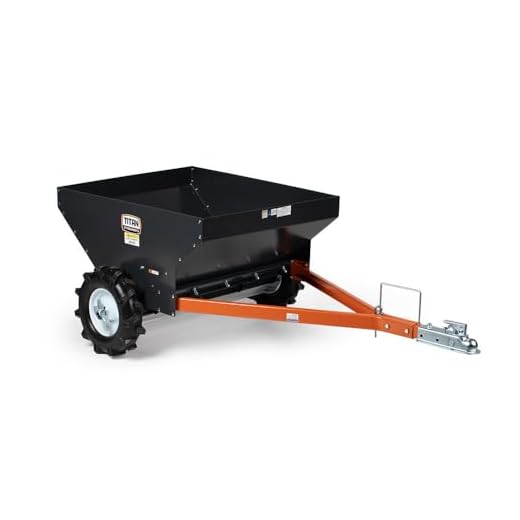
I found it balances compact convenience with serious spreading capability, making it great for stalls, small pastures, and hobby farms. It does require careful assembly and attention to very-wet materials, but overall it’s a smart, cost-effective tool for most small-scale users.
Quick overview
I’ve spent time with compact spreaders and the Titan Attachments Compact Manure Spreader is the kind of tool that makes life easier when you’re dealing with limited space and routine cleanup. It’s built around a simple, ground-driven design and offers an 8.7 cu. ft (about 200 lb) hopper on a powder-coated steel frame. If you run a few stalls, keep a couple of horses, or want a tow-behind unit for pasture spot-spreading, this model is designed to be practical and straightforward.
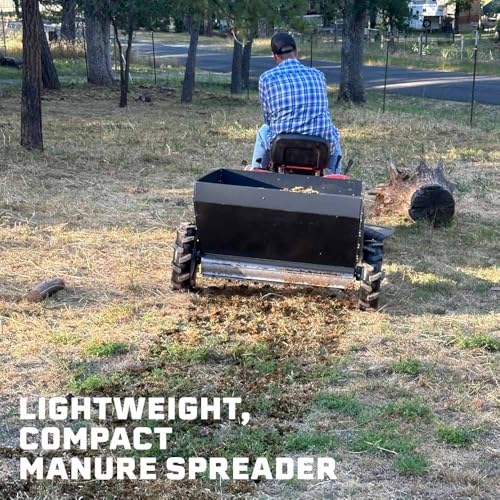
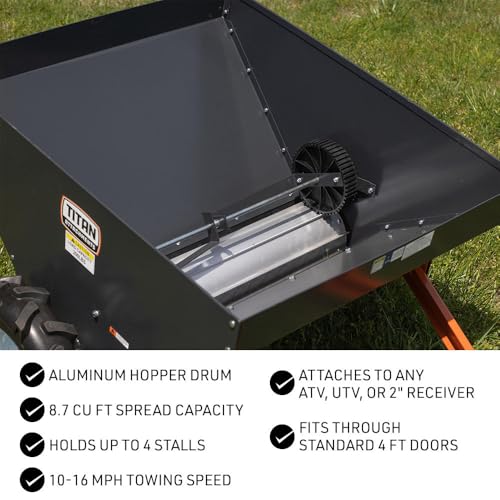
Who this is for
Key features at a glance
Design and construction details
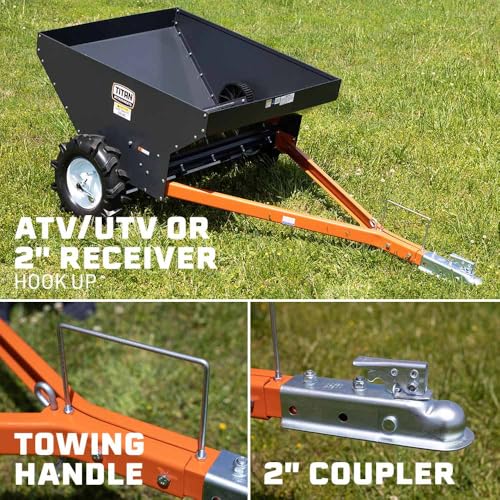
The frame is steel with a powder-coated grey finish, and internal components are built to resist the usual corrosion you get with agricultural gear. The basic architecture is intentionally simple: material drops onto a ground-driven agitator/auger that breaks and tosses the load backward. That ground-driven approach avoids the complexity of hydraulic or PTO systems and reduces maintenance requirements.
Specifications table
| Specification | Value |
|---|---|
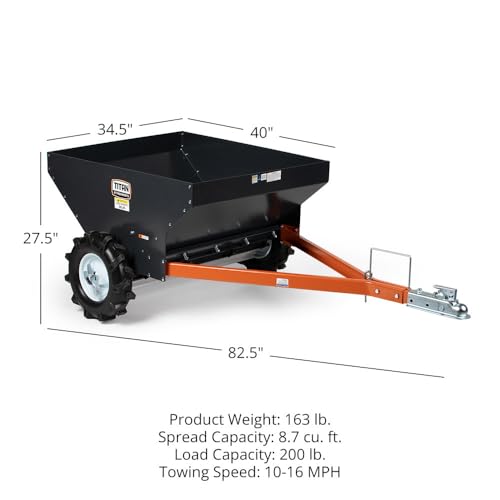
| Capacity | 8.7 cu. ft (~200 lb) |
| Item weight | 163 lb |
| Package weight | 202 lb |
| Wheels | 16″ heavy-duty all-terrain (2) |
| Material | Steel (frame), Aluminum/steel components |
| Tow options | Ball coupler or pin hitch |
| Max recommended towing speed | 10–16 MPH |
Performance: how it spreads and what to expect
Spreading performance is where this unit shines for its target market. It breaks up and distributes manure effectively when the material is in the right moisture range. The adjustable opening relief panel matters a lot — small openings work best for drier, finer materials while larger openings let wetter or chunkier material pass.

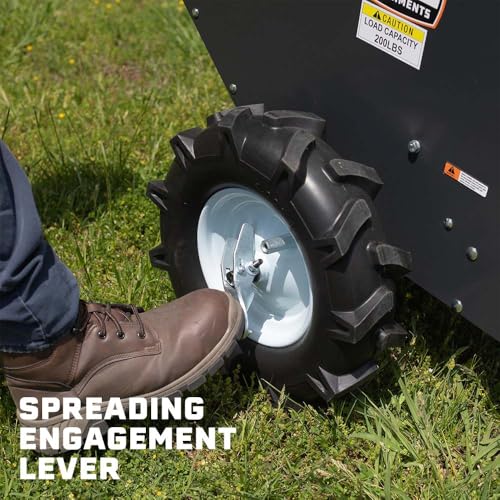
Towability and terrain handling
The two 16″ all-terrain wheels make towing over pasture or rough ground straightforward. It’s light enough to tow with lawn tractors and ATVs but solidly built to handle small to medium workloads. The tow options (ball coupler or pin hitch) add flexibility depending on what vehicle you already own.
Practical towing notes:
Assembly, maintenance, and longevity
Assembly is the part many users mention. The unit ships disassembled to save space in freight, and the instructions are more of an overview than a detailed step-by-step. Expect an afternoon (or an extra set of hands) to get it squared away.
Maintenance tips:
Common issues reported by owners include occasional breakage of the engagement rod or wear on the levers. Those parts are replaceable, but I’d keep a close eye on them during the first season and keep the support contact handy.
Practical tips to avoid clogging and maximize uptime
What I liked and what to watch for
I like the rugged build and the thought put into towability and hopper size — it’s sized right for people who don’t need a farm-scale spreader. The adjustable opening is a practical feature that makes a real difference in day-to-day use.
Stuff to be aware of: assembly takes patience, and if you routinely deal with very wet slurry-like material you’ll face clogging unless you pre-process it. Also, some users have seen wear on levers early on; regular inspection and minor adjustments will keep it working.
Final thoughts
If you manage a small brood of horses, have a couple of stalls, or want to spot-treat pastures and paddocks without wrestling a massive industrial unit, this spreader hits the sweet spot. It’s not perfect, and it performs best with the right material handling and a little preventative maintenance, but for the price and capabilities it’s a solid, practical choice. I’d recommend it to hobby farmers and small-ranch owners who want something rugged, compact, and straightforward to tow.
FAQ
Yes — the spreader is designed to be towable by garden tractors, riding mowers, ATVs, and UTVs using either a ball coupler or pin hitch. Make sure your mower has the recommended towing capacity and keep speeds in the 10–16 MPH range for stable spreading.
It works best with horse manure and composted or semi-dry organic material. You can use it for wood-shavings mix, biochar blends, and some compost/topsoil mixes. Very wet, sticky material and oversized chunks are where the unit can struggle — pre-screen or break up that material first to avoid clogging.
Assembly is doable for a handy person with basic tools, but it can be fiddly because some parts arrive unlabelled and instructions are minimal. Having a helper makes the job faster and safer. If you’re not comfortable with mechanical assembly, a local farm shop or mechanic can assemble it in an hour or two.
Adjust the opening to be wider, load more evenly, and run shorter passes so the agitator isn’t overloaded. I also recommend stirring the hopper if you notice bridging and pre-breaking very wet clumps before loading. Regular cleaning after wet-use days helps, too.
Grease pivot points, check wheel bolts and tire condition, inspect engagement levers and the drive rod for wear, and rinse/dry the unit after extended wet exposure. Replace worn fasteners or levers promptly to avoid failure in the field.
Titan Attachments offers replacement parts, and many components (bolts, pins, cotter pins) are standard hardware you can source locally. For specific rods or levers, contact Titan support or check the parts list with your purchase info to speed ordering.





Does anyone have experience with Amazon returns if something arrives damaged? The package dimensions are big and I’m worried about dings in transit. Also, $1134.99 is in my cart but shipping to Alaska is a mystery…
Will do. Appreciate the input — saves me a possible headache.
Thanks — good to know. I might ask the seller if they can pallet-ize it for safer shipping.
I had a dented panel once — Amazon refunded the cost of the damaged part after I sent pics. Took a week but no hassle.
Palletizing is a smart ask for remote shipments. Worth the extra cost for peace of mind.
Shipping concerns are valid. For larger items from Amazon, inspect the crate immediately and document damage with photos. Amazon’s marketplace returns/claims depend on the seller/fulfillment method, but photos and prompt reporting help. For remote locations, contact the seller before purchase to confirm shipping options.
Good read. Pricey but seems worth it for small farms. Curious if anyone has used it for lime or seed?
Love the ‘small but mighty’ tag — sounds like the exact kind of machine for my situation.
Five things I’d add:
– Get a waterproof cover for winter storage.
– Keep the chain greased after wet runs.
– Consider a hitch stabilizer for bumpy trails.
– Test a small load first to dial the gate.
– If you’re short on bench tools, ask a neighbor for help with assembly 😂
Anyone else have funny first-assembly stories? I probably will make at least one silly mistake.
I accidentally installed a bolt the wrong way round and had to take half of it apart. Two beers later it was fine. 😅
@Evan @Nina omg — collective facepalm. I’ll be extra careful and maybe keep the beer for after assembly.
Great checklist, Hannah — thanks for sharing. The cover and greasing tips are especially useful for durability.
Haha I forgot the hitch pin the first time and drove three feet before I realized. Ended up with half the spreader hanging sideways — learn fast!
‘Small but mighty’ — cute marketing. In practice, 8.7 cu ft is small if you’re trying to cover a medium pasture, but for stalls it’s perfect. Price feels like a ‘luxury convenience’ for people who aren’t into manual spreading.
Also: who measures manure in cubic feet and thinks ‘wow that’s a number I can picture’? 😂
Fair point, Ethan. The review emphasizes that it’s aimed at stalls, small pastures, and hobby farms rather than large-acreage operations.
Haha agree on the cubic feet. Reality: you either eyeball it or do a few test loads and then you know.
Just ordered this after reading the review — looks like a nice balance for my three-stall barn. I live on a hobby farm and space is tight, so the compact size is a big win.
One thing that worried me was the assembly note in the article. Anyone else find the instructions frustrating? Also curious how it tows behind a small ATV with uneven ground.
Thanks for the comment, Laura — glad the article helped. Assembly can be a bit fiddly: take your time with the axle and gate bolts, and check the torque after a few uses. For rough ground, a lower hitch point and slow speed help keep the spread pattern even.
I put mine together last month — bring an extra set of hands for the heavy bits and lay out all the bolts first. Took me about 90 minutes total. Tows fine behind a 4×4 ATV at slow speed.
Agreed with Derek — also, watch the chain routing on the spreader. If it’s a bit wet, clean it after each use so it doesn’t gum up.
Interesting review. A few logistical questions from someone who moves equipment often:
– How easy is it to hitch/unhitch when you’re solo?
– With a package weight of 202 lbs (shipping) and item weight 163 lbs, how manageable is it on a trailer ramp?
– Any tips for securing it for transport to avoid shifting?
I’m also curious about corrosion resistance — it’s steel + aluminum, but coastal humidity where I am tends to eat things alive.
I use ratchet straps across the axle and a transom saver strap on the tongue — stops shifting during highway runs.
@Alan Good tip — I was wondering about straps. Does anyone know if Titan offers a corrosion package? I couldn’t find it on Amazon.
Good logistics questions, Priya. Hitching solo is doable but easier with a low ramp or a small tilt trailer. For loading, use wheel chocks and a winch if possible — the 163 lb item is manageable but awkward. For coastal areas, frequent wash-downs and a corrosion-resistant spray help.
No official kit that I saw. I just hit it with a marine-grade rust inhibitor every few months and it helped a lot.
Thanks everyone — useful. I’ll probably add a few DIY touches before shipping it to my place.
Pretty tempted to buy. A few stray thoughts:
– The weight (163 lbs) means I can lift it onto my trailer but will probably ask a mate for help.
– The design looks simple enough for DIY mods (tractor hitch, better tires).
– Love a product that doesn’t require a PhD to operate. 😅
Also: minor typo in the article (you wrote “very-wet” twice in one paragraph) — just saying so it reads smoother. ✍️
@Kevin Good tip — balance matters more than we admit. I will not be the person who learns that the hard way. 😆
Thanks for the heads-up on the typo, Fiona — we’ll correct that. Glad the review was helpful; DIY mods are common with these units.
One more: bring a box of spare nuts/bolts. Lost one during setup and had to run to the hardware store in the rain — ugh.
If you mod tires, keep them balanced. I slapped on bigger tires once and neglected balance; it vibrated like mad.
I like the compact footprint, but the review glossed over a couple of practicalities. The hopper lip can be a dust/trap spot during dry spreads.
Also, when it’s really wet, the spinner clips sometimes struggle and you get uneven patches. Not a dealbreaker, but something to be aware of.
Still better than hauling by bucket every weekend.
I rigged a little scraper on the gate hinge to knock off clumps — cut down on uneven throws a lot.
Good points, Marcus. The article aimed to highlight trade-offs — for dusty material, a tarp or slow feeding can reduce build-up. For very wet loads, emptying and scraping between uses helps.
Thoughtful review overall. A few detailed observations from my side:
1) The 8.7 cu ft capacity seems modest but is actually pretty efficient for a 1–2 acre paddock.
2) The steel/aluminum combo keeps weight down but still feels solid.
3) The article mentioned problems with very-wet material — I found that a PTO-driven spinner would have helped, but for this tow-behind the gate speed and frequent shaking worked.
4) Price is decent at ~$1,134.99 for what you get; comparable units were pricier last season.
5) If you’re planning to use it for composted bedding, give it a test run before you buy — spread pattern can vary with material consistency.