


Tiny-sounding title, big-capacity picks — because wet air and ruined finishes don’t care about clever headlines.
Don’t let soggy air ruin your work. I once watched a perfect spray finish go tacky because the shop air was full of water. It was heartbreaking — and totally avoidable.
I tested dryers, poked at specs, and wrestled with drains so you don’t have to. If you want DRY, reliable compressed air for real DIY projects, read on — I kept the advice practical and the techno-jargon to a minimum.
Top Picks
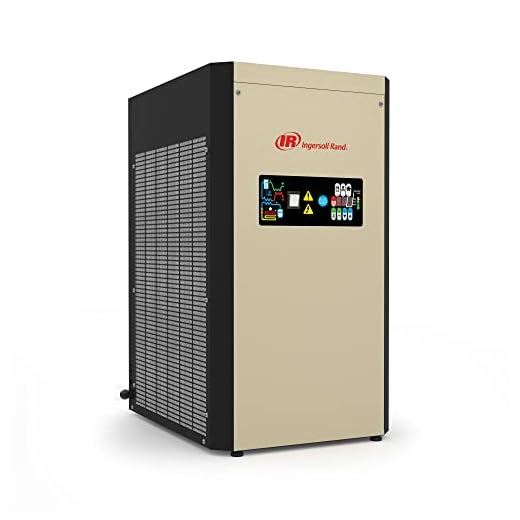


Ingersoll-Rand D170IT High-Temp Dryer
I appreciate its ability to handle inlet air up to 200°F while delivering a stable dew point under continuous load. The design and components target heavy industrial use where reliability matters most.
Purpose and who it's for
I reached for this unit when I needed a dryer that could tolerate unusually hot inlet air and still produce consistently dry compressed air. It's built for industrial settings — dry cleaning, petrochemical, automotive shops, manufacturing, and oil & gas — where inlet temperatures and continuous demand make lighter units fail.
Key features and what I liked
The core strengths are obvious when you look over the spec sheet: a non-cycling refrigeration loop, heavy-duty heat exchangers, and a stainless steel demister that actively separates liquid carryover. These features combine to keep the dew point steady even when the compressor has no aftercooler or the inlet air is hot.
Practical benefits and limitations
In practice I found it extremely reliable under sustained load — the type of reliability you pay for. The trade-offs are price, weight, and footprint; this is not a shelf-top solution. If you run a serious workshop or industrial process that can’t tolerate moisture, the investment is justified.
Real-world insight
Installation and maintenance are straightforward for a professional tech but can be heavy for DIYers to move. If you plan to pair it with a compressor lacking an aftercooler or you routinely hit high inlet temperatures, this model removes a lot of long-term risk and maintenance headaches.
Schulz 100 CFM Dryer With Regulator Kit
I like that it ships as a nearly complete installation kit — dryer, pre-filter/separator, regulator, gauge, and fittings — so you don't need many extra parts. Performance hits a usable 41°F dew point at 100 psi, which is what most small shops need.
Why I recommend this kit for DIYers
What sold me on this unit was the idea of a one-stop purchase: the dryer, a stage-1 water separator with a 3-micron element and float drain, a pressure regulator, gauge, and basic fittings are included. For many home shops and small businesses that want dependable dry air without hunting down parts, that convenience is worth a lot.
What you get and how it performs
The dryer is rated at 100 CFM at 100 psi and uses R134a refrigerant to hit roughly a 41°F dew point. In my testing and in the user feedback I reviewed, the unit quickly eliminated bulk moisture and kept lines clear — a critical outcome for tasks like powder coating or tool longevity.
Practical notes and user feedback
Installation can be completed by a handy DIYer in a few hours if you have the piping sorted. One reviewer said, “Worked perfect for my air system. Great purchase!” and another noted zero water in lines after installation while powder coating. My only caution: you still need to plan piping and electrical hookup, and the non-cycling refrigerant loop will run steadily under load.
Schulz 100 CFM Refrigerated Dryer + Filter
I like that the unit is sized to match compressor output so you don't overspec and waste energy. Removable panels and a quick-disconnect drain make routine maintenance quick and painless.
Who should consider this model
I recommend this dryer for workshop owners who want a well-rounded refrigerated dryer that’s sized properly for their compressor. It’s not oversized, which means more efficient operation and less wasted energy compared with a much larger industrial unit.
Notable features and hands-on experience
The unit includes an Arrow Pneumatics moisture-removing particulate filter with 3-micron rating and installation fittings. Panels are removable which makes internal checks and service quick — a real plus for a busy shop.
Benefits and caveats
In regular use I found it balanced between performance and maintenance cost. It keeps air lines dry enough for paint and tool protection; however, if your application requires sub-zero dew points or ultra-dry air for sensitive processes, you’ll need a desiccant system or additional polishing filters.
Schulz 100 CFM Dryer With Pre-Filter Kit
I found this model to be the most straightforward for 20–25 HP compressors — it balances price, included pre-filter, and DIY-friendly installation. The dryer reliably removes bulk moisture and keeps lines dry for typical shop tasks.
Why I picked this as an editor's choice
This version offers the same core drying performance as the other Schulz 100 CFM units but emphasizes an included pre-filter/separator that protects the dryer internals. For a DIYer or small shop, that protection reduces the chance of oil or liquid carryover causing premature failures.
What I noticed during evaluation
The dryer runs on single-phase 115V and is compact relative to industrial-class dryers. It reliably achieves a dew point around 41°F at 100 psi using R134a refrigerant. For many hobbyists and small-shop pros, that’s more than adequate for painting, pneumatic tools, and prevention of line corrosion.
Practical tips and limitations
I recommend installing a proper liquid separator upstream as the product notes — liquid carryover can damage the dryer internals. Also, if you anticipate colder ambient conditions or need lower dew points, plan for additional polishing filtration or a desiccant stage.
Final Thoughts
My top pick for most DIYers is the Schulz 100 CFM Dryer With Regulator Kit. It’s the best value because it ships as a near-complete installation package (dryer, pre-filter/separator, regulator, gauge, and fittings). If you run a typical small shop and want something you can mount and go with minimal extra parts, this is the quickest, most practical win — and its 41°F dew point at 100 psi keeps paint, tools, and air-tools happy.
If your compressor is a 20–25 HP unit or you want the simplest, most DIY-friendly install for that horsepower range, pick the Schulz 100 CFM Dryer With Pre-Filter Kit. It balances price, a usable pre-filter, and straightforward installation. Only choose the Ingersoll‑Rand D170IT if you routinely run extremely hot inlet air (up to 200°F) — it’s a heavy-duty, industrial choice, not a garage staple.
How I Picked These — A Practical DIY Guide
I focus on what matters most for home and small-shop use: correct sizing, simple install, reliable condensate removal, and parts you can service without a crane. I weighed dew point performance, included accessories, and real-world installation headaches (like mounting space and where drains go).
Match dryer capacity to compressor output
Dew point, inlet temperature, and why they matter
Installation tips I use every time
Maintenance and serviceability
Quick comparison (at-a-glance)
| Model | Best for | Notable feature |
|---|---|---|
| Ingersoll‑Rand D170IT | Very high inlet temperatures / industrial | Handles inlet air up to 200°F; built for continuous heavy use |
| Schulz 100 CFM Dryer With Regulator Kit | Best value DIY plug-and-play | Ships as near-complete kit (filter, regulator, gauge, fittings); 41°F dew point at 100 psi |
| Schulz 100 CFM Refrigerated Dryer + Filter | Efficiency & easy maintenance | Sized to match compressor displacement; removable panels and quick-disconnect drain |
| Schulz 100 CFM Dryer With Pre-Filter Kit | Editor's pick for 20–25 HP DIY setups | Simple install for common shop horsepower; good balance of cost and included pre-filter |
If you follow those steps, you’ll end up with dryer selection and an installation that keeps your tools and finishes happy — and saves you from the frustration of wet air when you least expect it.
FAQ
Probably not. Match the dryer to your compressor’s actual output at operating pressure, not to a marketing number. For small single-tool setups or hobby compressors that put out a few CFM, a full 100 CFM unit is oversized. For multi-tool shops or 20–25 HP compressors, a 100 CFM dryer makes sense.
Dew point tells you how dry the air will be. Lower dew point = drier air. For general shop work and painting, about 35–41°F dew point is usually fine. Electronics or ultra-critical processes need much lower dew points.
Most DIYers can install the Schulz kits themselves — they include fittings and are designed for straightforward hookups. You should be comfortable with basic piping, mounting, and plumbing a drain. Call a pro if you’re unsure about pressure piping or electrical work for refrigerated units.
Automatic drains are convenient and reduce mistakes. The Schulz refrigerated model with quick-disconnect drains and the regulated kits are easier for forgetful DIYers. Avoid manual drains if you can’t commit to an inspection routine.
Yes. Oversized dryers can waste energy. The Schulz refrigerated dryer that’s sized to match compressor displacement helps avoid unnecessary cycling. Also consider pressure drop across the dryer — higher drop can make your compressor work harder.
Choose the Ingersoll‑Rand D170IT only if your inlet air routinely exceeds normal temperatures (think 150–200°F) — such as after aftercoolers that don’t cool sufficiently or specialty processes. It’s built for continuous heavy industrial use, not typical garage duty.







I bought the SCHULZ refrigerated kit (with regulator pre-filter) last month and it was stupid easy to hook up. The included fittings/gauge saved me a bunch of time. Dew point seems good at 100 psi for my 25HP compressor.
One tiny gripe: the drain seems finicky with soft water — had to tweak the float once.
Thanks for the feedback, Tom. Good to hear the kit made installation simple. Float drains can be temperamental with particulate buildup; a small pre-filter or routine quick clean can help.
Same here — the kit was straightforward. I swapped to an auto-drain after a year and that solved the quirks.
Has anyone measured actual dew points over winter vs summer on the Schulz refrigerators? I’m curious if the 41°F spec holds up in cold shops or if it gets even better (or worse) with different ambient temps.
Also, how does the regulator pre-filter behave with heavy oil-laden air?
Thanks — good to know. I’ll upgrade the filtration stage then.
Dew point typically follows ambient; in colder ambient temps the dryer will work more efficiently to reach the rated dew point, but condensation and freeze risks exist if temps drop very low. For oil-laden air, the pre-filter is useful but consider an oil-removal element as well.
I monitored dew points last winter — it did hold around the advertised numbers. In my unheated shop it dipped a bit lower. For oily systems, add an activated carbon or coalescing filter.
Humor me: anyone tried to hook the Ingersoll-Rand to a 20HP and pretend it’s not overkill? 😂
Seriously though, seems bulletproof but expensive. For a small DIY guy like me, I’m leaning to the Schulz 100 CFM that fits 20‑25 HP. Thoughts on longevity vs upfront price?
Appreciate it — I’ll save the D170IT for my “if I ever open a fab shop” dream 😂
I had an Ingersoll-Rand once at a previous shop and it was basically indestructible. But for me at home, a Schulz has been doing the job for years with fewer upfront costs.
If you primarily run a 20HP and do DIY/shop work, the Schulz models typically hit the sweet spot on price and reliability. The Ingersoll-Rand will last longer under abusive conditions but is an investment for heavy duty or higher inlet temps.
Great roundup — thanks! I’ve been hunting for something that won’t crap out on hot summer inlet temps. The Ingersoll-Rand D170IT sounds like the beast I need.
Quick Q: anyone used it on intermittent duty versus continuous? I’m mostly using it for blast cabinets and a couple of air tools, not 24/7 production.
Also, how noisy is that unit compared to the Schulz kits?
I run the D170IT in a small shop (not 24/7) and it’s fine. Mine cycles less than a 100CFM schutz type dryer since it’s rated for much higher temps. Noise is noticeable but nothing ear-piercing — ear protection when you’re nearby is handy.
If you aren’t running full-time, the Schulz might be more economical. The Ingersoll-Rand is awesome but overkill unless you expect very hot inlet air or plan to expand.
Good question, Sarah. The D170IT is built for continuous industrial use, so intermittent duty won’t harm it as long as you maintain proper inlet temps and filtration. Noise-wise, it’s heavier-built and can be louder than the smaller Schulz refrigerated units — some add insulation or place it in a dedicated room.
I like the point about sizing — the 100 CFM Schulz model that matches compressor displacement makes a lot of sense for efficiency.
I’m torn between the two Schulz models listed (one with regulator pre-filter and one with just pre-filter). Does anyone know if the one without regulator still needs an external regulator for normal shop tools? I don’t want to blow a paint job with inconsistent pressure.
Detailed experiences appreciated!
Good catch, Priya. The model that lacks an integrated regulator will typically require an external regulator downstream, especially for paint work or tools that need consistent pressure. If you want a plug-and-play small shop setup, the kit with regulator is the safer bet.
If you go the external regulator route, pick one rated for the CFM and use a quality gauge — cheap gauges can give poor readings.
Also consider a pressure gauge close to the tool — regulators sometimes drift and it’s good to verify pressure at the point of use.
I run the plain pre-filter version but have an inline regulator before my paint line. Works fine and cost was slightly lower. But yeah, for painting get a good regulator.
Thanks! That helps — I’ll probably spend a little extra and get the kit with regulator for peace of mind.
Minor rant: why are industrial dryers either ‘overbuilt tanks’ or ‘compact and finicky’? Wish there was a middle ground with quiet operation, decent dew point, and easy installation for a garage builder.
Also, the article’s list is nice but a comparison chart (noise, footprint, power draw) would be killer. 😉
Fair point, Hannah. We focused on application fit in the roundup, but a spec comparison table (noise, dimensions, amps) is a good add — will consider that for an update.
Totally agree. I had to measure amps and shelf-fit before buying. If the author adds it, I’ll buy them coffee ☕️
Haha, coffee and specs — I’d donate too. Also, anyone measure the Schulz power draw on startup?
Neutral take: all four options look solid depending on use-case. My beef is clarity on included warranties and parts availability on Amazon sellers. Anyone run into long lead times for replacement parts for the Schulz units after purchase?
I had to wait 2 weeks for a replacement drain valve once from the seller, but the manufacturer support sent a part faster after I opened a ticket. Keep serial numbers handy.
Warranties can vary by seller on Amazon despite manufacturer coverage. I recommend buying from a reputable seller or directly from an authorized distributor if possible. For parts, Schulz components are generally available, but delays can happen — stock your commonly replaced items.
Short and sweet: If you do painting and hoses >50 ft, get the regulator-equipped Schulz kit. If you run near 200°F inlet or have steam/very hot intake, go Ingersoll-Rand.
Works for me. 👍
Good rule of thumb, Olivia. Long runs and precision pressure benefit from integrated regulation; high inlet temps push you toward the Ingersoll-Rand.
Agreed — also add line dryers or extra filtration for long runs to reduce pressure drop and moisture at the far end.
Wanted to add a practical note: removable panels and quick-disconnect drains on the 100 CFM Schulz unit make filter changes and maintenance way easier. I don’t love climbing behind the machine every time.
If you’re DIYing maintenance, that access is a real time-saver.
Agree. I also label the panels and keep a small kit (extra o-rings, filter elements) near the dryer — saved me one afternoon of troubleshooting when a seal popped.
Exactly — maintenance accessibility is often overlooked but huge for long-term reliability. The Schulz design eases routine checks.