

Which tri-fuel titan will save your blackout — the loud beast or the quiet genius?
Lights out? Time to get tactical. One minute you’re streaming, the next your fridge is a science experiment. I’ve fumbled with fuel swaps, transfer switches, and noisy neighbors so you don’t have to.
Top Tri-Fuel Generator Picks
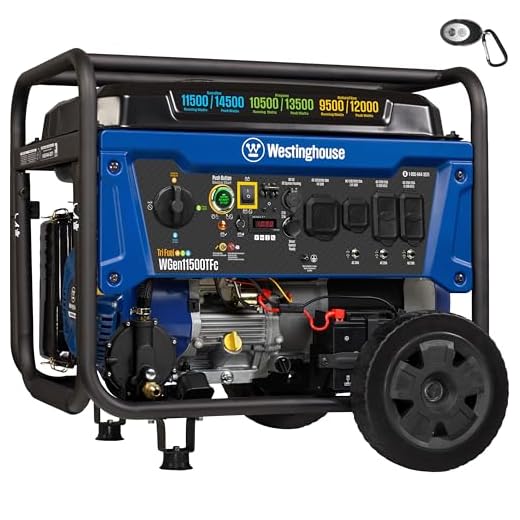



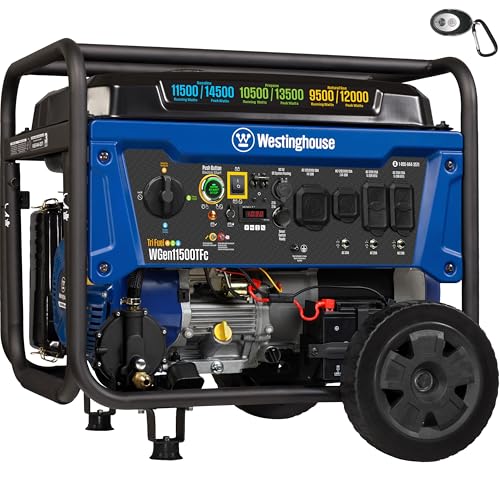
Westinghouse 14.5kW Tri-Fuel Home Backup Generator
I view this unit as one of the strongest options for larger homes that need portable whole-house capability. High peak output, transfer-switch readiness and remote start make it very practical for serious backup use.
Who should consider it
I recommend this Westinghouse when you need a portable generator capable of running most of a larger home — HVAC, multiple appliances and critical circuits — without immediately moving to a permanent standby system.
What stands out
In real-world use I appreciate the robustness and the practical connectivity: being transfer-switch ready and having a 50A outlet makes panel integration straightforward for a licensed electrician. Numerous user reports show it handles whole-house loads reliably when sized correctly.
Limitations and user tips
Noise, weight and space requirements mean you must plan installation carefully; it’s not a unit you drag into place for a quick weekend camping trip. Fuel usage is significant under heavy loads so larger propane or natural gas infrastructure is recommended for prolonged outages.
Practical advice
For homeowners who need a mobile but powerful backup solution, this ranks near the top in my book.
Westinghouse iGen11000TFc 11kW Tri-Fuel Inverter
I like that it combines inverter clean power with high output for whole-home use. It’s quiet for its class, remote-start capable, and transfer-switch ready, so it fits both RV and serious backup roles.
What I like about it
I picked the Westinghouse iGen11000TFc when I wanted inverter-level clean power but with the muscle to run large loads. The sub-3% THD is important if you plan to run computers, modern appliances, or sensitive medical equipment during an outage.
Standout features
The heavy-duty engine and a 7.9-gallon tank mean long runtimes (up to ~19 hours quoted under certain loads), and the pack-in accessories — never-flat wheels, foldable handle, digital fuel gauge — make it far easier to position and monitor than an open-frame unit.
Caveats and real-world notes
While quieter than many open-frame generators, this unit still requires a thoughtful placement plan for noise and exhaust. Its size and weight make one-person transport awkward; wheels help, but you’ll want two people for lifts. Also, some buyers expect automatic standby features that aren’t fully automatic without additional hardware.
Practical tips
All told, I recommend this when you want cleaner power without sacrificing whole-house capability.
DuroMax XP13000HXT 13,000W Tri-Fuel Generator
I found this to be a brute-force solution when you need maximum portable output. It pairs large-capacity power with tri-fuel flexibility, making it a solid option for extended outages or powering an entire house.
Purpose and first impressions
I picked this unit when I needed a portable generator capable of keeping large household loads running. It aims squarely at whole-home backup — HVAC, electric water heaters, ranges and multiple circuits — and it shows that in its spec sheet and real-world performance.
Key features and benefits
I appreciated how complete the package is right out of the box: hoses, regulator, 50A capability and a remote control mean less hunting for add-ons. Users reported reliable starts on propane and the ability to backfeed a house with a 50A connection (I’d only recommend that with a proper interlock or transfer switch and a licensed electrician).
Limitations and practical notes
This is an open-frame, heavy-duty generator — comfort features like ultra-quiet enclosure and super light weight aren’t in its DNA. Expect noise in the 70s dB and plan how you’ll store and move a ~240 lb machine. Also, while it starts reliably most of the time, some owners note occasional backfires or a need to retry starting on propane after long sit times.
Real-world use tips
Overall, I think this is one of the better value options if your priority is raw power and fuel flexibility rather than absolute quiet or lightweight portability.
WEN TF1450X 14.5kW Tri-Fuel Transfer-Ready Generator
I like how this WEN balances high wattage with a competitive price, making it a great choice for those who want transfer-switch readiness without a premium cost. It’s practical for home backup and jobsite use alike.
Product role and audience
I’d recommend the WEN TF1450X for homeowners and contractors who want big portable power without breaking the bank. It’s designed as a workhorse that can handle transfer-switch installations and push serious wattage.
Features and benefits
What I appreciate is the balance: you get very high output, the essential transfer-switch outlets, and safety sensors at a price point that undercuts some of the more premium brands. It’s very capable of powering essential circuits and major appliances during outages.
Real-world cautions
Noise and weight are trade-offs — this is not a quiet inverter but rather a powerful portable generator. Also, double-check what accessories (NG hose, etc.) are included with the version you order so you aren’t missing items needed for quick hookup.
Usage tips
In short, this WEN model is a compelling high-output value pick for serious backup needs.
Champion 11kW Tri-Fuel Inverter Generator
I found it impressively quiet for its output class and appreciated the CO Shield safety feature. Remote start and economy mode add convenience and fuel savings during extended use.
Why I’d choose this model
I picked this Champion unit when I wanted a balance between quiet operation and serious backup capability. It’s designed to be homeowner-friendly with remote start, safety shutoffs, and an inverter for clean power.
Features that matter in daily use
I like the convenience items Champion includes: economy mode that throttles engine RPM under light loads for quieter operation and better fuel economy, plus common outlet types including 50A for transfer switch integration. The unit’s design makes routine maintenance easier (easy access oil changes, simple air filter layout).
Limitations and real-world advice
Some buyers report spotty customer service experiences for complex troubleshooting, so if you rely on local support, check service center availability first. Also, if you need fully automatic standby functionality integrated with solar or ATS systems, you may need additional hardware or a different model.
Practical tips
In short, this is a solid, homeowner-oriented tri-fuel inverter with useful safety and convenience features that make it a strong everyday backup choice.
Gidrox GNV11000T 11kW Tri-Fuel Inverter Generator
I like that it blends an inverter’s quiet, clean power with enough output for whole-house use. It’s ATS-ready and comes with useful accessories, making installation and setup easier for many buyers.
What this generator does well
I consider the Gidrox GNV11000T a smart pick if you want inverter-quality output without sacrificing the ability to run major household loads. It’s designed to be ATS-ready and includes several accessories so you can get it running quickly.
Important features
Owners report the unit starts easily, runs quietly for its size, and the remote and display features make monitoring simple. The inclusion of a cover and hoses is a nice convenience that saves a few accessory purchases at setup.
Trade-offs and tips
As a heavier unit, it needs a planned installation spot and likely two people for safe positioning. Brand support for newer manufacturers can be a mixed bag compared with legacy brands, so I suggest confirming service and parts availability in your area.
Practical advice
Overall, I see it as a solid inverter-class option for homeowners who want the clean output and functionality of modern inverters with serious wattage.
GENMAX GM10500iETC 10.5kW Tri-Fuel Inverter
I like that it bridges the gap between inverter quietness and higher wattage capability. It’s feature-rich with ATS compatibility, remote start and a floating neutral for easy panel integration.
Where this unit fits
I chose the GENMAX GM10500iETC when I wanted an inverter-style generator that could still handle whole-house loads. It’s one of the few machines that pairs inverter electronics with true 10k+ running capability, which is very useful if you want cleaner power for sensitive devices while still being able to run big loads.
Key features and benefits
Owners commonly praise build quality and included extras (magnetic dipstick, waterproof cover, NG/LP hoses and battery charger). The readout/wattage meter is handy to dial in loads during a switchover to avoid overloads.
Practical limitations
While it offers inverter benefits, it’s still an open-frame machine in many respects and won’t be as whisper-quiet as smaller inverter-only units. Warranty and service terms (1 year) are shorter than some big-name competitors, so factor that into a long-term ownership decision.
Use recommendations
Overall, I think this is a compelling choice for someone who needs inverter-quality power but doesn’t want to sacrifice whole-house capability.
WEN TF1450 14.5kW Tri-Fuel Electric Start Generator
I like that it gives very high output and is supported by a broad parts network, making it convenient for DIY installation and maintenance. It’s a solid choice if you want portability and near–standby-level power without a permanent unit.
Who should consider this WEN
I’d pick the WEN TF1450 if I needed a powerful portable generator with a strong aftermarket support network and a reasonable price. It’s a practical alternative to a permanent standby generator for many homeowners.
Key characteristics
During use it behaved predictably: easy assembly out of the box (wheels and handles only), straightforward fueling options, and a runtime that’s adequate for most multi-day outages if you plan fuel properly. The digital meter makes maintaining schedules and logging hours simple.
Limitations and practical notes
Noise levels and weight make it best suited to a semi-permanent placement outside the house rather than frequent transport. If your SKU doesn’t include the NG quick-connect hose, factor that into your purchase checklist.
Tips for installation and use
If you want a powerful, widely supported portable generator for hands-on installation and long outages, this WEN model is a solid, practical pick.
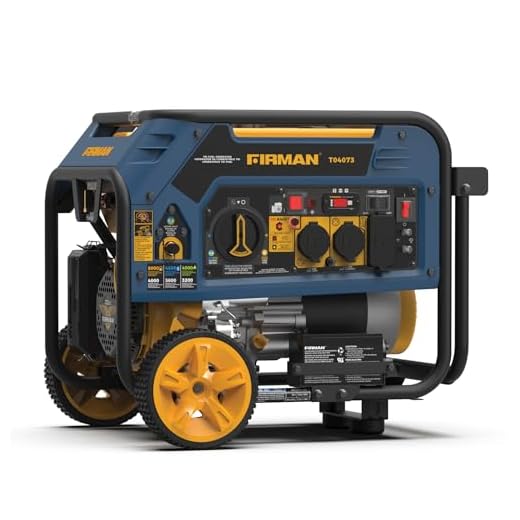
FIRMAN T04073 4kW Tri-Fuel Portable Generator
I like its compact size and decent runtime for shorter outages or RV trips. It’s an affordable, lower-wattage tri-fuel option that handles essentials well but won’t run whole-house loads.
Who this is for
I’d recommend the FIRMAN T04073 if you need a reasonably portable tri-fuel generator for an RV, small home essentials, or outdoor events. It’s aimed at users who want fuel flexibility in a package that’s easier to maneuver than the big 200–300 lb machines.
Notable features
In practice, it’s a solid mid-range option: enough power to keep refrigerators, lights, a sump pump and a few other essentials running, while still being compact enough to move with two people. Quietness is a plus if you’ll use it near campsites or neighbors.
Limitations and tips
You shouldn’t expect this to power central air or multiple high-draw appliances simultaneously — its wattage is designed for essentials. Also, if you plan long-term home backup, consider a larger unit with a transfer switch-ready 50A outlet.
Practical advice
For the price and size, this is a convenient and practical tri-fuel option for light-to-medium backup and recreational use.
DK 5000W Electric Start Inverter Generator
I see this as a budget-friendly inverter-style generator that covers basic backup and camping needs. It has a decent feature set for the price, though long-term reliability reports are mixed.
Positioning and expectations
I consider the DK 5000W a practical choice if you need inverter-like output on a tighter budget. It fits well for jobsite tools, RV use, and keeping essential household circuits alive during short outages.
Useful features
It’s a compact workhorse for those who don’t need whole-house capacity. I like the mix of convenience features (electric start, digital readout) for the price point, and users have reported it runs well when treated correctly.
Cautions and maintenance notes
Some reviewers have had early failures (starter, valves) and complaints about limited parts/support in some regions. If you buy one, I recommend regular checks during the warranty period and keeping spare spark plugs and basic filters on hand.
Practical tips
For a low upfront cost, it’s a reasonable entry point — but buyers should be proactive with maintenance and realistic about long-term expectations.
Final Thoughts
My top pick for serious whole-house backup is the Westinghouse 14.5kW Tri-Fuel Home Backup Generator. I choose it when you need MAX output, transfer-switch readiness, and reliable remote start — think larger homes, long outages, or anyone who wants near-standby power without a permanent install. It’s the easiest way to keep HVAC, refrigerators, and big loads running.
For anyone who cares about CLEAN power and quieter operation—especially if you’ll run sensitive electronics or want RV-friendly performance—I recommend the Westinghouse iGen11000TFc 11kW Tri-Fuel Inverter. It pairs inverter-grade sine wave output with high wattage, is quieter than most in its class, and is transfer-switch and remote-start ready. Ideal for smaller whole-house setups, RVs, and electronics-heavy environments.
If you’re installing a whole-house solution, plan for a transfer switch and professional wiring. If you’re prioritizing quiet, clean power for electronics, pick the inverter unit; if you need brute force for long outages and big loads, go with the 14.5kW Westinghouse.







Safety question: almost all these units mention CO sensors or alerts. Is the factory CO sensor reliable enough, or should I buy a separate/independent CO monitor for the garage/home area? I don’t trust single points of failure.
Great safety-first thinking. I recommend a redundant, certified CO detector installed in living spaces independent of the generator’s onboard sensors. The onboard CO alert helps prevent the generator running dangerously close to you, but home detectors provide house-wide early warning.
Agreed — had a false sense of security once. Separate CO detectors in the house (and battery/plug-in with battery backup) are inexpensive insurance.
Anyone have direct comparisons between the Champion 11,000 and the GENMAX 10500 for quietness? I camp a lot and also want to keep the neighbors asleep during outages. Noise level and CO safety are my top priorities.
Champion markets quiet tech and has CO Shield; in practice the Champion is usually slightly quieter under similar loads. GENMAX is decent but tends to be a touch louder due to less sound-damping. For camping, both work but I’d give the edge to Champion for quiet/CO features.
Also remember that inverter generators like some Westinghouse models will be quieter than conventional open-frame units at low loads, so consider inverter tri-fuel options if silence is essential.
I own the Champion and it’s surprisingly quiet for the output. At 25-30% load it’s whisper-quiet compared to traditional generators. CO Shield is a great reassurance.
GENMAX has a nice feature set and price, but if noise is the deciding factor go Champion. Also check placement: carpet, small hills, and positioning affect how sound travels.
I’m skeptical of the DK 5000W. The price looks great but I’ve read mixed long-term reliability reports. Anyone here actually own one for more than a year? Would you recommend saving up for a more established brand?
If budget is tight, consider a mid-tier refurbished model from a reputable brand — you get quality at a lower price and better support than an unproven budget unit.
I had a DK5000iE clone a few years back and it did OK for weekend projects but I wouldn’t trust it for prolonged outages. Buy cheap, buy twice applies sometimes.
DK is a budget option. If you need it for occasional use and want the cheapest inverter-style backup, it can be fine. But for regular home-backup duty, established brands (Westinghouse, Champion, DuroMax) usually have better support and proven durability. It depends on frequency of use.
Quick technical Q: GENMAX mentions a floating neutral — can someone explain what that means for hooking into a home panel? Do I need a different transfer switch or special wiring?
Floating neutral means the generator’s neutral is NOT bonded to the frame/chassis, so it’s isolated. For most modern transfer switches (especially automatic/manual transfer switches that switch the neutral), a floating neutral generator simplifies integration. But check your transfer switch type — if it doesn’t switch the neutral you may need a bonded-neutral generator or an electrician to reconfigure safely.
TL;DR: talk to your electrician and tell them the GENMAX has floating neutral — they’ll advise the correct transfer switch.
My electrician explained the same. If your home has a bonded neutral at the main panel, you typically want a generator that matches the transfer switch behavior. Hire a pro to avoid backfeed issues.
Don’t forget to label the panel and document the setup — future repairs will thank you. Also, floating neutral is generally easier for parallel/inverter setups.
Great roundup — thanks! I’m leaning toward the Westinghouse 14500 for my house because of the transfer-switch readiness and remote start.
Quick question for anyone who’s done this: do you need a certified electrician to hook up the transfer switch, or are there DIY-friendly kits? I’m handy but not licensed.
Also: has anyone tested how long that unit runs on propane vs gas under a heavy load? Curious about realistic runtimes.
Appreciate any tips about placement/venting too — I live in a colder climate and worry about starting in sub-freezing temps.
Good questions, Amy. For transfer-switch hookups you should hire a licensed electrician — it’s both safer and usually required by code. For runtimes: propane tends to be slightly shorter than gasoline at the same load, but it’s excellent for long-term storage. For cold starts, keep a small insulated cover over the generator (NOT airtight) and use stabilizer if gas sits for months.
I had a Westinghouse 14500 installed last year. Electrician did the switch in a few hours. Propane run time was about 15% less than gasoline at 50% load for me — depends on tank size though.
If you’re handy, you can prep the conduit and mount the transfer switch box to save on labor time, but don’t touch the live connections unless you’re certified. Also: exhaust clearance is critical in cold climates (ice buildup can redirect gases).
Looking for something RV-friendly that can also handle occasional home backup. The Westinghouse 11000 mentions parallel capability — is that the best pick for both worlds, or should I consider GENMAX or Gidrox instead?
I use a Westinghouse for my RV and it’s great. For occasional home backup you may also want to check ATS/transfer-switch compatibility — plan that part before buying.
Westinghouse 11000 is a strong, balanced choice — inverter clean power, parallel capability, and transfer switch readiness make it versatile for RV + home backup. GENMAX and Gidrox are also viable but Westinghouse has better brand support and consistent inverter performance.
I’ve been using the FIRMAN T04073 for weekend camping and it’s been awesome. Lightweight, quiet enough, and the 14-hour runtime claim is pretty accurate if you run at low loads.
A few camping notes:
– Bring extra oil, it sips but you don’t want to be stranded.
– Keep it on a rubber mat if ground is wet.
– Don’t expect to run AC, but fridges, lights, and chargers are fine.
If you want something small and reliable for RV or tailgates, this is a solid pick.
Thanks for the field report, Carlos. FIRMAN is exactly the kind of small tri-fuel that fits those use cases. Good tip on the rubber mat — prevents moisture ingestion and reduces vibration noise.
Most compact units like the FIRMAN won’t support parallel unless explicitly stated. If you need modular scaling, pick a model that lists ‘parallel capable’ in the specs (like the Westinghouse inverter on the list).
Sam: not sure on factory parallel for that model — I just run one. If parallel is a must-buy, check specs carefully or consider a small inverter that explicitly supports paralleling.
I camp with that model too. One annoyance: the electric start battery dies if you leave it months without charging. I keep a trickle charger in my kit now.
Does the FIRMAN accept parallel hookups? I know some small inverters do — would love to double up when I need more power.
Great roundup — thanks! I’m on a tight budget and the WEN TF1450X looks tempting. But I’m confused: there are two WEN 14,500 models on the list (TF1450X and TF1450). Are they basically the same? Any gotchas if I pick the cheaper one? 🤔
Also, any tips for storing propane long-term? I see people say differnt things…
Good catch, Priya. The TF1450X often includes CO Watchdog and minor accessory differences (model-year/kit updates) while TF1450 is the base model; performance is similar but double-check included features. For propane storage: use certified tanks, keep them outdoors upright, and inspect valves regularly.
Also check local emissions/installation codes — sometimes there are small differences that affect permits.
I bought the TF1450 (non-X) to save cash — works fine, just fewer bundled extras. If you plan to rely on it for serious backup, spring for the X version for the CO monitoring and slightly better accessories.
I bought the DuroMax XP13000HXT last hurricane season and wow — what a beast. It started my whole house (fridge, well pump, furnace) without blinking. A few notes:
– It’s loud and big — not for slumber parties.
– Propane hookup was a little fiddly but worked great.
– CO alert saved me from placing it too close to the garage door (facepalm moment).
Would buy again, but I recommend ear protection and strong friends to move it 😅
Totally — moved my DuroMax with a furniture dolly and a buddy. It’s heavy but once it’s in place it’s rock solid.
Thanks for sharing, Sophie — that’s the kind of real-world feedback readers love. Good to hear the CO alert helped. For loud units, a wooden sound baffle (non-enclosed, with clearance) can help reduce perceived noise.
Nice list. I’m torn between the Westinghouse 11000 inverter and the Gidrox 11000W. I use sensitive electronics (home office) and want low THD. Does anyone know if the Westinghouse is noticeably cleaner than the Gidrox, or are they comparable?
Both are inverter-style and advertise low THD. Westinghouse has a longer track record and tends to have slightly lower THD under variable loads in independent tests, but the Gidrox is competitive and often cheaper. If you run high-end audio or medical devices, stick with the Westinghouse for peace of mind.
One tip: use a UPS between sensitive gear and the generator even if THD is low. It smooths spikes and gives you clean shutdowns.
Agree with Samantha — UPS + inverter generator is the safest combo for expensive electronics.
I run studio gear on a Westinghouse inverter and never had issues. The Gidrox was fine for my router and monitor, but I’d pick the Westinghouse if you can stretch the budget.