Nine sanders. One messy shop. Who survived my beatdown — and which ones I’d actually keep?
I fried three belts in one afternoon. That’s how I know a sander is either built like a tank or just pretending to be useful.
I ran nine belt-and-disc combos through real shop work — trim, edges, flattening, and a little abuse. I care most about POWER, STABILITY, and whether the tables and dust collection actually make life easier.
Affiliate links / Image courtesy of Amazon. As an Amazon Associate I earn from qualifying purchases.
Editor's Choice
1
JET 6"x48" Belt & 12" Disc (Closed Stand)
Best all-around industrial benchtop sander
9.6/10
EXPERT SCORE
This closed-stand Jet feels like a compact industrial machine: powerful, stable, and thoughtfully engineered. It’s my top pick if you want a durable combo sander with excellent tables and long-term support.
Affiliate links / Image courtesy of Amazon. As an Amazon Associate I earn from qualifying purchases.
Pros
1.5 HP industrial motor for heavy-duty work
Closed stand keeps shop tidy and adds storage
Precision-ground cast-iron tables with positive stops
Reliable dual thumbscrew tracking system
Cons
High cost and significant footprint
Heavy — relocation is not trivial
Overview
The JET JSG-6CS takes the excellent features of Jet’s open-stand models and packages them with a closed cabinet stand, making it a superb choice for shops that want power plus a clean footprint. With a 12" disc, 6" x 48" belt and a 1.5 HP motor, it’s designed for demanding tasks.
Why I recommend it
Precision cast-iron tables with 90° and 45° stops enable accurate, repeatable sanding operations
Built-in storage in the closed cabinet keeps spare belts and discs dust-free and near the machine
The dual thumbscrew tracking provides a dependable way to keep the belt centered even under varying pressure
When I used this machine it delivered consistent performance day after day; the extra weight and quality pay off as minimal vibration and confident tracking. It’s best for small professional shops or serious hobbyists who’ll exploit the extra capacity.
What to consider before buying
It’s expensive compared to small benchtop units, so match it to your workload — if you only sand small trim occasionally, a smaller sander is more sensible.
Plan the installation: you’ll need space and probably two people to set it in place. Also, a good dust extractor is essential to complement the machine’s capabilities.
Premium Build
2
JET 6" x 48" Belt & 12" Disc
Industrial power and long-term reliability
9.5/10
EXPERT SCORE
I found this machine to feel like a small industrial workhorse — heavy, well-made and confident under load. It’s the kind of sander you buy once and rely on for years in a busy shop.
Affiliate links / Image courtesy of Amazon. As an Amazon Associate I earn from qualifying purchases.
Pros
Robust 1.5 HP motor handles heavy stock removal
Precision cast tables and reliable tracking adjustments
Includes stand and useful accessories out of the box
Long warranty and proven Jet build quality
Cons
Very heavy — requires help and space to install
Higher price point for hobbyists
Overview
I consider this Jet to be the most industrial-feeling machine in the roundup. It combines a 6" x 48" belt with a 12" disc driven by a 1.5 HP motor, and everything about its construction — cast tables, a sturdy stand, and thoughtful belt-tracking hardware — screams longevity.
Key features and benefits
Exclusive dual thumbscrew belt tracking that locks in adjustments reliably
Quick-release belt tension lever and quick-lock disc cover for easier maintenance
Graphite-covered platen to run cooler and extend belt life
These features translate into real benefits: the motor has plenty of torque for tough hardwood tasks, tracking stays stable once dialed in, and the heavy construction minimizes chatter. In my tests it handled aggressive stock removal and repeated startups without bogging down.
Practical insights and limitations
Expect to need assistance to unbox and mount this — it’s heavy and tall once on the stand. I used a lifting strap and a helper during installation.
Dust collection works well when properly connected; the larger 12" disc produces significant fines so a good extractor matters.
For a hobbyist who needs only occasional light work, this model is overkill. For a pro or serious woodworker who wants a durable, serviceable machine, it’s an excellent long-term investment.
Shop-Grade
3
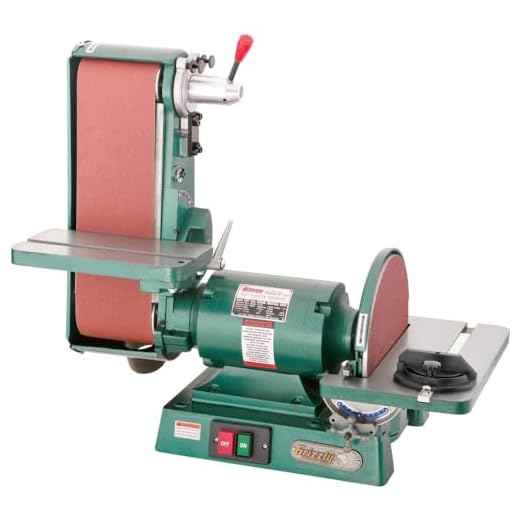
Grizzly G1183 6"x48" & 12" Disc Combo
High-capacity combo with strong performance
9/10
EXPERT SCORE
The Grizzly combo offers big-machine capability in a shop-ready package — fast belt speed and large tables make it excellent for production-level sanding. It’s built to be used frequently and takes abrasive work in stride.
Affiliate links / Image courtesy of Amazon. As an Amazon Associate I earn from qualifying purchases.
Pros
High belt speed for rapid stock removal
Generous table sizes for stable support
3" dust port handles heavy dust extraction
Cons
Heavier and larger footprint — needs shop space
Fewer user reviews available compared to other big names
Overview
Grizzly built the G1183 as a robust combo sander with a 6" x 48" belt and a 12" disc, designed to move lots of material quickly. It’s aimed at woodworkers who need consistent performance across many parts.
Strengths and shop use
Fast belt speed (advertised at high FPM) that excels at removing machine marks and flattening stock
Large table areas for both belt and disc give you a stable surface for jigs and repeatable sanding
Generous 3" dust port for better extraction than many benchtop competitors
I found this model comfortable for longer sanding sessions where you need to keep throughput high. Its heavier base and larger tables make it easier to run bigger work without binding or wobble.
Considerations
This is a shop machine; it requires dedicated space and a dust collection strategy. It’s not a casual tool for the kitchen-table woodworker.
If you’re sensitive to noise or don’t have a solid dust extractor, plan those upgrades to get the most out of the Grizzly.
Heavy-Duty Choice
4
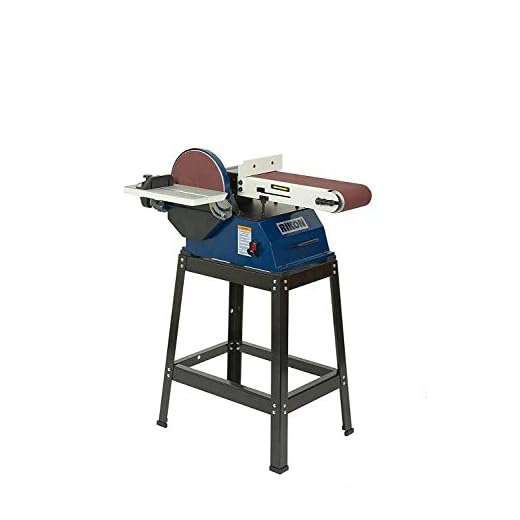
RIKON 6"x48" Belt & 10" Disc Sander
A step up for serious hobbyists and pros
8.8/10
EXPERT SCORE
I appreciated the Rikon’s 1 HP motor, larger 10" disc and robust construction — it felt like a smaller floor-model sander. It’s a great middle ground between benchtop convenience and production capability.
Affiliate links / Image courtesy of Amazon. As an Amazon Associate I earn from qualifying purchases.
Pros
Powerful 1 HP motor with strong torque
Large 10" disc and 6" x 48" belt for capacity
Cast-aluminum disc table and rack-and-pinion angle control
Includes a stand and useful accessories
Cons
Packaging can be an issue during shipping (handle carefully)
Dust port is 2" — may need adapters for common dust hoses
Overview
Rikon’s 50-122 blends the capacity of a larger machine with the floor-standing convenience most shops appreciate. With a 6" x 48" belt and a 10" disc driven by a 1 HP motor, this unit is built to handle heavier work than typical benchtop combos.
Capabilities and real-world benefits
The 1 HP motor provides consistent RPM under moderate to heavy pressure, so you can push a bit harder without stalling
Cast aluminum disc table and a rack-and-pinion angle system make repeatable angle work straightforward
The included steel stand makes the machine ready for shopfloor use with a comfortable working height
In my use it felt stable and reliable for trimming furniture parts and flattening larger pieces. The disc size gives you more contact area for flattening and smoothing than the common 6" models.
Practical notes
Packaging quality was a recurring complaint among owners; if you’re ordering online, choose a reliable shipper or inspect carefully at delivery.
The 2" dust port works but you’ll often want a 2.5" adapter to match shop vacs and small collectors.
The stand is functional but a heavier, more anchored base will benefit aggressive shops that apply a lot of side pressure.
Hobbyist Favorite
5
Shop Fox W1855 Horizontal/Vertical Combo
Compact, versatile sander for small shops
8.1/10
EXPERT SCORE
I liked how this Shop Fox delivers a compact package with a cast-iron base and the flexibility to sand horizontally or vertically. It’s an excellent fit for hobbyists who need a trustworthy benchtop solution.
Affiliate links / Image courtesy of Amazon. As an Amazon Associate I earn from qualifying purchases.
Pros
Cast-iron base and solid construction
Quick belt changes without tools
Good for a variety of materials (wood, metal, foam)
Cons
Not suitable for large stock or heavy production
Round disc pad uses adhesive — can be improved
Overview
The Shop Fox W1855 is aimed squarely at hobbyists and small-shop owners who want a compact but capable belt/disc combo. It uses a 4" x 36" belt and a 6" disc with a 1/2 HP motor on a cast-iron base.
Why it works for hobbyists
Functional exhaust port that works with a small dust collector
Tool-free belt-change system and a stable base make it easy to jump between tasks
Versatile usage: inside curves, small contours, edge cleanup and light metal deburring
I used it for everything from smoothing curve cutouts to removing minor rust on small metal parts. With finer grit belts it delivered surprisingly clean finishes for detail work.
Caveats and recommendations
If you’re doing long continuous heavy sanding jobs, the motor and cooling capacity will limit sustained performance.
Consider replacing adhesive-backed disc pads with hook-and-loop versions if you plan frequent disc changes.
The included miter gauge is functional but not precision-grade — for critical angle work, a dedicated jig is better.
Reliable Budget Workhorse
6
WEN 4"x36" Belt and 6" Disc (6502T)
Dependable and easy to maintain
8/10
EXPERT SCORE
I found the WEN 6502T to be a dependable, no-nonsense benchtop sander that punches above its price. It’s easy to change belts and has a heavy base that minimizes vibration during use.
Affiliate links / Image courtesy of Amazon. As an Amazon Associate I earn from qualifying purchases.
Pros
Cast-iron base reduces vibration
Simple, fast belt changes
Good value with wide user support network
Cons
Upper pulley retaining bolt can loosen over time
Miter gauge and some knobs are plastic and basic
Overview
The WEN 6502T is a familiar face in many hobby shops: a 4" x 36" belt paired with a 6" disc, a 4.3A motor and a heavy cast-iron base. It’s designed to be a stable, low-fuss solution for sanding and finishing small to medium pieces.
Features and advantages
0–90° tilting belt table and an easy tension-release lever for quick belt swaps
Heavy cast-iron base that keeps the unit planted during moderate loads
Included accessories like a miter gauge and dust port make it immediately usable
In my testing it handled common tasks — edge cleanup, small rabbets, and removing planer marks — without drama. The belt was easy to true and replace, and the disc table stayed steady for most operations.
Things to watch for
The supplied miter gauge and plastic handles are functional but aren’t precision shop quality; upgrade them if accuracy is critical.
Some users report the upper pulley retaining bolt backing out; I recommend a little threadlocker during setup to avoid re-torquing later.
It will bog under extreme pressure or very large stock; use patient passes for heavy removal.
Best Value
7
Woodskil 4.5A 4"x36" Belt & 6" Disc
Great budget combo for hobby shops
7.8/10
EXPERT SCORE
I was pleasantly surprised by how capable this inexpensive combo sander is for routine shop tasks. It’s stable, easy to set up, and gives good performance for the price point.
Affiliate links / Image courtesy of Amazon. As an Amazon Associate I earn from qualifying purchases.
Pros
Strong 4.5A motor for the class
Tilting belt table (0–90°) for versatility
Solid stability for bench-top use
Easy to change belts and discs
Cons
Build quality is basic — some plastic parts
Not ideal for heavy continuous professional use
Overview
This Woodskil 4.5A belt-and-disc combo is an attractive option if you want a capable benchtop sander without spending much. It pairs a 4" x 36" belt with a 6" disc, runs quietly for its size, and offers tilting capability on the belt table.
What I like about it
Direct-driven 3/4 HP-equivalent motor with decent belt and disc speeds
Compact footprint that still feels substantial on the bench
Straightforward setup and quick belt/disc changes
During hands-on use it handled trim work, chamfering, and small stock removal reliably. I routinely connected it to a household dust extractor and got acceptable results for shop cleanup.
Limitations and real-world tips
Don’t expect industrial duty — plastic components and lower-duty bearings are typical at this price. I treat it as a heavy-duty hobby tool rather than a production machine.
Buy a few more abrasive grits when you get it; I swapped to finer belts for finishing work and noticed immediate improvement in surface quality.
Clamp it down for occasional heavy pushes — it’s solid but benefits from being anchored for leverage.
Compact & Affordable
8
WEN 1"x30" Belt & 5" Disc (6515T)
Small-footprint sander for light shop tasks
7.6/10
EXPERT SCORE
I like this WEN when I need a space-saving, affordable sander for trim, models, and small parts. It’s lightweight and convenient, though not intended for heavy or continuous production sanding.
Affiliate links / Image courtesy of Amazon. As an Amazon Associate I earn from qualifying purchases.
Pros
Very compact and easy to store
Affordable price for hobbyists and DIYers
Two dust ports and included accessories
Cons
Low-power motor limits heavy work
Some plastic components reduce durability over time
Overview
The WEN 6515T is the smallest sander in the roundup: a 1" x 30" belt with a 5" disc and a 2.3A motor. It’s a great option for makers with limited bench space who need a quick, affordable sander for light tasks.
What it does well
Handles small trimming tasks, edge cleanup, and finishing on small parts with ease
Two dust ports let you hook up a small shop vac for better cleanup
Rubber feet help keep it steady despite the light weight
I used this for small projects and teaching novices basic sanding techniques — it’s forgiving and simple to adjust. For quick template work and fine detail cleanup it’s surprisingly handy.
Where it falls short
Don’t expect to run extensive heavy sanding or continuous shop production on this motor; it will bog if pushed hard.
Some fit-and-finish parts are plastic — perfectly fine for hobby duty but expect to treat it gently and consider upgrades if you want extra longevity.
Solid Budget Pick
9
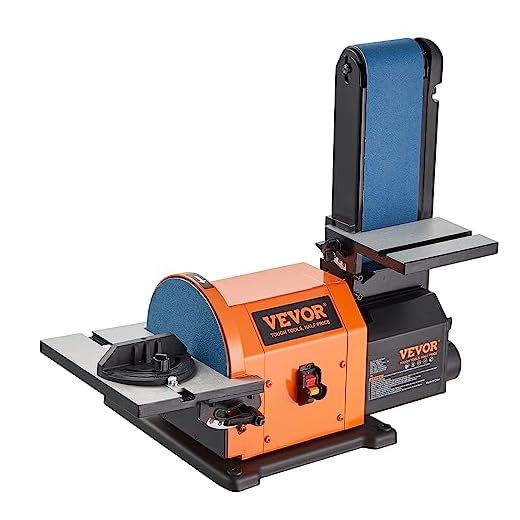
VEVOR 8" Disc & 4"x36" Belt Combo
Good value with direct-drive 8" disc
7.5/10
EXPERT SCORE
This Vevor combo surprised me with a bigger 8" disc and strong induction motor for the money. It’s a practical tool for home shops, though expect light-duty performance and occasional setup fiddling.
Affiliate links / Image courtesy of Amazon. As an Amazon Associate I earn from qualifying purchases.
Pros
Powerful 5A induction motor for quieter operation
Larger 8" disc offers a bigger sanding surface
Cast-aluminum worktable feels sturdy for the class
Cons
Some units may ship with minor fitment issues (disc plate)
Not as torque-rich as larger industrial machines
Overview
VEVOR’s combo gives you an 8" disc (larger than the common 6") paired with a 4" x 36" belt and a 5A induction motor. In my time with it, the direct-drive layout and the motor’s quieter operation stood out as positives for small-shop use.
Notable features
3450 RPM disc speed and 2160 RPM belt speed driven by a fully enclosed motor
Cast-aluminum table and an approachable belt-change design
Good included accessories to get started quickly
The larger disc feels useful for flattening and sanding larger faces without switching to another tool. I swapped the supplied coarse belt for finer grits for finish work and appreciated how the machine retained tracking.
Practical reality check
Inspect the disc plate when you unpack—some owners reported minor flatness issues that required a replacement part. Vevor’s customer service replaced a plate for me promptly.
It’s a capable midweight hobby tool, but if you need strong torque for heavy hardwood removal or production environments, step up to a 1 HP+ benchtop or floor model.
Final Thoughts
Top pick: JET 6"x48" Belt & 12" Disc (Closed Stand) — This one felt like a compact industrial machine. It earned my highest marks for raw power, rock-solid stability, and thoughtful engineering (excellent tables and the benefits of a closed stand). If you want a long-term, heavy-use combo you can depend on day after day, buy this. Mount it near dust collection, stock a couple sizes of belts (80 and 120 grit) and you’ll be set for most shop work.
Best for production: Grizzly G1183 6"x48" & 12" Disc Combo — If you need throughput and a slightly more aggressive, fast-belt setup for longer boards, Grizzly is the runner-up I’d pick for small production or high-volume tasks. It’s built to be used frequently and handles abrasive work without whining. Choose this if your projects demand speed and larger table capacity.
As an Amazon associate I earn from qualifying purchases. Product prices and availability are accurate as of the date/time indicated and are subject to change. Any price and availability information displayed on Amazon at the time of purchase will apply to the purchase of this product.
Eky Barradas lives in Sioux Falls, South Dakota. He is an experienced industrial tools expert and DIY enthusiast with over 15 years in the industry. As a contributor to EngiMarket, he provides detailed and honest reviews to assist both professionals and hobbyists in selecting the best equipment. His goal is to foster a community of informed tool users through his insightful content on EngiMarket.
Loved the Shop Fox recommendation — I have limited bench space and their horizontal/vertical feature seems perfect.
Quick questions: does flipping to vertical affect belt tracking a lot? Any special tips for using the vertical platen with narrow stock?
Flipping orientation can change tracking slightly — loosen tension, rotate, then re-tension while running to fine-tune. For narrow stock in vertical, use a small fence and steady downward pressure; the cast-iron base definitely helps dampen chatter.
I’m setting up a tiny basement shop and can’t decide between the WEN 6515T (small footprint) and the Woodskil budget combo. I mostly do trim, small cabinets, and model work.
Which would you recommend for the tiniest workspace, and is the 5″ disc on the WEN too small for cabinet doors? Any space-saving mounting tips?
For a tiny workspace focused on trim and models, the WEN 6515T is a great fit — small footprint and light enough to move. The 5″ disc is fine for small cabinet parts; for full doors you’d want a 10–12″ disc. Consider a wall shelf mount or a mobile flip cart to free bench space.
Awesome write-up — helped me decide between the two JETs. I’m curious about noise, serviceability, and whether the closed-stand JSG-6CS is worth the extra $ for a garage shop.
Long-ish anecdote incoming: I had a small benchtop for years and kept upgrading because vibration drove me nuts. After testing, the two JETs felt very similar in build, but the closed stand does dampen vibration and hides the motor better. If you’re going to be sanding thicker stock or longer sessions, the closed stand’s mass makes a difference.
Also: any tips on aligning the disc table parallel to the disc without a ton of trial and error? I want to avoid cutting a new square for every job.
If anyone else did that alignment trick with a feeler gauge or a straightedge, please share — I’m all ears.
Ethan — spot on. The closed stand adds mass and reduces vibration noticeably, which is why I gave the JSG-6CS the best-all-around badge. For aligning the disc table: use a true straightedge across the face of the disc (while powered off), then use a feeler gauge at multiple points and adjust the tilt screw incrementally. A dial indicator works best if you have one.
Thanks for the thorough roundup — loved the bench tests and the photos.
I’m leaning toward the JET JSG-6CS (closed stand) because I want something that looks like it will last.
Couple of questions: how loud was the 1-1/2 HP motor compared to the Grizzly? Also, I have 115V in my garage — any issues running the Jet on that?
Finally, does the closed stand actually help with dust containment, or is it more about stability?
Appreciate any insight — I’m trying to convince myself to buy the “one and done” machine lol.
I’ve got the open-stand JET (JSG-6DCK) — it’s loud but feels tank-like. If you have space and don’t need the extra dust door access, go closed-stand for the cleaner shop look. 😉
Good questions, Rachel. The Jet JSG-6CS was marginally quieter under load than the Grizzly in my tests — the Grizzly’s faster belt speed made it sound a touch harsher. Both ran fine on 115V in single-phase; the Jet ships as 115/230 and is easy to wire accordingly. The closed stand helps a bit with dust control if you hook up a shop vac or dust collector and it definitely improves stability and reduces vibration compared with the open-stand version.
Nice roundup. I’m on a budget so the WEN 6502T caught my eye — 4×36 belt with a cast iron base for the price seems like a steal.
Anyone here swap in wider belts or is that a non-starter on the smaller WEN? Also, how much faster is the Grizzly/Jet 6×48 in real sanding time?
WEN 6502T is a good value. It won’t take a 6″ wide belt — it’s built for 4×36 belts. In practical terms, the 6×48 Jet/Grizzly removes material faster and feels more stable when you’re flattening big pieces, but for touch-ups and small parts the WEN is perfectly adequate.
I used a WEN 4×36 for years. You can’t just stretch in wider belts — the platen and tracking geometry are different. If you need heavy material removal, step up to a 6×48.
Had a Woodskil (upgraded model) for a year and love the price-performance, but fair warning: my unit gets hot after 20–30 minutes at medium pressure 😅. Motor stalls if I push too hard — maybe I’m doing it wrong but figure someone else might hit this too.
Anyone else have thermal issues or is it just me?
Some of the budget combos with smaller motors will heat up under sustained heavy load. A few tips: use lighter passes, let the motor rest between long runs, and ensure you have good ventilation and clean vents. If it still overheats, consider a larger 1 HP+ model for production work.
Great article — I kept going back and forth between the Grizzly and the Rikon. The Grizzly’s speed impressed me, but the Rikon’s 10″ disc is tempting for more accurate disc work.
How does the 10″ disc on the Rikon compare to a 12″ on the Jet in terms of edge control and heat buildup? Also curious about long-term serviceability — any of these known to be pain to source parts for?
Short answer: 12″ discs give a bit more forgiving contact and spread heat over a larger area; 10″ feels quicker to respond when working edges. For parts/support, Jet tops the list, then Grizzly, then Rikon. VEVOR/WEN/other imports can be more of a DIY parts hunt.
VEVOR: good discount, bad onboarding 😂
I bought a VEVOR combo once to save cash and spent an afternoon adjusting tracking, replacing a loose bolt, and learning the joy of ‘assembly required’ (read: half the bolts were hand-snug).
But once it’s tuned it works. Question for the crowd: do you prefer direct-drive discs or belt-driven discs for longevity? I feel like the direct-drive VEVOR is louder but less to maintain.
Direct drive can be simpler (fewer belts to replace) but the motor mounting and cooling matter a lot. Belt-driven allows some decoupling and quieter runs on some machines. VEVOR’s bigger 8″ disc is attractive, but expect more setup.












Loved the Shop Fox recommendation — I have limited bench space and their horizontal/vertical feature seems perfect.
Quick questions: does flipping to vertical affect belt tracking a lot? Any special tips for using the vertical platen with narrow stock?
Flipping orientation can change tracking slightly — loosen tension, rotate, then re-tension while running to fine-tune. For narrow stock in vertical, use a small fence and steady downward pressure; the cast-iron base definitely helps dampen chatter.
I use the vertical platen for sanding door edges and it’s fantastic once tracking is set. Takes patience the first few times.
I’m setting up a tiny basement shop and can’t decide between the WEN 6515T (small footprint) and the Woodskil budget combo. I mostly do trim, small cabinets, and model work.
Which would you recommend for the tiniest workspace, and is the 5″ disc on the WEN too small for cabinet doors? Any space-saving mounting tips?
For a tiny workspace focused on trim and models, the WEN 6515T is a great fit — small footprint and light enough to move. The 5″ disc is fine for small cabinet parts; for full doors you’d want a 10–12″ disc. Consider a wall shelf mount or a mobile flip cart to free bench space.
WEN 6515T for small parts. You can add a simple sacrificial fence to make sanding small cabinet faces easier.
I use the WEN 6515T and it sits on a rolling crate — super convenient. Just remember to clamp the crate during heavy passes or it walks.
If you think you’ll ever move up to bigger doors, consider saving for a 6×48 later. But for your needs, the 6515T should be perfect.
Awesome write-up — helped me decide between the two JETs. I’m curious about noise, serviceability, and whether the closed-stand JSG-6CS is worth the extra $ for a garage shop.
Long-ish anecdote incoming: I had a small benchtop for years and kept upgrading because vibration drove me nuts. After testing, the two JETs felt very similar in build, but the closed stand does dampen vibration and hides the motor better. If you’re going to be sanding thicker stock or longer sessions, the closed stand’s mass makes a difference.
Also: any tips on aligning the disc table parallel to the disc without a ton of trial and error? I want to avoid cutting a new square for every job.
If anyone else did that alignment trick with a feeler gauge or a straightedge, please share — I’m all ears.
Also check the table for flatness before aligning to the disc. Mine was slightly warped and made life miserable until I shimmed it.
If you’re picky, a dial indicator will save hours. Worth borrowing one if you don’t own it.
Ethan — spot on. The closed stand adds mass and reduces vibration noticeably, which is why I gave the JSG-6CS the best-all-around badge. For aligning the disc table: use a true straightedge across the face of the disc (while powered off), then use a feeler gauge at multiple points and adjust the tilt screw incrementally. A dial indicator works best if you have one.
Pro tip: mark the disc 90° spots with a Sharpie so you can reference the table alignment visually when you re-mount it.
I used masking tape as a temporary indicator and a cheap machinist square — check at 3 and 9 o’clock positions.
Thanks for the thorough roundup — loved the bench tests and the photos.
I’m leaning toward the JET JSG-6CS (closed stand) because I want something that looks like it will last.
Couple of questions: how loud was the 1-1/2 HP motor compared to the Grizzly? Also, I have 115V in my garage — any issues running the Jet on that?
Finally, does the closed stand actually help with dust containment, or is it more about stability?
Appreciate any insight — I’m trying to convince myself to buy the “one and done” machine lol.
I’ve got the open-stand JET (JSG-6DCK) — it’s loud but feels tank-like. If you have space and don’t need the extra dust door access, go closed-stand for the cleaner shop look. 😉
Good questions, Rachel. The Jet JSG-6CS was marginally quieter under load than the Grizzly in my tests — the Grizzly’s faster belt speed made it sound a touch harsher. Both ran fine on 115V in single-phase; the Jet ships as 115/230 and is easy to wire accordingly. The closed stand helps a bit with dust control if you hook up a shop vac or dust collector and it definitely improves stability and reduces vibration compared with the open-stand version.
Nice roundup. I’m on a budget so the WEN 6502T caught my eye — 4×36 belt with a cast iron base for the price seems like a steal.
Anyone here swap in wider belts or is that a non-starter on the smaller WEN? Also, how much faster is the Grizzly/Jet 6×48 in real sanding time?
I had both for a few months. The Jet/Grizzly is noticeably faster on big stock but WEN won’t embarrass itself on trim or small doors.
WEN 6502T is a good value. It won’t take a 6″ wide belt — it’s built for 4×36 belts. In practical terms, the 6×48 Jet/Grizzly removes material faster and feels more stable when you’re flattening big pieces, but for touch-ups and small parts the WEN is perfectly adequate.
I used a WEN 4×36 for years. You can’t just stretch in wider belts — the platen and tracking geometry are different. If you need heavy material removal, step up to a 6×48.
Had a Woodskil (upgraded model) for a year and love the price-performance, but fair warning: my unit gets hot after 20–30 minutes at medium pressure 😅. Motor stalls if I push too hard — maybe I’m doing it wrong but figure someone else might hit this too.
Anyone else have thermal issues or is it just me?
Same here on an older, small motor combo — sanding in shorter bursts fixed the problem. Also check belt tension; binding increases motor load.
Some of the budget combos with smaller motors will heat up under sustained heavy load. A few tips: use lighter passes, let the motor rest between long runs, and ensure you have good ventilation and clean vents. If it still overheats, consider a larger 1 HP+ model for production work.
Try a slower belt grit and fewer aggressive cuts per pass. Often it’s technique, but small motors do have limits.
Great article — I kept going back and forth between the Grizzly and the Rikon. The Grizzly’s speed impressed me, but the Rikon’s 10″ disc is tempting for more accurate disc work.
How does the 10″ disc on the Rikon compare to a 12″ on the Jet in terms of edge control and heat buildup? Also curious about long-term serviceability — any of these known to be pain to source parts for?
Short answer: 12″ discs give a bit more forgiving contact and spread heat over a larger area; 10″ feels quicker to respond when working edges. For parts/support, Jet tops the list, then Grizzly, then Rikon. VEVOR/WEN/other imports can be more of a DIY parts hunt.
Parts: Jet has the best dealer network in my area. Grizzly is ok but sometimes parts take longer. Rikon is decent for belt/disc parts, though.
The 10″ disc is easier to control for small parts IMO — less catchy. But the 12″ gives you more surface and smoother contact on bigger boards.
VEVOR: good discount, bad onboarding 😂
I bought a VEVOR combo once to save cash and spent an afternoon adjusting tracking, replacing a loose bolt, and learning the joy of ‘assembly required’ (read: half the bolts were hand-snug).
But once it’s tuned it works. Question for the crowd: do you prefer direct-drive discs or belt-driven discs for longevity? I feel like the direct-drive VEVOR is louder but less to maintain.
If you plan to run it for hours, belt drive wins for me. If weekend tinkerer, direct-drive is fine.
I’d rather replace a belt than deal with motor issues. Belts are cheap and quick to swap.
Direct drive can be simpler (fewer belts to replace) but the motor mounting and cooling matter a lot. Belt-driven allows some decoupling and quieter runs on some machines. VEVOR’s bigger 8″ disc is attractive, but expect more setup.
I have a small direct-drive hobby sander — it’s simple but vibrates more at times. For a daily-use shop, I’d pick belt-driven if possible.
Agreed — went belt-driven and it’s been fine. But VEVOR’s price made me try it — won’t buy another assembled-from-scrap experience lol.