


Can a shop press make you fall in love with metalwork? I tested five — one earned my respect (and a few calluses).
Big power doesn’t always mean big headaches. I put five pneumatic shop presses through real shop work — pulling bearings, pressing bushings, and straightening stubborn brackets. Results? Not what you’d expect.
I like tools that earn their place on the floor. These presses range from compact 30-ton workhorses to a BEASTLY 100-ton monster. I’ll tell you which one I’ll actually reach for when a job’s on the line.
Our Top Picks


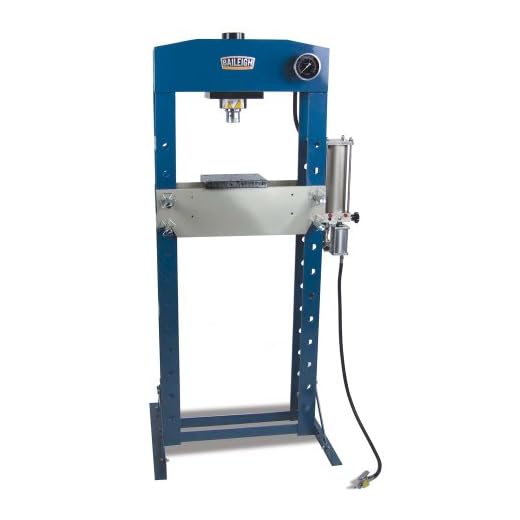


Baileigh 100-Ton Pneumatic Shop Press
I was impressed by the raw capacity and the controllability the unit delivers — it feels built to last. The movable cylinder and dual control (foot pedal plus hand lever) give me the finesse I need on off-center and delicate jobs.
Overview
I found this press to be an absolute workhorse — its 100-ton capacity and industrial-grade hydraulics make it best suited for heavy fabrication, plate forming, and severe-duty repair work. The fully welded plate-steel frame minimizes flex so parts stay true while pressing.
Key features and what they mean in practice
I liked having the movable cylinder — when I was aligning eccentric parts it saved me time and reduced fiddling. The foot pedal gives consistent, repeatable strokes and the hand lever is great when I need a delicate touch.
Limitations and practical tips
The press is big and heavy so plan for freight handling and a permanent footprint in your shop. If you mainly do light-to-medium tasks, this is overkill and tying up floor space and budget. For those who need the capacity though, its longevity and control justify the cost.
If you buy one, I recommend a forklift or at least two strong people for installation and bolting it to a level concrete pad for safe, vibration-free use.
Baileigh 75-Ton Pneumatic Shop Press
I found this model to be the sweet spot for most professional shops — plenty of power with features that make repeated work easier. The winch-assisted table and large cylinder stroke make setup and operation noticeably smoother than smaller presses.
Overview
This Baileigh 75-ton press is my go-to recommendation when you need serious force but still want good operator control and shop-friendly features. It felt robust and consistent across repeated cycles, and Baileighs one-year warranty plus technical support is reassuring.
Notable features and real-world benefits
I used the winch to move heavy tooling in seconds, and the foot pedal made it easy to seat bearings without overshooting. The requirement for a 90–115 psi compressor is worth noting — get a compressor with some overhead to maintain consistent pressure.
Limitations and practical advice
The press is heavier and pricier than compact alternatives, so its best for shops where that capacity will be used regularly. If youre outfitting a home garage with limited air supply, verify your compressor can maintain the required pressure under load.
Overall, I appreciated the balance of features and power; for many shops this model hits the right compromise between capability and usability.
Baileigh 30-Ton H-Frame Pneumatic Press
I found this 30-ton press to be extremely versatile and well-built for its size — it tackles bearings, bushings, and axle work with ease. The movable cylinder and optional manual operation make it flexible for jobs that need a delicate touch.
Overview
This Baileigh 30-ton H-frame press is one I reached for repeatedly when I needed a reliable, mid-capacity solution that wont dominate a small shop. Its the sort of machine that pays for itself through everyday use on transmissions, wheel hubs, and suspension work.
Useful features and how I used them
I used the manual pump when pressing seals that required a slower feel, and the lateral cylinder helped when aligning odd-shaped housings. The unit is heavy and demands at least two people for safe assembly, but once set up it felt rock-solid.
Limitations and practical tips
If you frequently work on heavy commercial gear or large pressed assemblies, 30 tons may be short of what you need. For typical automotive and light fabrication work, though, this press is a great blend of capability and size.
Tip: keep the press bolted to a flat surface and remove packaging carefully — assembly is straightforward but the crate and packing are extensive.
Strongway 50-Ton Pneumatic Shop Press
I found it to be a reliable mid-range option — more capacity than the 40-ton while still staying approachable in price and footprint. The winch and gauge add practical shop conveniences for everyday pressing tasks.
Overview
This Strongway 50-ton press sits comfortably between entry-level and heavy industrial machines — I used it when a 40-ton wouldnt cut it but a 75/100-ton unit would be overkill. Its practical for larger automotive or light-fabrication jobs where that extra capacity matters.
What I liked during testing
The gauge is handy for quick visual feedback during work, and the winch makes table repositioning painless compared to brute-forcing the table up and down. It feels serviceable and straightforward to maintain.
Limitations and recommendations
Expect a heavy crate and the need for proper handling equipment during delivery. If you need precise, repeatable pressure control for very delicate jobs, consider higher-end presses with finer hydraulic controls.
For typical shop use I recommend this model as a reliable middle ground: big enough for most tasks, without the price tag and footprint of industrial 75–100 ton machines.
Strongway 40-Ton Pneumatic Press with Winch
I think this is a solid value if you need a dependable 40-ton press without breaking the bank. The H-frame construction and included gauge/winch make it a practical shop staple for many general pressing tasks.
Overview
This Strongway 40-ton press is the pragmatic choice for small machine shops and home garages that need substantial pressing power without premium pricing. I found it sturdy and well-suited for bearing, bushing, and general pressing jobs.
Features that stood out during testing
During use I appreciated the winch-assisted table adjustment — it saves time and prevents unnecessary strain when relocating heavy fixtures. The gauge is a handy reference for repeatable jobs even if it’s not a precision hydraulic transducer.
Limitations and tips
You should expect a heavy package and some assembly effort; freight delivery and a helper are almost mandatory. Also, if you require ultra-fine control or industrial cycle duty, consider higher-end Baileigh options; this Strongway is tuned for value and ruggedness rather than subtle features.
I recommend bolting it to the floor and keeping the paint and hardware lubricated to minimize long-term corrosion and sticking.
Final Thoughts
If you need brutal capacity and surgical control for heavy fabrication or press-fit work, the Baileigh 100-Ton Pneumatic Shop Press is my top pick. It delivers massive force with precise control, and the movable cylinder plus dual foot-pedal/hand-lever operation make it the go-to for off-center or delicate heavy jobs. Ideal for professional shops doing large bearings, heavy shafts, and heavy-duty frame work.
For most pro shops and serious hobbyists who want a versatile daily driver, the Baileigh 75-Ton Pneumatic Shop Press is the best all-around choice. It strikes the sweetest balance of power, smooth setup (winch-assisted table), and stroke length. Choose the 75-ton if you want something that handles repeated shop tasks comfortably without overkill.
If you run a small shop or mostly work on cars, bearings, and light fabrication, consider the Baileigh 30-Ton H-Frame for its compact versatility, or the Strongway 40-Ton if budget matters — but for clear winners in capability and durability, pick the two Baileigh models above.
Shop-Press Buying & Use Guide
Choosing a pneumatic shop press is as much about job fit as it is about raw numbers. I break the decision down into what I actually evaluate in the shop: tonnage vs. use case, cylinder configuration, table adjustability, controls, and what your air system must deliver.
Tonnage: Know the real numbers
Cylinder style, controls, and setup speed
Movable cylinders and multiple control modes matter a lot in real use. I prefer models with:
Air supply and cycle considerations
Pneumatic presses don't always demand huge CFM, but stable pressure matters. Tips I follow:
Safety, fixturing, and maintenance
I treat setup like a ritual. A few concrete habits that saved me time and parts:
Quick comparison (at-a-glance)
| Model | Best for | Standout feature |
|---|---|---|
| Baileigh 100-Ton | Heavy fabrication, large shafts | 100-ton capacity with precise dual controls |
| Baileigh 75-Ton | Professional daily driver | Winch-assisted table and long stroke |
| Baileigh 30-Ton | Small shops, bearings/bushings | Compact, movable cylinder for delicate work |
| Strongway 50-Ton | Mid-range capacity on a budget | Durable build with useful gauge/winch |
| Strongway 40-Ton | Budget-conscious shops | Best value for common pressing tasks |
I hope this guide saved you a few hours of research and a few ruined bearings. In the shop, reliable repeatability beats flashy specs. I pick the press that makes my daily work easier — not the one that only looks impressive on paper.
FAQ
Start with the jobs you do most. Bearings and bushings on passenger cars usually need 10–30 tons. Medium-duty axle and suspension work sits around 40–75 tons. Heavy fabrication, big shafts, or plate forming often needs 75–100+ tons. I map my common tasks and pick a press with a bit of headroom — not so much that it’s unwieldy, but enough so I’m never struggling at max stroke.
Most pneumatic presses use low-volume, high-pressure actuation. I recommend an air supply that holds 90–120 psi reliably. For frequent, repeated cycles choose a compressor with decent tank capacity (20+ gallons) and sustained CFM; look for 4–6 CFM at 90 psi as a practical baseline. The exact need depends on how fast you want the ram to cycle.
Yes — if you support the race correctly and apply steady, even pressure. I always use properly sized adapters and an arbor plate; I never press on the bearing’s balls or seals. Pneumatic control (especially the Baileigh models with fine control) helps you feel when the race seats, reducing the risk of damage.
Yes. A winch-assisted table saves time and keeps setups repeatable. A gauge lets you monitor applied pressure and avoid overloading delicate parts. In my workflow, those two small conveniences pay back in speed and fewer ruined parts.
They’re safe if you follow basics: clamp the work, use guards/adapters, keep hands clear of the ram path, and use the foot pedal only when the piece is fully supported. I also lock out air and bleed the lines before maintenance. Pneumatic presses are forgiving compared to some hydraulic setups, but respect and awareness are non-negotiable.







I keep looking at the Baileigh 100-Ton (HSP-100A) like it’s a mythical beast. 100-ton power with precision control sounds perfect, but does anyone have experience mounting it in a garage with a concrete floor — any special anchoring needed?
Anchoring recommendations usually depend on how much lateral force you’ll generate. For heavy 100-ton jobs, bolting to the slab with expansion anchors is common. Check Baileigh’s manual for specific specs.
I anchored mine to 4″ slab with heavy-duty anchors and it’s rock solid. Also shim the base to get it perfectly level before bolting.
Has anyone compared the stroke length differences closely between the Baileigh 75 and 100? I’m trying to press some large bushings and want to make sure the cylinder stroke covers it without constant repositioning.
I measured mine when shopping: the 100-ton had a slightly longer maximum stroke, but both are generous. If you’re near the limit, the 100 is safer.
The reviewer mentioned the 75-Ton’s large cylinder stroke as a plus. For exact stroke specs, check the manufacturer listings — those numbers will tell you if repositioning will be frequent.
Also consider the movable cylinder feature — it helps if stroke alone isn’t enough.
Longer note because I want to help others who might be on the fence:
I had a cheap manual press before upgrading. Switching to a pneumatic model (Strongway 50-Ton) changed my workflow. Faster setups, less wrist fatigue, and the gauge helps me repeat pressures more reliably. If you’re doing more than occasional presses, the time savings pay back fast.
Drawbacks: installation takes space and you need a decent compressor. Also, read the safety warnings — hydraulic/pneumatic force is no joke.
Thanks for sharing your experience, Dylan — that’s exactly the practical perspective many readers appreciate.
Agree 100% — moving from manual to pneumatic was night and day for my shop throughput.
Good point about compressor size. I underestimated that and had to upgrade later.
Love the detail on the dual control of the Baileigh 100-Ton — foot pedal + hand lever sounds like the best of both worlds. Anyone used both controls in the same session? Is switching between them seamless?
I use the foot pedal for most jobs and the hand lever when I’m aligning delicate parts. It’s intuitive after a couple of uses.
Yes, the reviewer emphasized that. Switching is straightforward; use the hand lever for delicate adjustments and the foot pedal for hands-free pressing.
Great roundup — thanks! I’ve been torn between the Baileigh 75-Ton and the Strongway 50-Ton for my small fabrication shop. My main use is bending brackets and pressing bearings. Can anyone chime in on how the winch-assisted table on the 75-ton compares in day-to-day use?
I’ve used a 75-ton for a year — the winch is a game changer for production. Less fiddling, more consistent setups.
The winch on the Baileigh 75-Ton really speeds up repetitive setups. If you do a lot of repeated height changes it saves time and reduces strain compared to manual shims.
Strongway 50 is solid too, but if you want smoother and faster setups go 75. Price vs budget is the deciding factor for me.
Pretty balanced list. I do mostly axle work and was leaning toward the 30-ton. Curious — does the 30-ton cylinder movement feel as robust as they claim? Any complaints about alignment or wobble?
No wobble on mine. Just check the pins and keep them greased. It’s surprisingly sturdy for 30 tons.
The reviewer noted good build quality for the 30-ton. For alignment issues, check the movable cylinder mounts and tighten per instructions. Most reports praise its solidity for small-shop tasks.
If axle work is your main job, 30-ton is often enough and much easier to handle in a cramped shop. 👍
I picked up the Baileigh 30-Ton H-Frame after reading this — compact and versatile indeed. FYI, if your shop has limited ceiling height, measure carefully. The stroke is generous but footprint matters.
Good tip, Evan. The H-frame models are great for footprint but always double-check overall height and table positioning before ordering.
Thanks — I have low clearance too. How do you like the optional manual operation when the air supply is unavailable?
Manual was handy once when the compressor was down. Not fast, but precise. Worth having for peace of mind.
I’m on a budget and the Strongway 40-Ton looks tempting. The article calls it the best budget-friendly heavy-duty press — anyone experienced with longevity? How long did yours last before needing parts replaced?
If you plan heavy daily production, consider stepping up to the 50-ton or 75-ton for longer life under load.
The Strongway 40-Ton scored well for value. For longevity, users suggest routine maintenance (check seals, bolts, and the gauge) keeps it running reliably; parts are generally affordable.
Owned one for 3 years with light daily use — replaced a seal once, no big deal. For the price it’s hard to beat.
Okay, I need real-talk: if you have limited help lifting heavy parts, which model would you pick? I’m leaning to the 75-ton because of the winch, but is the 50-ton easier to move around if needed?
For limited help, the winch-assisted table on the 75-Ton reduces lifting strain. The 50-Ton is lighter but still a two-person move. Consider your floor and whether you’ll ever need to reposition the press.
I moved my 50-ton with a couple of friends and a furniture dolly — doable but a pain. Winch for the table = must-have for solo work imo.
If you won’t move it often, go 75. If you need portability, the 50 might be slightly easier but still heavy.
I noticed the 30-ton got an 8.8 rating and the 40-ton only 8.0 — curious why the smaller one scores higher. Is it truly better built, or just better suited to its intended use?
The 30-ton scored higher because it balances size, build quality, and versatility for small shops. The 40-ton is a great budget option but scores lower due to fewer premium features.
Exactly — the 30-ton is more refined for compact tasks, while the 40-ton focuses on value.
Short and sweet: anyone found the Baileigh 75-Ton to be noisy compared to the others? Our shop cares about sound levels.
The review didn’t flag excessive noise for the 75-Ton. Pneumatic systems have some hiss, but it’s similar across models — insulated fittings and a quieter compressor help most.
It’s not silent but not louder than typical shop air tools. You get used to it.
Quick question: are the gauges on the Strongway models generally accurate out of the box? I rely on the psi reading for some delicate presses.
Most user feedback says the Strongway gauges are decent for shop use, but for precision-critical jobs some users calibrate or verify with a separate gauge.
I cross-checked mine with a handheld gauge and they were within a reasonable margin. For high-precision tasks, double-check though.
A bit of humor: I bought a 100-ton press and now my bench feels like it needs to apologize for being so weak 😅 Seriously though, that Baileigh looks like an investment — anyone regret going 100-ton for mostly automotive tasks?
Haha — no regrets from the reviewer. The 100-ton offers headroom for stubborn parts and heavy-duty jobs, though it may be overkill for strictly light automotive work.
I use a 100-ton in my shop and the extra capacity has saved me on a few stubborn hubs. It’s bulky but worth it for peace of mind.
I’m picky about precision — does anyone recommend calibrating the Strongway gauges right away, or are they fine out of the box? Also, are replacement parts easy to come by?
Mine was close enough out of the box, but I still checked with a handheld gauge. Parts were easy to order online when needed.
For precision tasks, it’s wise to verify the gauge against a trusted meter. Replacement parts for Strongway are generally available through retailers and third-party suppliers.
If you plan to calibrate, document the offset — makes future checks quicker.
Okay, slightly off-topic: any tips on keeping the press clean/maintained for longevity? I know basics but want any shop-tested tricks.
Wipe down after use and use a light oil on pivot points. Replace seals at first sign of leakage rather than waiting.
I use a thin plastic sheet over the top and keep a small toolkit nearby for quick checks — saves time in maintenance.
Regularly inspect seals, keep moving parts greased per the manual, tighten fasteners, and protect the cylinder from dirt. Covering the press when not in use helps too.
Not a technical comment, more of a shop-lore one:
If you get a big press, make room for it in the layout BEFORE unpacking. It becomes the new island of power and everything else orbits it. Also, label your gauge units so apprentices don’t freak out 😅
Practical and funny — great advice. Layout planning saves headaches and safety issues down the line.
Amen to that. I learned the hard way and had to rearrange the whole bay.
Haha — yes, apprentices and gauges are a comedy duo. Plan the footprint and clearances first.