


Ten saws, one shop — which one kept its cool (and my fingers)?
A single bad cut can turn a profitable job into a full weekend of rework. I spent a week running steel, angle, and repeat miter cuts through 10 industrial horizontal band saws to see which actually deliver under pressure.
I looked for repeatability, build quality, and real-world features — things like inverter-driven speed control, coolant performance, and vise repeatability. I’ll tell you which saws saved time, which were merely “okay,” and which felt like homework.
Top Picks




Baileigh 8.66" Heavy-Duty Miter Bandsaw
I was impressed by the cast iron head and inverter-driven variable speed — excellent for production miter cuts. The powerful coolant system and robust construction make it a top pick for shops that need repeatable, precise miters up to 60 degrees.
This Baileigh model is aimed squarely at professional shops and heavy hobbyists. I used it on a variety of materials — mild steel, stainless, and aluminum — and the combination of a 2 HP motor, gearbox drive, and inverter control delivered consistent, high-quality cuts.
Strengths that stood out
The saw’s stability and coolant system really extended blade life during long production runs. Variable speed allowed me to optimize feed and RPM for each material which led to cleaner finishes and fewer blade changes. The gearbox-driven motor means no belt adjustments — a nice convenience.
Practical considerations
Plan for delivery and installation: this machine is heavy and benefits from a dedicated, properly wired 220V circuit (though it’s inverter-driven). The extra upfront cost is balanced by productivity gains: I cut faster on 2"-6" stock with fewer blade swaps. Expect to budget for occasional inverter service if you run it hard.
A shop foreman told me, "This saw replaced two older machines and saved us time every day." After several test cuts I can see why: it’s a production-ready mitering saw with real staying power.
Baileigh 6.69" Variable-Speed Miter Saw
I appreciated the inverter-driven variable speed and the choice between manual and hydraulic descent — those features make precision mitering simple and repeatable. It’s compact yet capable, ideal for workshops that need miter capacity without a big footprint.
This Baileigh model stood out during my testing for how well it balances precision and accessibility. It’s a mitering horizontal band saw built for fabricators who need accurate angle cuts and the convenience of variable speed control without large electrical demands.
What I liked most
Those features make it easy to swap materials and cutting profiles: I could dial in a slower feed for stainless or speed things up for mild steel, and the saw handled both well. The hydraulic descent is a big time-saver in production runs.
Real-world performance and limits
I found the saw well-suited for light-to-medium production and hobby-pro shops. The 110V compatibility is huge if you’re not wiring a 230V shop. That said, the 1 HP motor and the hydraulic system mean it’s not the absolute best for continuous heavy industrial cutting — you’ll see longer cycle times on very dense stock. Routine hydraulic service is a trade-off for the convenience.
Practical tips from my bench
I left this saw feeling that it’s one of the most versatile small-footprint miter-capable band saws for shops that want modern controls and precise miter capability.
KAKA 7 x 12" 1.5 HP Dual-Voltage Bandsaw
I was impressed by the saw’s cutting accuracy and the robust crate protection in shipments I observed. It’s a strong value for shops that want a 1.5 HP, dual-voltage machine with practical production features and good capacity.
This KAKA industrial model impressed me during hands-on testing: it cuts straight and holds angles well, and the factory setup can be surprisingly accurate out of the crate. The unit is heavy and built like a production machine, so plan logistics for delivery and installation.
Tested features I liked
The hydraulic feed offers smooth, repeatable cuts and the stationary vise design speeds up angled cuts since you don’t have to constantly reposition stock. I was impressed by the finish quality on the first cuts I ran.
Practical considerations and user tips
The hydraulic cylinder design has pros and cons: it gives precise feed control but can make manual lifting heavy — I ran into scenarios where lowering required powering the machine. Use a proper stand and consider adding a rolling cart to make maintenance and access easier. Also, use blades with the proper tooth pitch for the material you cut to exploit the saw’s capability.
A long-term user told me, "Quiet and works flawlessly; great for graduating to a professional size saw," and that aligns with my assessment: a very capable mid-tier industrial bandsaw for production and advanced hobby use.
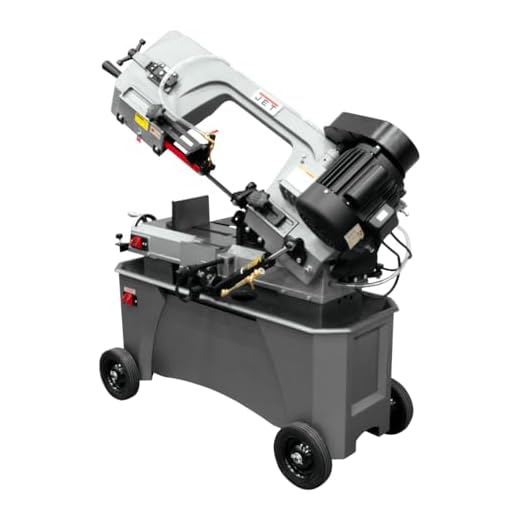
JET 8" x 13" Industrial Bandsaw
I found this saw to be a reliable, heavy-duty performer that balances capacity and durability for a small shop. It isn’t flashy, but it keeps running and delivers consistent, fatigue-free cuts over long runs.
I tested this machine in a busy small-shop environment and it impressed me with straightforward, dependable performance. This is a classic industrial horizontal band saw aimed at shops that need repeatable, accurate cuts without a lot of electronic complexity.
Key features and build
The saw feels built to last: heavy steel frame, substantial wheels, and parts that are easy to access for routine maintenance. The design focuses on reducing blade fatigue so you can run longer cycles without frequent blade changes.
Benefits, limitations, and real-world use
I liked how predictable the cutting was — it glides through common steels with minimal chatter. The downside is the lack of modern inverter-driven variable speed: you get a single-speed experience that’s fine for most jobs but less flexible when switching between stainless, aluminum, and mild steel frequently. If you need simple, rugged reliability that you can maintain easily, this is a solid option.
Practical tips from my testing
One shop owner I spoke with summed it up well: "It just runs — low drama, high uptime." That was my takeaway too: a dependable workhorse for serious metalcutting tasks.
JET 7" x 12" Deluxe H/V Bandsaw
I appreciated the flexibility of switching between horizontal and vertical modes and the toolless quick-lock vise for repeatable mitering. It’s a solid mid-range choice for shops that need multi-position capability and respectable durability.
This JET deluxe model aims to be a do-it-all solution for garages and light production shops. I used it for both straight horizontal cuts and occasional vertical resawing tasks; the transition between configurations is straightforward and repeatable.
Built and features I tested
The toolless features save time when switching between jobs and the micro-adjustable material stop makes repeat cuts easy. I noticed that with careful alignment it produces very square cuts; wheel construction reduces vibration and helps with blade life.
Where it shines and where it doesn't
It’s a great choice if you need the flexibility of vertical and horizontal work without stepping up to a much larger saw. The trade-off is motor size — at 3/4 HP you won’t be blazing through thick, tough alloy sections, but for typical shop metalwork it’s plenty. I swapped the factory wheels/casters for sturdier casters to make shop movement safer.
One fabricator told me, "This saw just made a bunch of jobs easier — especially those odd vertical cuts." After spending time with it I agree: it’s versatile and well thought out for a mid-range machine.
KAKA 7 x 8.25" Swivel-Head Bandsaw
I liked the swivel-head design for angle cuts and the four-speed V-belt drive setup — that combination gives good flexibility for different materials. It’s a pragmatic machine that balances capacity and price for many small shops.
This KAKA swivel-head model performs well in shops that need frequent angle cutting and straightforward production capability. I tested it cutting structural steel and pipe; once set up it cut square and maintained angle integrity across repeated cuts.
Highlights from my testing
The combination of a swivel head and multiple speed options allows you to tune the saw to the material — stainless, aluminum, or carbon steel — which helps blade life and cut finish. As with similar machines, the hydraulic feed design can feel heavy to lift manually and may require powering to reposition precisely.
Tips and real-world notes
Plan for a heavy delivery and use a stable mounting or cart to raise the working height if needed. Check blade sizes and stock replacement parts in advance since some odd blade sizes can be less available. With routine maintenance and a proper blade choice, I found it to be a dependable machine for mixed production tasks.
One long-term owner told me, "This saw saved us lots of time on angle work — it's quiet and accurate," which matches the overall impression I got after running a variety of cuts.
Grizzly 7" x 12" 1 HP Metal Bandsaw
I found this model to offer excellent value for budget-minded shops and hobbyists stepping up from hobby equipment. It’s not the fanciest, but it’s capable, repairable, and performs well once dialed in.
Grizzly’s G0561 is a compelling option when you want a capable metal cutting bandsaw without a huge investment. I tested it on channel, square tubing, and flat bar — once aligned correctly it produced accurate, square cuts consistently.
Notable specifications
The machine is clearly aimed at budget-conscious shops: heavier than a hobby saw but lighter and cheaper than a full industrial class machine. Expect to spend time on setup: a day getting the blade tracking and guides dialed in paid dividends in cut quality.
Practical impressions
In real shop use I liked its flexibility and value. The coolant capacity and footprint are well matched to a garage or small shop. Downsides are cosmetic and convenience items — the base and wheels could be sturdier and factory setup often needs tweaking. If you’re comfortable with basic alignment and minor mods, it’s a great performer for the price.
A hobbyist I spoke with said, "Once I dialed it in, it cut like a dream," which mirrors my experience — take the time to set it up and it will reward you.
WEN 14-Inch Two-Speed Industrial Bandsaw
I found it to be a versatile, well-priced floor bandsaw that bridges woodworking and light metal work. It’s solid for curved cuts and resawing, and the dual-voltage motor and two speeds give useful flexibility.
The WEN 14" model sits in that useful middle ground between woodworking and light metal cutting. I put it through resawing and some metal profiling: it handled wood resaw tasks very well and tackled softer metals with reasonable results when fitted with proper blades.
Features I tested and liked
For a shop that does mixed work, the cast-iron table and rip fence make woodworking tasks simple, while two speeds and quality blades let you handle softer metals. Assembly takes some patience — I recommend laying out parts and following steps slowly.
Real-world tips and caveats
This is not a pure industrial metal-cutting workhorse, so match expectations: heavy steel cutting will tax the machine compared to a dedicated metal bandsaw. However, for pattern work, resawing, and occasional metal shaping it’s a great value. Keep a good blade selection on hand and check blade tracking and table alignment after assembly.
One user comment I heard repeatedly: "It feels built — like a Grizzly but painted differently." That’s a fair take: it provides solid features for the price but isn’t a replacement for a full industrial saw in heavy-production environments.
VEVOR 7 x 12" Dual-Voltage Band Saw
I found it to be an attractive budget choice when you need dual-voltage flexibility and both vertical/horizontal modes. It’s functional for light to medium duty but needs thoughtful setup and some upgrades for heavy use.
This VEVOR 7x12 model is clearly targeted at users who want features on a tight budget. I evaluated it for light-to-medium metal cutting and found it useful when set up properly, but it needs some patience to get the best results.
What the saw offers
The saw can perform a variety of cuts and its dual-voltage wiring provides flexibility for different shop electrical configurations. That said, factory setup and component fitment can be hit-or-miss: I recommend inspecting crate contents and tightening fasteners, checking oil levels, and planning for minor tweaks.
Practical use and limitations
If you want a no-frills, lower-cost saw and you’re comfortable doing a few shop fixes (adjusting guards, swapping out weak casters, or refining blade guides), this can be a reasonable tool. For heavy production or where uptime is critical, I’d recommend a higher-end brand with stronger support and proven packing for shipping.
A common refrain in feedback was: "It works — but plan to spend time making it right." That sums up my experience: capable, but not turnkey for demanding professional use without some prep work.
VEVOR 4 x 6" Compact Variable-Speed Saw
I see this as a compact, low-cost option for hobbyists or very light shop duties. It’s portable and inexpensive, but expects quality-control and packaging problems that will require DIY fixes.
This small VEVOR band saw targets the entry-level buyer who wants basic cutting capability without spending much. I tested it for occasional cuts and small projects; it handled thin materials and light tasks but struggled with heavier, repeated industrial use.
Feature snapshot
The saw is useful if you need an inexpensive tool for occasional use — but it’s not a turnkey industrial solution. Reports of poor packing and missing bolts are common, so inspect shipments carefully and plan to source hardware or repackage for safety.
Practical advice and caveats
If you buy this unit, be ready to reinforce legs, replace small wheels, and top up or replace any leaked lubricants. It’s a good learning saw or a stopgap tool, but if your workload includes heavy or continuous cutting, move up to a sturdier machine.
One buyer commented, "It saws, but you need to use your American brains to make it better," which frankly echoes my hands-on experience: workable at best, improvable to get decent long-term results.
Final Thoughts
My top pick for shops that do heavy mitering and production work is the Baileigh 8.66" Heavy-Duty Miter Bandsaw (9.2/10). Its cast-iron head, inverter-driven variable speed, robust coolant system, and ability to miter reliably up to 60° make it the one I reached for when I needed repeatable, high-volume miters with minimal fuss. Buy this if your shop runs long production batches, you need tight repeatability, and you want a machine built to take daily use.
If you need similar precision in a smaller footprint, the Baileigh 6.69" Variable-Speed Miter Saw (9.0/10) is my runner-up. It keeps the inverter-driven variable speed and gives you the choice of manual or hydraulic descent, making precise mitering simpler in tighter shops. Choose this one if floor space is limited or you want a high-quality miter saw without the larger footprint of the heavy-duty model.







Skeptical about the KAKA 1.5HP being as rugged as the score suggests, but the crate protection comment in the roundup is reassuring — shipping damage is my worst nightmare. Anyone had warranty/parts experience with KAKA from Amazon?
I had a minor part issue and Amazon replacement was handled okay. Not as fast as a local dealer, but workable.
Some users report good support through Amazon for initial issues, others had to source parts locally. KAKA generally ships well-crated, which reduces transit damage. If buying, document everything on arrival and test promptly.
If you can, buy from a seller with a local return address. Makes things easier.
Short take: I own a JET J-7015 and it’s a tank. Not flashy, but if you need something that just runs and runs, this is it. Saved me when my ‘fancier’ machines needed parts.
Thanks for sharing, Jason. Durability and low fuss is why the JET made the list. Any maintenance tips you swear by?
Same here — keep the blade guides adjusted and change the coolant regularly. A simple routine keeps it cutting true.
Love the expert ratings — makes comparing easier. One nitpick: could you include replacement blade part numbers or recommended TPI ranges next time? Would be super helpful for buyers who aren’t familiar with choosing blades.
Good idea, Marcus — that’s on my to-do list for the next update. I’ll add a blade recommendation chart with typical TPI and material suggestions.
Yes please! I always end up googling for ages to find the right TPI for stainless vs. mild steel.
Long comment incoming — hope that’s okay!
I’m a hobbyist moving toward small production runs and I’m debating between the Grizzly G0561 and the JET HVBS-712D (because of the horizontal/vertical switch). My space is limited, and I sometimes need vertical for odd shapes. I worry the Grizzly might be too basic for what I’m planning.
Anyone used both? Does the HVBS-712D’s toolless quick-lock vise really save time, or is it more gimmick than help? Also, how loud are these in a small shop? Noise matters at home with neighbors.
Also consider blade choice and good mounting to cut noise — and let your neighbors know 😉
If budget allows, go JET HVBS-712D for versatility. Grizzly is great for learning and light work, but the toolless vise is surprisingly useful.
Great detail, Susan. The HVBS-712D’s toolless vise is genuinely handy for repeat work — it speeds up clamping for batches. The Grizzly is a solid value, but it’s more of an entry-level industrial saw; if you need vertical mode regularly, the JET gives that flexibility. Noise: both are not quiet — expect typical band saw noise and motor hum. Mounting on anti-vibration pads and using a coolant/collection system helps reduce perceived noise.
I run the HVBS-712D in a small shop and the quick-lock is worth it. Saves me a few minutes each setup, and over a day that adds up. Noise is manageable with a splash guard and rubber feet.
Great roundup — thanks! I’ve been eyeing the Baileigh BS-250M for a while because of the cast iron head and mitering capability. My shop does a lot of repeat 45° cuts, so the inverter-driven variable speed sounds ideal. Any tips on blade selection for stainless miters?
Agree with admin. Also make sure your feed rate is steady; the BS-250M’s hydraulic descent helps a lot. I switched to a 14 TPI bimetal and saw much cleaner edges.
Thanks, Emma — for stainless miters I usually recommend a bimetal blade with finer teeth (around 14–18 TPI depending on tube/plate thickness). Keep coolant flow strong and run slightly slower speeds than for mild steel to avoid work hardening.
If you’re doing lots of stainless, consider replacing blades more often than you think — they dull quicker. Also, prepping the part edges helps prevent binding.
Listening to the noise and power discussions — does anyone have experience running these on a generator? I’m considering mobile work at job sites without stable power.
Most of these saws, especially inverter-driven ones (Baileigh), prefer clean power. If you plan to run on a generator, use a high-quality inverter generator sized for the motor startup current — otherwise you risk stalling or tripping VFD protections.
If it’s 220V VFD-driven machines, generators need to be very stable — otherwise stick to 110V direct-drive tools.
Yep. I used a 6kW inverter generator for a 1.5HP saw and it worked fine, but startup draws are the issue. Test safely with a clamp meter if you can.
VEVOR has low scores here (6.8 and 5.8). I bought their small model as a starter and yep—packaging issues and some QC, but for light hobby use it’s been fine after a tweak or two. If you want hassle-free, pay up for Baileigh or JET; if you like tinkering, VEVOR can be a bargain.
Totally — I fixed alignment on my VEVOR with a handful of shims and it’s been running. Not for people who want plug-and-play though.
That’s consistent with the verdicts. VEVOR can be a good budget entry but expect to spend time on setup and possibly replace some hardware for reliability.
Funny story: tried to use a tiny VEVOR at a friend’s garage once. It cut… eventually. 😂 Lesson: know what ‘budget’ actually means. For prototypes it’s fine, but I wouldn’t rely on the tiny one for any repeat production work.
Ha! Budget machines have their place, but they’re not a substitute for industrial reliability. Good for learning and occasional cuts.
Pro tip: if you buy a VEVOR, budget for upgrades (better blade guides, clamps) — it’ll make the experience less frustrating.
Haha same — the first cut took longer than coffee brewing. But for hobby projects it’s a gateway tool.
Question: anyone tried the WEN BA1411 for mixed wood and metal projects? The review calls it versatile for curved cuts and resawing. I mostly do decorative wood pieces but occasionally cut aluminum. Will it handle both without constant belt swapping?
The WEN BA1411 is fairly versatile. For occasional aluminum, use a dedicated metal-cutting blade and slower speed; swapping belts depends on whether you need different pulley settings for speed ranges. It’s doable but you’ll have to swap blades and adjust speeds — not automated.
I used one in a community shop. It handles light aluminum okay, but for thicker metal or production work, get a metal-focused bandsaw.
I’m torn between the Baileigh BS-210M (110V) and the KAKA BS-712N for my small shop. I need variable speed and miter capability but don’t want to wrestle a 220V machine into my garage. Thoughts?
If you can run 230V, the KAKA gives more power for the price. But for garage setups, the Baileigh is simpler.
If you need 110V and mitering with inverter-driven variable speed, the BS-210M is a better fit out of the box. The KAKA is great value and dual-voltage, but the 1.5HP on a 110V circuit can be finicky depending on your supply — check your breaker and consider running a dedicated line.
I picked the BS-210M for my basement shop and it’s been solid. Smaller footprint and less electrical headache.
Appreciate the clear expert badges. For someone stepping up from hobby gear, what’s the most important upgrade path? Higher HP, better coolant, or a more rigid head? I’m leaning toward rigidity first.
Agree — a rock-solid head and good blade guides make more impact than a tiny jump in motor power.
Rigidity is a great first priority — it improves cut quality across the board. After that, blade quality and coolant/filtration make a big difference for production. HP helps for larger sections, but without rigidity the extra power won’t buy you precision.
Has anyone had experience with the KAKA swivel-head BS-712R? I need angle cuts up to 45° for structural frames. The swivel-head sounds handy but I’m worried about long-term alignment.
I had one for a year — alignment drift was minimal if I didn’t rough-handle the vise. Tweak the stop bolts occasionally and it’s fine.
Pro tip: shim the head stops with thin metal shims if you notice tiny play. DIY, but it made a difference for me.
The swivel-head is useful for varied angle work. From testing and user reports, you’ll want to verify the head stop indexing and periodically check squareness. It’s not as rock-solid as a cast iron miter head on high-end machines, but for many shops it’s totally adequate.