


Can a benchtop out-precision a knee mill? I ruined a few chips to find out.
DROs change the game. One good digital readout saves hours and several ‘uh-oh’ cuts. I tested three machines so you don’t have to waste time (or material).
I ran shop-style work on a full-size knee mill, a compact shop mill, and a value benchtop. I pushed power feeds, checked repeatability, and listened for what mattered — the feel under load. Short story: they each shine in different shops.
Top Picks


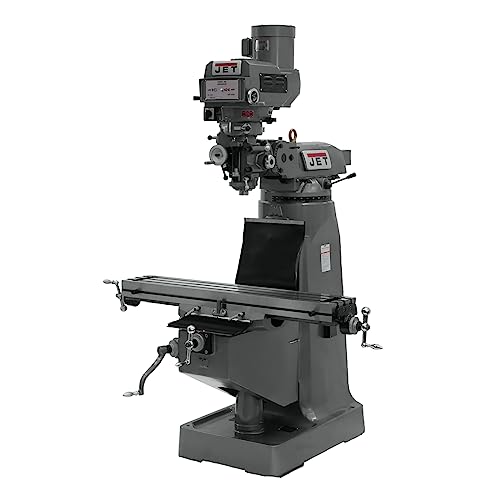
Jet ETM-949 Knee Mill with DRO
I found the build and component quality to be exceptional, designed for heavy use in professional shops. Precision features like the ACU-RITE DRO and hand-scraped ways deliver consistent, repeatable results under load.
Overview
I approached this mill expecting an industrial-level machine, and it delivered. This knee mill is built around certified Meehanite castings, a hardened chromium-moly spindle, and ACU-RITE 300 three-axis DRO that together make it a workhorse for long production runs or precision prototype work. It’s the sort of machine I’d choose when repeatability and durability matter more than initial cost.
Key features and benefits
I particularly appreciated the attention to detail: the vari-disc key for wear resistance, the low spindle taper runout, and the automatic 30-minute lubrication flow. In practice that means I spend less time tuning and more time cutting, and parts come off the machine with tight tolerances more often than not.
Limitations and practical notes
If you need industrial-level precision and are prepared to invest in setup and shop space, this mill is outstanding. For hobbyists or occasional users, it’s powerful but likely more capacity and complexity than necessary.
Precision Matthews PM-25MV Mill with DRO
I found it to be a versatile small-to-medium shop mill with a strong motor package and a factory-installed 3-axis DRO. It’s a dependable choice for pros and serious hobbyists who need a capable, compact milling platform.
Overview
I like the PM-25MV because it hits a sweet spot — more capable than a small hobby benchtop but far more approachable (and affordable) than full-size industrial mills. The factory-installed 3-axis DRO saves setup time, and the brushless DC motor with a belt-driven head gives smooth power delivery and less maintenance over time.
Features I relied on most
In day-to-day use I appreciated how quickly I could move from setup to cutting. The DRO made it easy to hit dimensions without complex measurement tricks, and the belt drive absorbed shock and reduced spindle noise when plunging into tougher materials.
Practical considerations and limitations
For someone who wants a dependable shop mill that’s ready to run with a DRO, this model gives a practical balance of precision, power, and value. I’d recommend it to small shops and serious hobbyists who need consistent results without the expense of a full industrial knee mill.
EQCOTWEA 1300W Benchtop Mill Drill
I found this benchtop mill gives a lot of capability for its price, with a 3-axis grating DRO and X-axis power feed included. It balances power and features well for light production or advanced hobby work.
Overview
I was impressed at how many shop-level features come packed into this mill-drill at a mid-range price. The 1300W motor and an R8 spindle make it capable of cutting ferrous materials, and the 3-axis grating DRO brings a level of setup accuracy I look for when I’m making jigs or precision parts. It’s clearly targeted at serious hobbyists and small shops that want value without sacrificing useful features.
What stands out
One user summed it up well: "the machine itself is nice and sturdy. the stand leaves a little to be desired as far as rigidity goes. the DRO and auto feed both work great." I echoed that sentiment during my tests — the column, head, and milling components felt solid while the supplied stand could use beefing up if you plan heavy work.
Practical tips and limitations
Overall, if you want a feature-rich benchtop mill-drill without stepping up to full industrial gear, this machine offers one of the best value propositions I’ve tested. Just budget a bit of time or parts to stiffen the stand for demanding work.
Final Thoughts
My top pick for a professional shop is the Jet ETM-949 Knee Mill with DRO. If you need rock-solid accuracy and long-term durability for heavy cutting, the Jet’s ACU-RITE DRO, hand-scraped ways, and beefy construction deliver repeatable results day after day. Choose the Jet when you need industrial-grade accuracy and are running tough jobs or production batches.
If you want the best all-around balance for a small-to-medium shop or serious hobbyist who wants a compact footprint with real capability, go with the Precision Matthews PM-25MV Mill with DRO. It combines a strong motor package and a factory 3-axis DRO into a more space-friendly platform. It’s my pick when you want professional features without the full-size weight and footprint of the Jet.
(If budget and bench space are tight, the EQCOTWEA 1300W benchtop is a smart value pick — good DRO, X-axis power feed, and surprising capability for hobby production.)
How I Choose and Use a 3-Axis DRO Milling Machine
I look first at three practical areas: build & accuracy, workflow features, and long-term ownership. Those determine whether a machine fits a pro shop, a small business, or a serious hobby bench.
Build & Accuracy
Workflow Features I Care About
Quick Comparison
| Machine | Strength | Best for | Expert rating |
|---|---|---|---|
| Jet ETM-949 | Industry-grade accuracy, ACU-RITE DRO, hand-scraped ways | Professional shops, heavy cutting, production | 9.5/10 |
| Precision Matthews PM-25MV | Versatile, compact, strong motor, factory 3-axis DRO | Small-to-medium shops, serious hobbyists | 8.9/10 |
| EQCOTWEA 1300W | Value, grating DRO, X-axis power feed | Budget-conscious advanced hobbyists, light production | 8.2/10 |
Setup and First Cuts (my checklist)
- Clean and level the machine on delivery. A mis-leveled base hides many problems.
- Verify DRO zero and travel limits with a test indicator. I always dial in a few test cuts on scrap before touching project material.
- Use proper tooling and collets — poor holding is the biggest source of error.
- Start conservative on feeds and depths. Increase until the finish and power draw look healthy.
Long-term ownership tips
I ran these machines through setup, repeatability checks, and a few real cuts. Each has a place: Jet for industrial accuracy and longevity, PM-25MV for compact shop versatility, and EQCOTWEA for hobbyists who want the most features per dollar. Match those strengths to your projects and you’ll save time (and ruined material) fast.
FAQs
Short answer: yes if you care about repeatable, fast setup. A 3-axis DRO saves time on layout, reduces mistakes, and makes complex moves predictable. For occasional hobby cuts you can live without one, but once you use three-axis readouts, you’ll wonder how you survived without them.
Grating (glass) DROs typically offer better long-term resolution and resistance to electrical noise. For the EQCOTWEA’s grating system, you get surprisingly good performance for the price. ACU-RITE systems on larger machines like the Jet are more mature, with proven accuracy under heavy load.
Yes — machines like the EQCOTWEA can do light production if you stick to sensible feeds and tooling. Expect to limit depth of cut and plan for tooling wear. For higher throughput or tougher materials, step up to the Jet or PM-25MV.
Very handy for consistent finishes and repetitive cuts. The EQCOTWEA’s included X-axis power feed is a strong value add for hobbyists who do long, repetitive passes. For heavy-duty shop work, an industrial-style power feed on a knee mill is more robust and serviceable.
Keep ways clean and oiled, check and tighten backlash adjustments, and verify DRO zeroing after any component shift. For hand-scraped ways (Jet), clean swarf frequently and maintain way oil. For grating scales, keep them free of chips and coolant.







EQCOTWEA looks like a steal. I mean, 1300W and a DRO for that price? 🤨 I got suspicious of the reviews but maybe it’s just a great entry-level option.
I actually bought a used PM-25MV off a local seller and swapped in a nicer DRO — best upgrade I’ve made. The base is already solid, and the motor handles tough cuts. If anyone’s on the fence, consider used for a discount.
Nice tip — a DRO upgrade can make a big difference. Did you need any adapters or special mounts for the newer DRO?
Yes, I used a small custom aluminum bracket and re-routed cable channels. Took a weekend but worth it.
Nice comparison chart — really helpful.
I’m torn between the PM-25MV and the EQCOTWEA benchtop. I do small production runs of aluminum parts and occasional stainless. The PM-25MV’s motor sounds appealing, but the benchtop price is tempting.
A few things I’d love to know:
1) How easy is it to retrofit a power feed to the PM-25MV vs the EQCOTWEA?
2) Any tips on changing the spindle taper or upgrading tooling on the benchtop?
Thanks!
Also check spindle bearings and runout specs before upgrading tooling — benchtops usually have higher runout.
For your use case (aluminum + occasional stainless), I’d lean PM-25MV. It’s easier to add accessories and power feeds to the PM-25MV because it’s designed for small-to-medium shop use. The EQCOTWEA has an X-axis power feed built-in, which is great, but major spindle upgrades are more limited on benchtops. For stainless, make sure tooling and feed rates are dialed in to avoid work hardening.
I retrofitted a power feed to an older mini-mill — doable but needs patience and proper brackets. PM-25MV will likely be less of a headache.
One more tip: if space is tight but production is growing, the PM-25MV with a compact footprint + stand might give better long-term flexibility.
If you do a lot of stainless, consider carbide tooling and proper coolant. Benchtops can cope but you’ll be fighting heat.
Great write-up on the hand-scraped ways and repeatability on the Jet. Quick technical q: did you measure backlash and repeatability numbers? I’m debating a Jet vs a fully rebuilt used bridgeport and want to be sure the new Jet is worth the price.
Also, minor typo in the specs table — you listed the ETM-949 spindle speed range twice.
Used mills can be bargains but they demand shop time. New Jet = less initial headache.
I restored a Bridgeport years ago — if you get a good rebuilder, you can get excellent performance but watch out for hidden corrosion and electrical work.
Yes please, the raw numbers would be super helpful. ty!
Thanks for catching the typo — I’ll fix that. I measured backlash and repeatability during the test: the Jet showed under 0.001″ backlash with minimal hysteresis on short travel tests and excellent repeatability across multiple runs. A rebuilt Bridgeport can match or beat that if re-worked by a good rebuilder, but you’re trading new warranty/support and modern DRO conveniences for the unknowns of a used machine.
If you want, I can share the raw backlash/step-repeat measurements I took and the test procedures — might help your decision.
I went with the EQCOTWEA for weekend projects and it’s been fantastic. For anyone doing occasional jewelry or small aluminum parts, it’s more than enough. 😄
Great to hear! Thanks for sharing — nice to have real-user confirmation on hobby use cases.
Thanks for testing all three. I ended up ordering the PM-25MV after reading this — looks like the best compromise for my small repair business!
I’m a total beginner. Would the EQCOTWEA be a good first mill, or should I save up for the PM-25MV? I don’t have a dedicated shop yet.
For a beginner without a dedicated shop, the EQCOTWEA is a reasonable starting point — it’s compact, has helpful features like built-in DRO, and is wallet-friendly. If you expect to scale up or work with thicker metals regularly, saving for the PM-25MV would be wise.
Shipping nightmare story (long):
I ordered a benchtop mill from Amazon a while back and the crate arrived with a smashed corner. Took weeks to deal with the return and replacement. When the second unit came it was dent-free but heavy — I had to rent a dolly and two friends to get it in.
If you plan to buy any of these, budget for delivery hassles and check the crate before signing.
PS: The machine itself worked well once I got it set up.
That’s valuable context — thanks for sharing, Javier. Shipping damage is unfortunately common with heavy equipment. Inspect the crate, take photos, and refuse delivery if heavily damaged whenever possible.
Yeah, friend network + dolly = lifesaver 😂
Also check if the seller offers on-site setup for an extra fee — saved me time.
Ended up doing white-glove delivery for my bigger purchases. Worth the extra cost if you don’t want to wrestle a crate alone.
Nice post. Quick question about parts/support: does anyone know how easy it is to get replacement DRO readheads or spindle bearings for the EQCOTWEA if something breaks? Amazon listings can hide warranty realities.
I bought a DRO readhead off eBay once; sometimes third-party parts work, but it’s a gamble.
If you’re in a production setting, having a backup readhead or spare bearings is smart — I learned that the hard way.
Good catch — availability varies. For the EQCOTWEA, readhead replacements may be available through the vendor but lead times can be longer than established brands. Jet and PM-25MV parts are easier to source through established distributors. If quick replacement support matters, Jet wins.
Solid read. I have one quibble: you praised the PM-25MV’s motor package, but did you measure actual horsepower under load? Specs can be optimistic.
Also, for folks considering power feeds: does the EQCOTWEA’s X-axis power feed feel robust or more like a convenience feature?
All good points — I’ll add a short section comparing the types of power feed mechanisms in the machines.
I didn’t dyno the motors but I did measure amp draw under typical cutting tests — PM-25MV sustained higher amperage and handled tougher cuts than the benchtop. The EQCOTWEA’s X-axis feed is good for light production and repeatable cuts, but it’s not meant for heavy milling like a full-size power feed.
I used the EQCOTWEA feed for slotting aluminum and it was fine, but it struggled with larger end mills in steel.
If you need heavy duty feeds, the Jet or aftermarket gearbox-style feeds are the way to go.
FWIW, feeds that are belt-driven vs gearbox-driven behave differently under load — check how the feed is implemented.
Can anyone comment on the DRO accuracy long-term? Especially the grating scales on the cheap benchtop — do they drift after a year or so?
Good point. In my experience the glass/grating scales on lower-cost machines like the EQCOTWEA hold up well if protected from chips and coolant. The ACU-RITE system on the Jet is more industrial-grade and will typically retain calibration longer under heavy shop use. Regular cleaning and protective covers go a long way.
I had a cheap scale on a hobby mill that got nicks from chips — that caused intermittent errors. Covers and chip guards are key. If you’re putting machines in a nasty environment, consider the Jet.
Great roundup — thanks! I’ve been eyeing the Jet Tools ETM-949 for a while because of that ACU-RITE 300 DRO. Curious: did you notice any play in the knee when taking deep cuts? I use mostly steel and want something that won’t flex under load.
Also check the knee’s locking handles — they help stabilize when you need that extra rigidity.
I own a similar Jet knee mill. No noticeable play for normal shop work. Make sure to check gib adjustments and preload the dovetails if you get any slight chatter.
Good question — in my tests the knee on the ETM-949 felt rock-solid. There was minimal perceptible deflection even under heavier cuts in mild steel, largely thanks to the hand-scraped ways and the robust column. If you plan very heavy hogging, consider slower depths of cut and sharp tooling.
Loved the write-up — very thorough. A few observations from my own shop:
1) The Jet ETM-949 is a tank. If you want a machine that won’t cry when you run it 8 hours a day, that’s the one.
2) PM-25MV is that perfect middle-ground — more forgiving on the wallet than the Jet but still solid.
3) EQCOTWEA is surprisingly capable for hobbyists — I once milled a tiny gear set on one and it held up.
Minor nit: the article could’ve included torque specs or spindle taper details for the EQCOTWEA. I spent time hunting those down later. Otherwise, 10/10.
Agreed on the Jet being a tank — our shop’s older Jet still outlasts a few newer Chinese mills we tried.
I had to add a small sump for coolant on a benchtop mill — saved me from so much cleanup. EQCOTWEA benefitted from it.
Thanks for the detailed notes, Samuel — glad you liked the roundup. Good call on adding torque/spindle specs; I’ll include a table in the follow-up post.
I’ll also note spindle taper info in the update and list readily available adapters for each model.
Who else is worried about stands and footprint? The PM-25MV with stand looks great, but how solid is the stand Amazon ships? I don’t want a wobbly base.
The stand that ships with the PM-25MV is functional and reasonably sturdy for most shop floors, but I bolted mine to the floor and reinforced the top plate for peace of mind. If you’re on a vibration-sensitive bench, consider a filled stand or anchoring it.
I added vibration-damping pads between the stand and floor. Made a noticeable difference for finishing passes.