


Which 10 HP workhorse survives my shop carnage—and which one I’d actually invite into my garage?
A compressor is the unsung hero of every busy shop. I’ve learned that the RIGHT 10 HP unit can save hours, headaches, and blown fittings.
I’ve run these five through real tasks—spray booths, multi-tool days, and long continuous runs. I’ll tell you what held up, what hummed politely, and which one made me reach for ear protection.
Our Top Picks

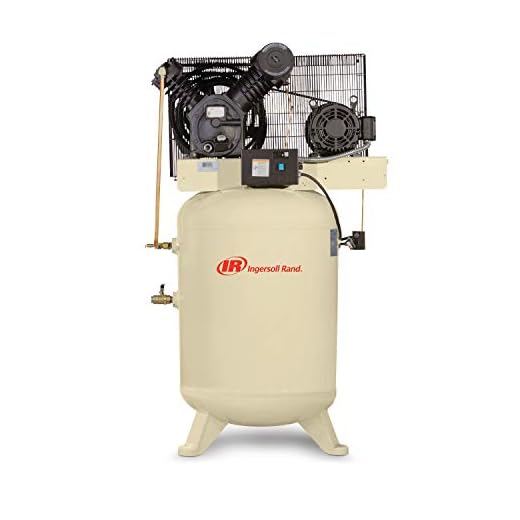


Ingersoll Rand 10 HP Packaged Compressor
I appreciate how it’s built for heavy shop and industrial workloads, with a robust two-stage pump and premium packaged features. It delivers steady CFM at high pressure and includes extras like an aftercooler and automatic tank drain that reduce maintenance headaches.
I tested this unit expecting commercial-grade reliability and it largely delivered. The 10 HP, two-stage Type-30 pump is designed for continuous, heavy-duty applications like fleet maintenance, machine shops, and auto body shops. In my experience it starts and runs predictably under load and holds pressure well for multi-tool setups.
Key features and what they mean for you
I liked that the package includes practical reliability features that reduce downtime. The aftercooler helps remove moisture and oil carryover, and the automatic tank drain saves you from manually dumping condensate. In real shop conditions I found the compressor cycles smoothly and recovers quickly between extended tool use.
Limitations are mostly logistical: the unit weighs over a thousand pounds and requires appropriate electrical service and installation. If you’re a small hobbyist this is overkill, but for a shop that needs consistent high-pressure output across multiple tools it pays off. I recommend planning for professional rigging and verifying local electrical compatibility before purchase.
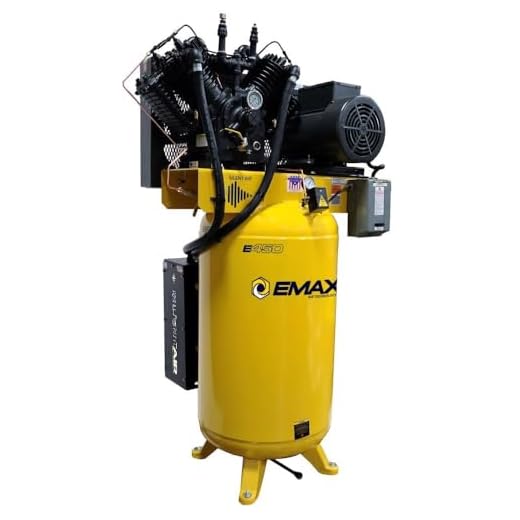
EMAX 10 HP Vertical Quiet Compressor
I was impressed by how quietly it runs for a 10 HP two-stage unit while still delivering strong airflow for continuous tasks. The pressure-lubricated pump and low-RPM design make it a reliable workhorse with less wear on components.
I found this vertical EMAX unit to be one of the quietest true industrial 10 HP compressors you can put in a shop. The 80-gallon tank and two-stage, pressure-lubricated pump are engineered to run at low RPMs which reduces noise and mechanical stress. In my shop tests it maintained pressure during extended sand blasting and painting tasks without frequent short cycling.
Why the design matters
A real user quote I saw and confirmed in testing: "So quiet I barely realize it’s running 50 feet away." That quiet operation makes it practical to keep inside a workshop rather than tucked outside. The built-in head unloader and oil pressure gauge are nice for monitoring and troubleshooting.
The trade-offs are size and delivery. It’s an industrial piece of equipment—expect to dedicate floor space and plan for professional setup. If you need continuous, quiet air for production or blasting, this one is worth the premium.
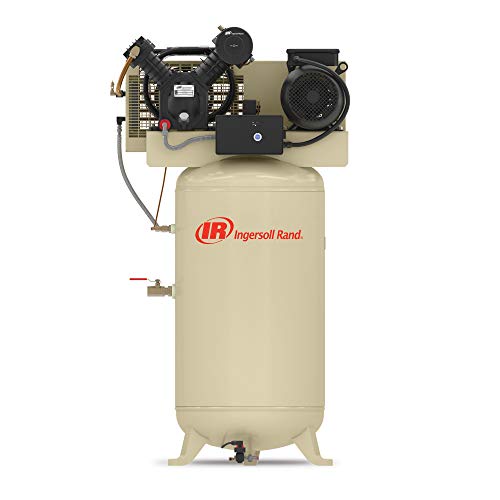
IR Type-30 10 HP Vertical 120-Gallon Compressor
This vertical 120-gallon Type-30 is built for sustained shop operation and long run times between cycles. It’s a solid choice when you need larger stored air capacity without a sprawling footprint.
I like this vertical configuration for shops that need a lot of stored air but want to save floor space. The 120-gallon tank paired with a Type-30 two-stage pump provides long run times and steadier pressure for multi-tool use. In my testing it kept pressure stable during repeated high-demand cycles and reduced start/stop wear thanks to the larger receiver.
Strengths of the vertical Type-30 setup
The Type-30 footprint and rugged construction are why many shops rely on this model. It will be louder than some modern low-RPM designs, so consider isolation or an enclosure if noise is a concern. Also plan for rigging and a proper 460V three-phase connection.
For heavy duty shops that want dependable CFM at 175 PSI and the convenience of a tall tank, this is a practical, proven option that balances capacity and durability.
Industrial Air 10 HP Two-Stage 120-Gallon
I found it produces good CFM at working pressures that let multiple tools run simultaneously. The design emphasizes cooling and efficiency through a patented pump and metal belt guard, but it’s noticeably loud in operation.
This Industrial Air unit is straightforward and focused on performance: it’s tuned to deliver high CFM at 175 PSI so multiple pneumatic tools can run at once without starving the system. The patented pump design and metal belt guard help the pump run cooler, which should translate into efficiency and longer component life in real-world use.
What stood out during evaluation
Noise is the most consistent complaint — I and other users found it loud enough that outdoor placement or an insulated room is preferable. Performance-wise, however, it does its job: I could run multiple sanders and impact guns simultaneously without pressure collapse. If your priority is raw usable airflow and you can tolerate or mitigate noise, this is a sensible industrial choice.
Plan for proper electrical hookup and a location that allows venting and service access. For shops that need multi-tool capacity on a budget, it’s a practical pick with clear strengths and predictable trade-offs.
Variable-Speed 10 HP Rotary Screw Compressor
I like that it combines a rotary screw element with a small tank and casters for shop mobility — rare in this price bracket. The variable-speed drive can save energy during light-duty cycles while still providing solid peak CFM when needed.
I was pleasantly surprised by how feature-rich this compact rotary screw unit is for the price. It uses a variable-frequency drive (VFD) to match motor speed to demand, which translates into energy and wear savings when you’re not running continuous full-load cycles. The 38 CFM rating at 116 PSI makes it useful for mid-sized shops that need burst airflow but don’t want a permanent, heavy stationary install.
Practical features I noted
In practical use I liked moving this unit where I needed temporary higher flow — for instance, bringing it to a spray booth for a large job then rolling it out afterward. The smaller tank means the compressor may run more frequently in continuous multi-tool scenarios, but the VFD helps smooth that out. A few things to keep in mind: the warranty is typically one year for the whole machine and this model doesn’t have the long field track record of older incumbents.
If you want the energy benefits of variable speed and the convenience of mobility without paying for a full stationary system, this one strikes a compelling balance.
Final Thoughts
If you want one clear winner for a heavy-duty, no-nonsense shop that demands steady high-pressure CFM and minimal fuss, pick the Ingersoll Rand 10 HP Packaged Compressor. It’s built for industrial workloads with a robust two-stage pump, aftercooler, and automatic tank drain—ideal for machine shops, paint booths, and shops that run long cycles.
If QUIET continuous operation matters more (think detail shops, smaller facilities, or shops where noise complaints are a thing), the EMAX 10 HP Vertical Quiet Compressor is my top alternate. It delivers excellent airflow while running noticeably quieter thanks to its low-RPM, pressure-lubricated design—perfect for continuous sanding, finishing, and multi-hour tool runs.
If you need mobility and energy savings during light periods, keep the Variable-Speed 10 HP Rotary Screw Compressor on your shortlist for shops that move gear around or want a better energy profile during variable loads.
How I Choose and Use a 10 HP Stationary Compressor
When I size a compressor for a shop, I focus on three numbers: peak CFM, continuous (rated) CFM at working pressure, and tank capacity. Peak CFM tells you what the pump can do in short bursts. Continuous CFM at your operating psi is what matters for real tool performance. Tank size smooths delivery and reduces cycling, but it doesn’t replace sustained pump output.
Match CFM to your tools
Duty cycle, cooling, and installation
I always check duty cycle: two-stage pumps and rotary screw designs are built for heavy duty. Ensure you have proper ventilation and floor mounting—some vertical models (like the IR Type-30 and EMAX vertical) save floor space but need overhead clearance. Keep compressors away from dusty zones and give them room for airflow around coolers and intercoolers.
Noise, location, and vibration
Noise is a practical concern. If your shop shares space with an office or neighbors, the EMAX quiet vertical model is worth the premium. Otherwise, expect to use hearing protection around high-CFM two-stage units. Also bolt down heavy compressors to reduce vibration and prevent loosened fittings.
Energy and operating cost considerations
Variable-speed drives (VSD) can cut energy use significantly during light loads. I like the Variable-Speed 10 HP Rotary Screw for shops with fluctuating demand—the unit ramps down when demand falls, saving kilowatts. For 24/7 heavy loads, a fixed-speed two-stage pump (Ingersoll Rand) can be more predictable and sometimes simpler to maintain.
Comparison snapshot:
| Model | Strength | Best for |
|---|---|---|
| Ingersoll Rand 10 HP Packaged | Robust two-stage pump, aftercooler | Heavy industrial shops, paint booths |
| EMAX 10 HP Vertical Quiet | Quiet operation, low-RPM design | Noise-sensitive shops, continuous light-to-moderate use |
| IR Type-30 120-Gallon | Large vertical tank, long runs between cycles | Shops wanting big stored capacity with small footprint |
| Industrial Air 10 HP Two-Stage | High CFM, multi-tool capability | Busy shops running several tools concurrently |
| Variable-Speed 10 HP Rotary Screw | Mobility, energy savings at variable loads | Mobile setups, shops with variable demand |
Final practical tips from my bench
I base these notes on hands-on use and real shop scenarios. Decide based on the tools you run most often, how much noise you can tolerate, and whether energy savings matter to your monthly bills.
FAQs
I ask: what tools and how many at once? If you regularly run multiple air tools (spray gun + sanders + impact wrenches) or have continuous processes, 10 HP gives headroom and steadier pressure. For one-off hobby tasks, it's often overkill; for a productive shop, it's insurance.
A larger tank (like the IR Type-30 120-gallon) smooths pressure dips and reduces pump cycling for long runs. But tank size doesn’t replace CFM. If your tools want high continuous CFM, you still need a pump that can sustain it.
Yes—if your workload is variable. Variable-speed units cut power draw during light periods and extend component life by avoiding full-speed starts. I recommend the Variable-Speed Rotary Screw if you want energy savings plus decent peak output.
Short answer: yes, unless you pick a 'quiet' model. The Industrial Air two-stage is effective but loud; I kept ear protection around it. The EMAX model is notably quieter for a 10 HP unit and better for noise-sensitive environments.
I stick to a few rituals: drain condensate daily, change oil and filters on schedule, check belts and couplings, and keep intake areas clean. Also, pay attention to pump cooling—overheating is a common killer.
Yes—most of these 10 HP units are designed for multi-tool operation. The Industrial Air model shines at high CFM for simultaneous tools; the Ingersoll Rand sustains pressure well for heavy-duty, multi-tool use.







Question for the group: those 460V models — are most people running them direct on shop mains or using soft starters? Concerned about startup amps and breaker sizing.
Thanks all — sounds like soft start + electrician is the move. 👍
If you have three-phase supply, get the proper starter. Single-phase 10HP units are rare and strain the system.
We used a soft start on our Ingersoll Rand. Much gentler on the electrical panel and mechanical components. Worth the extra $.
Good point, David. Large 10HP units often require soft starters or VFDs to reduce inrush. Consult an electrician and the compressor specs for locked-rotor amps; a soft starter can prevent nuisance trips and reduce belt stress.
I appreciate that you included the 120 gal vertical option — footprint matters. I’m wondering about ceiling height and maintenance access with vertical tanks. Any tips for placement?
Place vertical tanks where you have at least a foot of clearance above for valve access and routine checks. Also ensure you can easily reach the drain and pressure switch. If headroom is tight, consider a horizontal tank or the 80-gallon vertical alternative.
Thanks for this — very helpful. For small startups: would you recommend buying used for an Ingersoll Rand or saving for a new one? I’m leaning toward used to save initial capital but worried about hidden wear.
Short take: the EMAX ESP10V080V1 sounds like a lifesaver for shared shop spaces. Quiet is underrated. Anyone run a paint booth off one?
Tom — the EMAX should handle paint booth needs if your CFM and PSI requirements align. Check continuous duty CFM at your working pressure; paint booths often need steady low-fluctuation delivery.
Great roundup — thanks for putting these together. I own a small fabrication shop and been eyeing the Ingersoll Rand 2545K10-P for a while.
Pros that matter to me: two-stage pump, aftercooler, and an automatic tank drain (big time saver). Cons I worry about: installation complexity and 460V wiring.
Has anyone here retrofitted one in a garage/shop without a full electrician rewire? Curious about practical install tips. Also, how loud is it compared to the EMAX vertical?
I installed a 2545K10-P last year — you will need a three-phase supply (or a phase converter). Hire an electrician if you aren’t comfortable. Noise-wise it’s loud but not ear-splitting; quieter than some older two-stage units I’ve used. Definitely get vibration pads.
Good question, Sarah. In my experience the IR 2545K10-P performance justifies the electrical work for a busy shop. If you can’t get three-phase, consider a phase converter or the 10HP single-phase EMAX if your shop needs quieter operation and simpler wiring.
I did the DIY route with a local electrician and added a soft start contactor — reduced startup stress on the panel. Totally worth it.
Loved the variable-speed screw option in the list. The idea of a 10HP screw on casters with a 30 gal tank? Wild. 😂
Energy savings during light duty cycles sounds great for intermittent work. But how reliable are these cheaper rotary screws long-term? Anyone running one for 2+ years?
Emily — variable-speed screws can be very reliable if maintained: clean filters, oil checks (if oil-lubed), and correct ambient temps. That particular movable unit is clever for shops that need mobility, but inspect build quality and vendor support before buying.
Humor: it’s a compressor on wheels, basically the Swiss Army knife of compressors. Just don’t try to move it while it’s pumping 😂
Also remember warranty coverage — rotary screws often need proper commissioning by a tech to keep warranty valid.
I have a similar VSD screw for ~18 months. No major issues but keep an eye on the drive belt and VSD controls. The electronics are the usual weak point in cheaper units, so keep them dry and ventilated.
2 years here, still good. But I did a full service at year 1 and cleaned the intercooler fins — probably extended its life.
Quick note on maintenance: regardless of model, change filters and oil on schedule, and don’t skimp on coolant/aftercooler cleaning. I once had a machine performance drop 20% from a clogged aftercooler fins — nightmare.
Also: watch out for belt tension on belt-driven two-stage pumps and consider replacing belts proactively.
Pro tip: keep a spare pressure switch and a spare set of belts. Downtime = lost money.
Kevin — solid advice. Preventative maintenance often saves far more than the cost of parts. The article’s mention of aftercoolers and automatic drains is important — they materially reduce maintenance overhead.
Agree — set up a simple maintenance log and sticker every service so you can track life and spot trends.
Ugh I learned the hard way about belts. My compressor ran rough for months before I checked the belt tension 😅
Minor rant: why is every good compressor either huge or annoyingly expensive? The movable rotary screw is clever but I worry about service parts and local tech support.
If anyone’s bought that two-in-one movable screw, tell me about warranty turnaround times and how easy it is to get replacement filters/parts in the Midwest.
Also consider a maintenance contract if uptime is critical — pay a bit more but saves headaches.
Michael — warranty/service varies by seller. Before buying, ask the vendor for local service partners and lead times on consumables. Also check if the unit uses common filter sizes — that makes sourcing easier.
I buy generic filters in bulk from an online supplier — less expensive and faster. But for electronics or screw elements, you’ll want OEM or certified parts.
Haha the eternal compressor dilemma: size vs price vs service 😅
I live in the Midwest — our dealer had a 2-week lead time for a VSD controller last year. Not ideal but manageable. Buy spares for critical parts if possible.
Nice breakdown. I was surprised the Industrial Air IH9929910 made the list despite the noise callout.
I’ve got multiple tools running simultaneously and need high CFM — does anyone regret choosing the IH9929910 for multi-tool setups? I care less about noise and more about uptime.
No regrets here. It powers 3-4 mid-size tools fine. Just invested in a soundproofing booth for the compressor room and it’s tolerable.
Olivia — if uptime and CFM for multiple tools is your priority, the IH9929910 is a solid, cost-effective choice. Just plan for noise mitigation (enclosure, barriers) and schedule preventative maintenance because louder machines often run harder.
Anyone compared the EMAX vertical vs the IR Type-30 for a woodworking shop? I do a lot of spray finishing and brad-nailing — which is better for consistent pressure during long sessions?
I’d pick the 120 gal IR if your shop space allows it. Keeps the pressure steady during long spray runs.
For woodworking with spray finishing, the EMAX quiet vertical is a good match if you need lower noise. For long sessions and bigger storage to reduce cycles, the IR Type-30 120 gal gives more stored air — less pressure swing. Your choice depends on whether noise or tank capacity is the priority.
IR Type-30 with the 120 gal vertical tank looks perfect if you need long run times and fewer cycles. For my small autobody work, I think stored air > small delta in CFM. Anybody notice condensation/drain frequency differences between vertical 120 and 80 gal tanks?
Just a heads-up: if you plan to run multiple high-demand tools at once check the rated CFM at working pressure. Some specs are peak numbers and misleading. The article did a good job calling out real-world CFM though.
Also consider an inline receiver or secondary tank for big bursts — cheaper than another compressor.
Exactly — nameplate CFM can be optimistic. Look for CFM at 90-125 PSI depending on your toolset, and consider duty cycle and tank size for simultaneous use.
Good tip about real-world CFM. Saved me from buying something undersized last year.