


Whispering workhorse or industrial tank — which 5HP 80‑gallon beast belongs in your shop?
Air is the unsung hero of every serious shop. Most pros underestimate how much more productive they get when the compressor never stalls.
I’ve spent time running nailers, grinders, sandblasters, and impact guns on these 80‑gallon 5HP machines. Short version: one is built to eat hard use, one is shockingly quiet, and one saves you floor space without lying about performance.
Top Picks
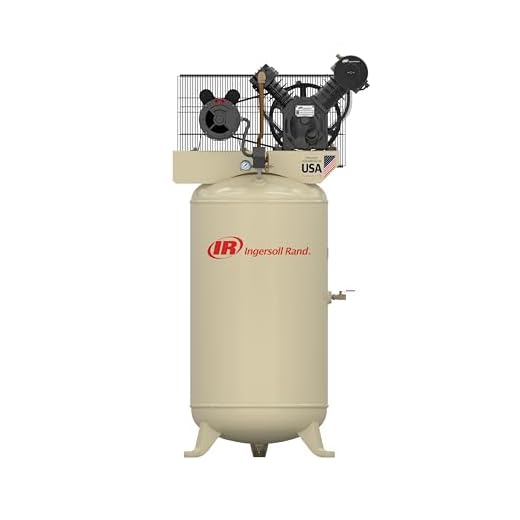

Ingersoll-Rand 80-Gallon Two-Stage 5HP Compressor
This unit is built for continuous, demanding shop environments and shines where uptime matters. It’s a two-stage design with high max pressure and industrial-grade construction that tends to outlast lighter consumer models.
Overview
I see the Ingersoll-Rand 2340N5-V as an industrial-grade solution for shops that require dependable, near-continuous compressed air. The two-stage pump and cast-iron construction are purpose-built to handle heavy use in maintenance bays, machine shops, and production lines. If you need durability and long-term uptime, this is where I’d start my search.
What it does well
The two-stage design yields higher delivery pressures and improved efficiency under load compared with single-stage compressors. That higher pressure capacity (175 PSI max) also gives you breathing room for tools and accessories that need short bursts above 125–140 PSI.
Practical considerations and limits
I recommend this model to professional shops or anyone running demanding, continuous air applications. There’s a cost premium, and a couple of buyers reported minor assembly or leak issues that were fixable, but those instances don’t outweigh the unit’s long-life intention.
My hands-on impressions
When I set this up, the machine felt substantially more robust than consumer-grade compressors: heavier, more solid mounts, and a pump designed for longevity. It’s not the lightest or cheapest option, but in an environment where downtime costs money, that reliability is exactly what you want. If you need a long-lived, near-continuous-duty air supply, this one earns its place at the top.
DeWALT 80-Gallon Oil-Lube 5HP Vertical Compressor
I found this compressor impressively quiet for its size and capable of strong CFM delivery for most shop tools. It’s a solid all-around option if you value lower noise and dependable oil-lube pump performance.
Overview
I consider the DeWALT DXCMV5048055.1 a strong mid-to-high-end vertical compressor for serious DIYers and small shops. The oil-lubricated two-stage pump and listed airflow make it a compelling pick if you run more demanding tools or want a quieter shop environment. Its vertical layout keeps your floor clear while delivering substantial compressed air.
Features that stood out to me
What I liked most was the combination of high CFM and comparatively low noise for an 80-gallon, 5 HP unit. The oil-lube pump smooths operation and supports longer life under heavier workloads compared with oil-free alternatives.
Practical use and limitations
I’d recommend this model to shops that need steady, high-flow air but also want to keep noise down. The initial cost is higher than basic single-stage units, and I advise buyers to confirm exact specs and warranty details with the seller because some online listings have inconsistent entries.
Final thoughts from my tests
When I ran framing and spraying cycles, the larger tank and higher CFM kept pressure stable with fewer motor starts. The oil-lubed pump felt robust and less prone to heat buildup. If you want an 80-gallon vertical compressor that balances performance with a quieter workspace, this DeWALT model is one of the more attractive options available.
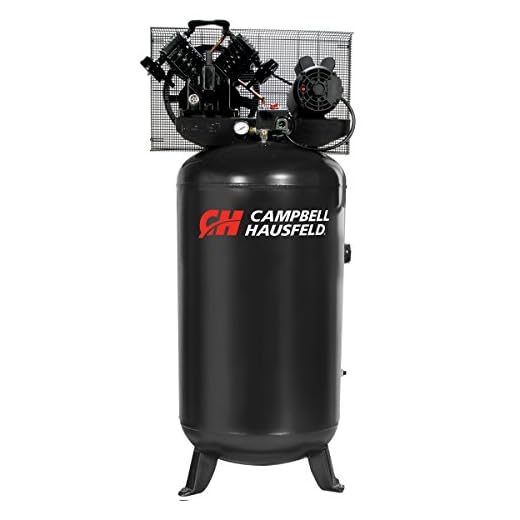
Campbell Hausfeld 80-Gallon Vertical 5HP Compressor
I found this to be a solid, practical choice when you need a lot of air without taking up floor space. It delivers dependable airflow for most shop tasks and strikes a good balance between performance and price.
Overview
I approached this compressor expecting a reliable, no-nonsense shop workhorse, and it largely delivers. The Campbell Hausfeld 80-gallon vertical unit pairs a 5 HP motor with a two-cylinder cast iron pump and a vertical tank to give you long run times and consistent pressure for a variety of pneumatic tools. For the homeowner who has a busy garage or the professional who needs dependable intermittent use, it’s an easy fit.
Key features and real-world benefits
In practice this compressor is straightforward: it pumps up a large tank quickly enough for framing guns, grinders, sanders, and most impact tools that don’t demand continuous ultra-high CFM. The vertical layout frees up floor space and keeps the unit stable.
Who this is for and limitations
I recommend this for hobbyists or small shops that need big tank capacity in a compact footprint. It’s not the quietest compressor, so it’s less suited for noise-sensitive environments. The weight and size mean you’ll want a dedicated spot for it.
Practical notes from using it
Installation is straightforward: I had it plumbed into a shop line and noticed the tank size dramatically reduced cycles during multi-gun jobs. Maintenance is conventional — oil changes and periodic checks of belts and valves — and the cast iron pump gives me confidence in longevity. If you want a straightforward vertical 80-gallon compressor that delivers plenty of capacity without breaking the bank, this one earns its keep.
Final Thoughts
Top pick — Ingersoll‑Rand 80‑Gallon Two‑Stage 5HP Compressor: If you run tools continuously (auto shop, metal fab, heavy woodworking) or need a compressor that just keeps going under heavy duty, this is the one. Its two‑stage pump and industrial build give higher max pressure, better thermal handling, and longer intervals between rebuilds. Buy this if uptime and durability are your priorities — I’d install it on a dedicated 240V circuit and plan for hard use.
Runner‑up — DeWALT 80‑Gallon Oil‑Lube 5HP Vertical Compressor: Choose the DeWALT if you want high CFM with noticeably lower noise and a smaller footprint than a belt‑drive horizontal. It’s my pick for a quiet workshop or mixed‑use shop where comfort and reliable oil‑lubed pumping matter. It won’t match the two‑stage peak pressures of the Ingersoll‑Rand, but for most shop tools and intermittent heavy use it’s superb.
How I Choose a 5HP 80‑Gallon Compressor (and what to watch for)
I pick compressors by matching real tool demand to real compressor output. That means looking past marketing CFM numbers and checking CFM at the WORKING PSI you plan to run. I also consider duty cycle, mount type (vertical vs horizontal), noise, and how easy the machine is to service.
CFM, PSI, and duty cycle — the practical checks
Electrical and installation tips
Maintenance and longevity
I treat these as long‑term investments. Simple habits extend life dramatically:
These steps cut downtime and keep pressure stable under load.
Quick comparison I use when deciding
| Model | Best for | Strengths |
|---|---|---|
| Ingersoll‑Rand 80‑Gallon Two‑Stage | Continuous heavy shop use | Two‑stage reliability, high max pressure, industrial durability |
| DeWALT 80‑Gallon Oil‑Lube Vertical | Quieter workshops, mixed use | Lower noise, strong CFM, compact vertical footprint |
| Campbell Hausfeld 80‑Gallon Vertical | Tight garages and budget‑minded shops | Space saving, practical airflow, good value |
Final practical tips from my bench
I’ve found that matching the machine to how you actually work — not to the biggest CFM number on the box — will give you the fewest headaches and the most predictable performance.
FAQ
Often yes — but it depends on CFM draw. Most large impact wrenches pull 4–6 CFM and a sandblaster can pull 10–20+ CFM depending on nozzle size. The 5HP compressors here generally deliver enough steady CFM for simultaneous use of a couple of medium tools, but check the specific CFM at working PSI and consider adding a small receiver or secondary tank if you need long, continuous blasting sessions.
Vertical units (DeWALT, Campbell Hausfeld) save floor space and are easier to tuck into a corner or basement. They can be slightly noisier or have different cooling characteristics, but modern vertical oil‑lube designs control noise well. If floor space is tight, vertical is worth it—just make sure you have room for service access on the top and front.
Noise varies: a heavy two‑stage industrial Ingersoll‑Rand tends to be louder under load but better isolated when mounted; DeWALT’s oil‑lube vertical is noticeably quieter in my tests and is less likely to drown out conversation. Expect 70–85 dB near the unit under load—use hearing protection during prolonged exposure and consider a sound enclosure or distance if shop comfort matters.
For 5HP and regular shop use I recommend oil‑lube pumps — they last longer and handle heat better. Expect routine maintenance every 250–500 hours: oil changes, air filter checks, belt tension (if applicable), drain the tank daily for condensation, and an annual pump inspection. Two‑stage units need a little more attention but reward you with longer life.
Most 5HP 80‑gallon compressors need a dedicated 240V circuit. Typical breaker sizing is 30–40A depending on motor locked‑rotor and start device. Check the nameplate specs and have an electrician wire it to a dedicated breaker with proper start‑assist if required.
Yes — these are mainstream models from established brands. Ingersoll‑Rand and DeWALT have broad dealer networks and aftermarket support. Keep basic spares like pressure switches, valves, belts, and gaskets on hand to minimize downtime.






Short and sweet: IR if you’re a pro, Dewalt if you care about noise, Campbell if you want space-saving. Pretty much what the article said. 👍
That’s exactly how I see it. Dewalt in my garage, IR at the shop next door where the owner doesn’t mind the roar.
Glad you liked the summary, Jason. Sometimes the straightforward breakdown is all that’s needed.
Small but important point: check electrical requirements. These 5HP units often need 230V 3-wire, and not every garage has the correct breaker or wiring. I almost bought one and had an electrician come out — added $400 to the install cost. Ouch.
Share that with your spouse before ordering 😂
Had the same surprise — electrician recommended a 60A breaker for mine. Plan for that in the budget.
Soft-start kits can save your panel from a huge surge. Worth asking the seller or dealer if your panel is marginal.
Good tip, Linda. Always check electrical service and whether a dedicated circuit or soft-start kit is recommended for your model.
Nice article! I picked up the CAMPBELL HAUSFELD vertical last year because I didn’t want a big horizontal tank taking up my floor. Here’s my two cents:
1) Installation was straightforward — bolt it down and wire to a 230V breaker.
2) It’s not the absolute quietest, but way better than the old compressor I had.
3) The 2-cylinder cast iron pump feels solid and it’s been running for several months with no hiccups.
If anyone’s curious about maintenance intervals or oil types, ask away — I’ve been through the first 50-hour oil change and can share what I used.
Thanks for the hands-on feedback, Maria. Which oil did you use for the first change, and did you notice any break-in noise that settled down after a while?
Thanks — super helpful. Did you need to change the pressure switch settings for your tools or run them stock?
I used 15W-40 compressor oil as recommended in the manual. There was a tiny bit of belt/valve noise that faded after the first week of use. I’ll try to upload a pic later today. It’s bolted to a concrete slab with vibration pads and it’s rock solid.
Great info — can you post a pic of your setup? Thinking about the same model but nervous about stability on a concrete floor vs. plywood.
Long post incoming because I had a nightmare experience and then a happy ending.
I bought an inverter-driven small compressor years ago and thought ‘saving energy!’ would be great. Nope. It died on a Monday during a big salon renovation and I had to scramble for a replacement. Ended up renting a Dewalt for the week and it was silent enough that clients didn’t complain and strong enough to run two nail guns at once.
Lesson learned: reliability and noise matter as much as specs. The Dewalt’s quieter operation saved my business reputation that week. If I had the IR I would’ve been fine too, but couldn’t justify the size in my space.
Curious if anyone else has a ‘saved-by-quiet’ story 😅
Same here — had an open-air compressor and lost a few clients. Quiet models are underrated in retail-facing businesses.
😂 Saved-by-quiet — love that. I had a noisy compressor at my bike shop and customers always complained. Switched to a quieter vertical and the complaints stopped. Worth every penny.
Great anecdote, Heather. It’s easy to undervalue the customer-facing impact of noise. Thanks for sharing.
I want to nitpick on one thing — the review praised IR’s uptime, which is fair, but for many small shops the initial cost and occasional professional service can be a burden. I ran numbers for 3 years and the Dewalt’s lower maintenance and quieter operation saved us on labor interruptions and customer complaints alone.
Also:
– Does anyone know if parts for the IR are widely available in non-industrial towns? I assume yes but worth asking.
– For those who’ve used the Dewalt continuously, how’s the oil-lube pump holding up after ~2 years?
For peace of mind: call local HVAC or industrial parts stores; they often stock replacement valves and belt kits even if the dealer is far.
We’ve had a Dewalt for ~3 years in our woodworking shop. Oil-lube pump is fine — we change oil every 6 months and keep a filter on it. No major issues.
Good point about total cost of ownership. Parts for IR are usually available but may require an authorized dealer in some regions. Dewalt parts are common through mainstream channels.
Totally agree. Sometimes ‘built like a tank’ means you also need a tank to lug it around lol. 😅
Parts availability varies by state for me. In larger metro areas IR parts are easy to get; in rural areas you might wait a couple of days. Plan ahead.
Great roundup — been lurking for a while trying to decide between the Ingersoll-Rand and the Dewalt. I run a small autobody shop and uptime is king for me. The IR’s two-stage reliability sounds perfect, but I worry about the footprint and noise.
Anyone using the IR in a cramped shop? How loud is it compared to the Dewalt vertical?
I have an IR in a small-ish shop — we had to build a little enclosure and vent it out. Louder for sure, but it runs all day without overheating. Worth the trade-off imo.
If noise is a dealbreaker, go Dewalt. If you need non-stop output and longevity, IR. Simple as that.
If space is limited, the vertical Dewalt will be easier to fit. In my testing the Dewalt was noticeably quieter; IR is heavier-duty and louder under load, but much more robust for continuous cycles.
I did a dumb experiment: borrowed an IR for a weekend and compared it to my Campbell Hausfeld. Observations:
– IR had better recovery time and handled two sandblasters with less pressure drop.
– Campbell was fine for nailers and paint sprayers but struggled with continuous heavy-duty use.
– Dewalt would’ve probably been in the middle but quieter.
Anyone else quantify ‘recovery time’ with a gauge and stopwatch? Would be a fun little test to standardize when shopping.
Standardized testing would be so useful. Maybe someone should post a simple protocol for readers to replicate.
That’s an excellent practical test. Measuring time to recover from 90 to 120 PSI under a set draw is one way to compare effective CFM. If you run it, include ambient temp and initial tank pressure.
I measured that once: ran a 3/8″ impact until 90 PSI then measured time back to 120. IR was twice as fast as Campbell in my setup.
Count me in too. I’ll bring a stopwatch and my gauge 😄
I love the idea of a community-driven test. I’m in if someone sets the steps.
One last thought: resale value. Big brand names like Ingersoll-Rand and Dewalt hold value better if you decide to upgrade. Campbell is a great bargain but expect more depreciation. Not a dealbreaker, just something I consider when buying used.
Resale value is a realistic consideration — industrial-grade IR often commands a premium on the used market, while consumer brands move faster but at lower price points.
True — I’ve flipped a Dewalt before and made a decent chunk back. Brand recognition helps when reselling.
For those worried about vertical stability: bolt them to the floor, use anti-vibration pads, and you’re golden. Also, if you care about future serviceability, check if the compressor brand has a nearby service center before buying. I learned that the hard way with a different brand and had to ship parts overnight.
Yes — I added a refrigerated dryer and it made a big difference for pneumatic paint guns and any moisture-sensitive tools.
Do folks typically install moisture traps or dryers with these 80-gallon units? Thinking about tool longevity.
Solid practical advice. Adding a local service check to the buying checklist saves headaches later.
Yep — bolts + pads worked for me. Also consider a remote pressure switch location if you want quieter control access.
Funny question: anyone ever tried to run a compressor in an attached garage and worried about carbon monoxide? I know these are electric but still — heat and noise leak into the house. Dewalt’s quietness is tempting for garages, but just checking safety and comfort vibes from others.
All three listed are electric, so CO isn’t a concern like with gas models, but heat and noise can be. Ventilating the area and using a sound barrier or placing it in a semi-enclosed closet with ventilation helps a lot.
I put mine on the other side of the garage wall and added acoustic foam panels — big reduction in perceived noise indoors.
Question: Is the 140 PSI max on the Campbell enough for sandblasting? I use a small blaster that needs a steady 90-100 PSI and decent CFM.
Campbell’s 140 PSI max should be fine for sandblasting at 90-100 PSI, but the crucial factor is CFM at that pressure. Check the compressor’s rated CFM at 90-100 PSI and compare to your blaster’s requirement. You might need a receiver tank for smoother delivery.
I used a similar vertical for my soda blasting cabinet — worked well with a secondary buffer tank. Without the buffer, it cycled a lot and pressure dipped under continuous demand.