

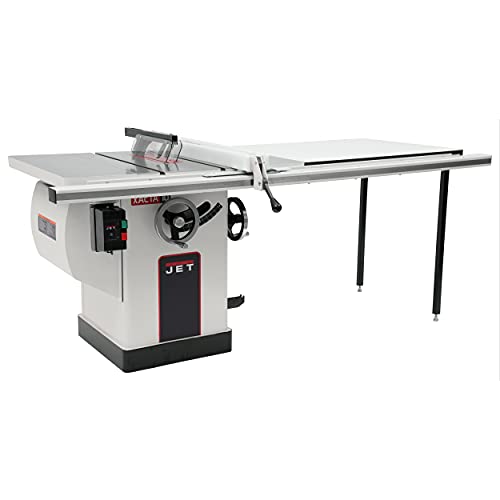
Which Jet table saw will survive your next project — and maybe outlift your bench? Let’s slice through the options.
I love a saw that feels like it was built yesterday — and keeps working tomorrow.
Small shop? Big shop? I’ve stood at all of them, measuring, cutting, and occasionally swearing at fences that wander. I want tools that are precise, solid, and predictable.
If you care about rigidity, rip capacity, and a fence that doesn’t make excuses, you’re in the right place. I’ll walk you through four Jet cabinet saws I trust and tell you when each one shines.
Top Picks


JET XACTA 10-Inch, 50-Inch Rip Deluxe
I consider this the go-to when you need commercial rigidity and a large working surface for furniture-grade work. It’s built to live in a shop and handle frequent, precise ripping of wide stock and long panels.
Why I picked this for pro shops
This Deluxe XACTA model is aimed squarely at the serious woodworker and small production shop. With a commercial-sized fence and a powerful 3 HP motor, I see it as a machine that reduces setup fuss and increases throughput when you’re cutting long casework panels, large tabletops, or furniture parts all day.
Standout features
Those elements add up to a saw that tracks well and resists racking under heavy use. The fence is the real star — once set up it holds parallel and gives repeatable reference for long runs of material. I also like that the dust path and enclosed cabinet make cleanup more manageable than many contractor-style saws.
What to expect day-to-day
You’ll need a 230V circuit or to hardwire the saw, and assembly is substantial. Plan several hours and ideally a second person for setup and leveling. Once running, the saw is quiet for its size and delivers excellent surface finish with the right blade.
Practical notes and shop tips
When I installed one in my shop I treated the first day as a commissioning session: verify fence parallelism, check blade alignment with a dial indicator, and select a quality crosscut and ripping blade for the work you do most. Customers in reviews often note that it outperforms more expensive brands on value; I’d add that regular maintenance (belt tension, trunnion lubrication) keeps it cutting like new.
JET ProShop II 10-Inch, 52-Inch Rip
I like this for shops that need extra table and rip capacity without stepping up to a bigger motor or commercial 230V saw. The 52" rip gives lots of room for panel work and sheet goods with fewer auxiliary supports.
Who benefits from the 52" configuration
If you frequently work with wide stock or like having extra outfeed and support surface without a separate outfeed table, this 52" rip configuration is compelling. I find it especially useful for cabinet doors, wide solid planks, and sheet ripping when space is at a premium.
Core features I value
The larger table transforms the saw from a space-saving cabinet into a small production-capable machine. That said, the 1.75 HP motor on a 120V circuit is still a limitation for dense hardwoods or repetitive heavy ripping — you’ll get the best results with sharp, appropriate blades and measured feed rates.
Practical considerations
Assembly and leveling are significant tasks because of the increased table size and weight. I’d budget time to ensure the extension table is perfectly coplanar with the center casting and to check fence alignment carefully.
Tips from use
One practical point: with the larger surface you can often avoid building temporary support tables for medium-sized panels, which speeds workflow. Keep a set of shims or a leveling strategy handy during assembly — small misalignment on the extension wings will show up quickly when you’re trying to get consistently square cuts.
JET ProShop II 10-Inch, 30-Inch Rip
I appreciate a compact cabinet saw that still brings solid fence accuracy and safety features to a small shop. It’s a great balance of performance and footprint for someone who wants cabinet-saw rigidity without the largest shop commitment.
Who this is for
I recommend this model if you want the feel and safety of a cabinet saw but don’t have space (or budget) for a full-size machine. It’s designed for hobbyists and small professional shops that need repeatable, accurate ripping and a durable working top without a huge footprint.
Key features I like
The fence and cast-top feel give you a stable cutting platform; the tradeoff is the stamped steel wings, which can flex more than cast wings under heavy loads. In day-to-day use I found the magnetic paddle switch convenient for emergency stops and the onboard accessory storage handy for keeping the miter gauge, wrenches, and dado insert close at hand.
Real-world performance and limitations
In my experience the motor runs smooth and delivers clean cuts on typical hardwood and project plywood. Expect to spend a little time dialing the fence and blade alignment out of the box — that’s normal for saws in this class.
Practical tips and examples
I recommend planning for two things at purchase: a proper strong stand or mobile base and good blades. With a high-quality blade this saw will give you crisp joinery and little tearout; with a dull or wrong-pitch blade you’ll see poor finish and increased motor load. One user quoted in reviews said the saw “felt like an upgrade from a 25-year-old contractor saw” after a few adjustments — that matches what I found when setting the fence and blade alignment.
JET ProShop II 10-Inch, 30-Inch Cast Wings
I favor the cast wings version when you want a more rigid outfeed and fewer table flex issues. It feels more professional under moderate shop use, but watch for assembly and quality-control pitfalls reported by some users.
Why choose the cast-wings model
I picked the cast-wings variant for shops where table rigidity matters — furniture makers and finish carpenters will notice less deflection across a cast surface compared to stamped steel. That extra stability translates to cleaner cuts and more reliable fence performance when you’re working with delicate joinery.
What stands out in daily use
That said, real-world ownership reports show a mix: many users praise the build quality and cutting performance after setup, while some encountered assembly problems like poorly threaded legs or missing parts. I always recommend inspecting shipments immediately and documenting issues with photos if you need replacement parts.
Limitations and shop advice
Because it’s still a 1.75 HP, 120V motor the saw isn’t intended for nonstop heavy ripping of very dense timbers — choose your blades and feeds accordingly. Also, the saw is heavy and not trivial to uncrate or return, so plan delivery and a mobile base or installation strategy ahead of time.
Final practical tip
If dust collection is a priority, pair the saw with a properly sized collector and check the dust shroud and hose fit during setup — several users found improved results after optimizing their duct path. In short, the cast wings give a nicer working surface, but the overall experience depends on careful assembly and proper shop setup.
Final Thoughts
If you need one saw to handle heavy, repeatable, furniture-grade ripping and long panels in a commercial or very serious home shop, I recommend the JET XACTA 10-Inch, 50-Inch Rip Deluxe. Its commercial rigidity and large table make it the go-to for demanding work — think cabinet sides, table tops, and long-frame stock.
If you want nearly the same working room with a slightly different balance of features and don’t want to move up to a 230V commercial motor, go with the JET ProShop II 10-Inch, 52-Inch Rip. It gives you the extra rip capacity for sheet goods and panel work while keeping installation and power requirements simpler for many shops.
Guide: How I Choose and Tune a Cabinet Saw
I pick a cabinet saw by asking three quick questions: How big are the parts I cut? How often will I use the saw? How rigid does the table need to be? Those answers map directly to rip capacity, table construction (cast vs fabricated), and cabinet build. Here are the practical points I look at every time.
Rip Capacity and Shop Workflow
Table Construction: Cast Wings vs Steel
Fence, Blade, and Safety Essentials
Setup, Alignment, and Maintenance
Choosing Between These Jet Models
I’ve owned and worked around these styles of cabinet saws long enough to say: get the rip capacity you actually use, prioritize table rigidity and fence quality, and don’t skimp on setup and dust control. That approach makes any of these Jet models a precise, long-lived partner in the shop.
FAQ
Pick the JET XACTA 50-Inch Rip Deluxe. I trust its commercial build for precise, repeatable cuts on wide panels and long boards. The larger table and robust cabinet reduce vibration and table flex — both important when you’re making furniture that needs tight joints and consistent parts.
The JET ProShop II 10-Inch, 30-Inch Rip (the compact cabinet version) is the balance I use in smaller shops. You keep cabinet saw rigidity and an accurate fence in a smaller footprint, plus it’s easier to fit into a two-car garage shop.
Cast wings can reduce table flex and give a firmer outfeed surface, which helps with heavier or wider panels. I’d choose cast wings if I’m frequently working with wide stock and need the extra stability. But expect a slightly more involved assembly and double-check for QC issues when unpacking.
The ProShop II 52" was highlighted because it gives big rip capacity without forcing you to step up to a 230V commercial saw. That said, shop power needs depend on your motor selection and workload. If you plan heavy, continuous ripping of thick hardwoods, evaluate motor and breaker requirements before buying.
I always mount a quality zero-clearance insert, a good riving knife or splitter setup, and a dust collection hose to the port. A mobile base helps if you need to move the saw, and a good thin-kerf rip blade speeds cuts with less tearout. These small changes make the saw safer and more accurate from day one.






I love the idea of the JET 10-Inch Deluxe XACTA (3 HP, 230V) for big furniture projects, but I’m worried about the 230V requirement.
Has anyone here converted a garage/shop to run that 230V model? What’s the ballpark cost to get an outlet installed and is it worth it if you only do heavy jobs a couple times a month?
Also, does the 50″ rip make a *huge* difference for something like table tops vs the 52″/30″ alternatives? Trying to justify the upgrade.
Good question—230V installation costs depend on local electricians and distance to your panel, but expect anywhere from $300–$1,200 typically. If you plan to rip wide stock regularly or do long panel work, the JTAS-10XL50’s rigidity and 3 HP motor will pay off in fewer passes and cleaner cuts. For occasional heavy jobs, consider renting a 230V or getting the 1-3/4 HP 120V JPS-10 (52″) instead.
The extra rip capacity is less about inches and more about workflow. 50″ vs 52″ isn’t night-and-day, but the XACTA’s table stability and 3 HP motor are. If you find yourself fighting feed or doing long rips, go 230V.
Installed a 230V in my detached shop — was about $450 for me. Worth it if you use it weekly. If it’s once every few months, I’d rent or hire a shop to do the big panels.
I’m working in a tiny garage shop and the JPS-10 30″ rip (steel wings, 1-3/4 HP) looks perfect on paper.
Pros: compact footprint, cabinet rigidity, decent fence.
Cons: I’m worried about table space when dealing with larger panels.
Anyone using the 30″ model in a small shop — how do you handle sheet goods? Do you need roller supports or a buddy to help?
For small shops, the 30″ rip JPS-10 is a very sensible compromise. Roller stands or a mobile outfeed cart help a lot with sheets. Some users build a simple fold-down support attached to the table saw or use a couple of adjustable roller stands when handling plywood.
I have the 30″ in a one-car garage. I use one roller stand and a cheap folding table for the other side — works fine for sheets up to 4×8, though you have to plan your cuts.
Curious about the 1-3/4 HP models: the expert ratings are high (8.6-8.7), but is that motor strong enough for hardwood ripping without bogging? I mainly do oak and maple furniture parts. Budget is limited so the 3 HP XACTA sounds great but costs a lot more and needs 230V.
Also blade selection matters a ton — a ripping blade with fewer, larger teeth will cut hardwood more cleanly than a general-purpose combo blade.
1-3/4 HP 120V motors are fine for many small-shop tasks and hardwoods if you take thinner cuts and keep sharp blades. For frequent heavy rips or large panels, a 3 HP 230V motor will offer better smoothness and less stalling. If your work is mostly small to medium parts, a JPS-10 (1-3/4 HP) should be adequate.
I run a JPS-10 on oak and it handles 3/4″ rips fine with a quality carbide blade. Just don’t try to hog big cross-sections in one pass.
Assembly note: the roundup mentioned “watch for assembly and quality-control pitfalls” for the cast wings JPS-10. Yep — that was me last spring. I spent a whole Saturday adjusting trunnions and shimming the fence. Fun if you like tinkering, annoying if you just want to cut wood.
On the bright side, once dialed in, the saw beats any contractor saw I’ve owned.
Also: Pro tip — don’t forget to lock the blade guard for certain sled cuts if you want visibility. But safety first, duh.
@Carl not from Amazon purchase, I think — but some local dealers will do setup for a fee. Worth calling them.
LOL ‘fun if you like tinkering’ — that’s the nicest way to describe it 😂 Worth it once it’s done though.
Good point — cabinet saws often require setup time. We recommend allocating at least a weekend for assembly, calibration, and test cuts. If setup isn’t your thing, a local tech can help get it dialed in.
Anyone know if JET offers in-shop setup at purchase? I couldn’t find clear info.
Totally relate. I had to re-index the mitre gauge, adjust the fence, and re-seat the motor mount. Took a few hours but now it’s solid as a rock.
Cast wings vs steel wings — I still don’t get it. 🤔
Are cast wings really that much better to justify whatever extra cost? The roundup mentions “firmer work surface” for cast wings but also QC issues for some models. Anyone faced that? Any tips to check when it arrives? typos ahead: i bought once and returnd it lol
I had a cast-wings model with a slightly warped outfeed; JET replaced the part under warranty. Definitely test flatness and fence squareness before fully assembling.
Cast wings generally reduce table flex and can feel more ‘solid’ for outfeed support — helpful for heavier panels. QC issues are usually around assembly alignment or packaging damage. When it arrives, check table flatness, fence alignment, and the arbor/runout. Take photos during unboxing in case you need to file a claim with Amazon.
Thanks! I’ll do photos during unboxing. luckily amazon returns are a breeze here so fingers crossed 😂
If you can deal with slightly higher weight, cast wings are worth it for cabinet-like feel. But inspect—some people get lucky, some don’t.
Just wanted to say: the Deluxe XACTA’s table surface on the 50″ model is insanely smooth. Dust collection also felt better than my old contractor saw. If resale isn’t an issue, it’s a long-term shop investment. 👌
Thanks for the feedback, Olivia. The XACTA’s enclosed cabinet and larger motor help with dust extraction efficiency when paired with a decent shop vac or dust collector.
Agree — the cabinet design really funnels chips better. You may still want a separate dust collector for heavy use though.
Quick question: does anyone know the arbor specs for the JPS-10 models? I want to swap in a thin-kerf blade but worried about compatibility. Also, how easy is blade changing on the Deluxe vs the ProShop II?
Bonus: funny thought — can you use the 50″ table as an ironing board? (kidding) 😆
Yep 5/8″ arbor on my unit. Swapped to a 40-tooth thin-kerf rip blade — great results. And no, do not iron clothes on it 😂
Thanks all — that helps. And fair, the ironing idea was probably a fire hazard 😜
Most JET 10″ table saws use the standard 5/8″ arbor. Thin-kerf blades with that arbor should fit fine, but check blade flange dimensions. Blade change procedure is typical for cabinet saws — locthe blade guard, remove throat plate, use the arbor wrench to loosen the blade nut. Deluxe vs ProShop is similar; Deluxe may have slightly easier access depending on your setup.
The 52″ rip on the JET ProShop II (1-3/4 HP, 120V) saved me so much time when I had to break down full sheets of plywood last month. No fancy sleds, just feed and go. Super happy with it.
Agreed. I added a couple of roller stands and it made cutting sheets by myself doable. 52″ is underrated for solo work.
Glad it worked well for you, Tom. For folks doing a lot of sheet goods, the extra rip and the steel wings make a big difference — fewer auxiliary tables and supports needed.
I’m torn between the 30″ cast wings and the 30″ steel wings JPS-10 models. Shipping to my place might be a hassle and assembly seems intense from the comments.
Anyone had Amazon deliver the cast wings model fully boxed and in one piece? How long did setup take for you? Also, any must-have accessories for day one? 😊
Cast wings are heavier, so make sure you have help for unpacking. Many buyers report the boxed units arrive intact but inspect for dings. Setup can take anywhere from 3–8 hours depending on experience (assembly, trunnion adjust, fence alignment). Must-have accessories: good rip blade, roller stands, dust collection hook-up, and a reliable measuring square for setup.
Bring a torque wrench for the larger bolts and a straightedge for checking table flatness. Oh, and coffee — you’ll need it 😄
My cast-wings unit arrived fine but I had two friends help unload. Setup took all afternoon but included leveling and fence calibration — worth the time.