


Which grinder-does-it-all will save your sanity (and your edges) in 2026 — the industrial bruiser or the nimble shop favorite?
I love a clean edge. Nothing beats running a board across a perfectly tuned oscillating edge sander and watching a rough piece become ready-for-finish wood.
I’ve sanded pieces at 6 a.m. and 10 p.m., in cramped garages and roomy shops. I’ll keep this short: pick the right machine for the work you actually do, not the one that sounds coolest on paper.
Top Picks



Powermatic 9" x 138" Vertical Edge Sander
I rate this highest for shops that demand power, precision, and long-term reliability. The large belt, high-power motor, and variable speed/oscillation controls give me the control I need on delicate and heavy-removal tasks alike.
Why I put this at the top
When I need the best blend of power, control, and capacity, this Powermatic delivers. The 3 HP motor, large 9" x 138" belt, and adjustable oscillation/speed options make it the machine I choose for finish-critical and heavy removal tasks in a professional shop.
Features that matter in daily use
Shop performance and benefits
In practice, the variable speed and oscillation let me switch from delicate finishing to aggressive shaping without changing machines. The table size and stability make it easy to handle cabinet doors, large panels, and long trim with consistent results. Dust porting is well thought out, which helps maintain a cleaner shop and better visibility on fine sanding work.
Considerations before buying
This is a serious investment and requires floor space and appropriate power. If you run a production shop or need the best possible finish control, it pays off quickly. If your woodworking is occasional or you have tight space, a smaller model may be more economical, but for consistent professional results this is my top pick.
JET 6" x 89" Edge Sander + Mobile Base
I like that this package combines the robust cast-iron sander with a mobile base — it keeps shop stability but lets me move the machine when needed. For shops that need occasional relocation, this is a practical compromise.
Why I recommend the mobile-base package
I often find shops need the stability of a cast-iron edge sander but also the flexibility to reconfigure the floor. This combined package gives you the familiar JET Black sander performance with a mobile base that makes repositioning and cleaning around the machine much easier.
Key benefits I noticed
Practical shop tips and trade-offs
When I moved between workstations, the mobile base saved me time and avoided back strain compared to lifting or disassembling. The base does not make the unit light — you still need floor space and a plan for power/dust hookups — but it dramatically reduces the friction of moving a large machine. If your shop is permanently laid out, the standalone sander may be just as good, but for multi-use spaces this package is a strong value.
Final thoughts
If you want the cast-iron durability but occasionally need to reconfigure the shop, this bundle hits a sweet spot between permanence and flexibility.
JET Black 6" x 89" Edge Sander
I appreciate the rock-solid cast-iron construction and the 90-degree tilting sanding head — it makes precise edge and bevel work effortless. The machine runs quietly for its size and its design emphasizes longevity and repeatable setups.
What this machine is for
I use this model when I need a heavy-duty edge sander that will live in my shop and handle long production runs. Its 6" x 89" belt size and 1-3/4 HP motor are well matched to cabinet doors, mouldings, and production trim work where stability and repeatability beat portability.
Key features I value
Real-world performance and benefits
In practice I found the cast-iron body dampens vibration, which translates to smoother finishes and less operator fatigue. The tilting head and adjustable table make it simple to set up for repetitive parts — I can dial in a stop once and run dozens of pieces. Dust collection integrates well with a shop system and helps keep the work area cleaner.
Limitations and practical notes
This isn't a machine you tuck under a bench — expect a heavy installation and some assembly time. Belt changes are straightforward but a little slower than lightweight models because of the robust guards and larger parts. If you need mobility, plan a dedicated cart or a shop location and consider a mobile base (see the mobile-base package as an option).
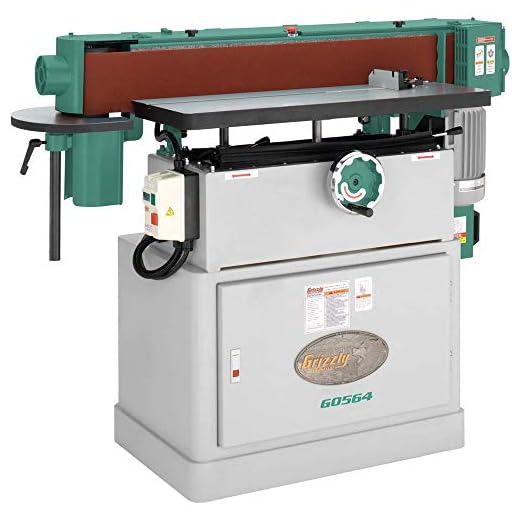
Grizzly 6" x 108" Oscillating Sander
I like the powerful 3 HP motor and the large table travel — it's built for longer runs and heavier parts. Oscillation is a touch shorter than I ideally want, but the overall capacity and adjustability make it a solid shop workhorse.
Ideal use case
I reach for this Grizzly when I need a heavy-duty, high-power sander for larger pieces or higher throughput. The 6" x 108" belt, robust 3 HP motor, and generous table dimensions are designed for serious shop environments and commercial woodworking.
Standout specifications
How it performs in the shop
The motor and the ergonomics make removing material fast and consistent. I found table adjustments intuitive and the machine handles prolonged use without bogging. That said, oscillation travel seems a bit shorter than some higher-end machines — it still works well, but if your workflow depends on maximum oscillation amplitude you might notice a difference.
Practical considerations
Assembly and setup are important: take time to check belt alignment and oscillation settings. Expect to do a little tuning out of the box; once dialed in, it’s a dependable piece of equipment for a busy shop.
RIDGID EB4424 Oscillating Edge Sander
I find this model attractive for smaller shops and serious hobbyists because it combines edge and spindle sanding in one unit. It’s well built for its price and easy to service, though dust collection is one area I’d improve.
Who this is for
I recommend this Ridgid when you want a capable, compact sander that covers both edge and spindle tasks without investing in separate machines. It’s a great shop centerpiece for door edges, trim, and small- to mid-size projects where space and budget matter.
Noteworthy features
How it behaves in real projects
In my hands it’s fast to change spindles and get into operation, which makes switching between tasks painless. The machine feels solid for the price and is forgiving for an operator who isn’t running a full production line. However, the dust routing seems best suited to a robust dust collector; a standard shop vacuum will reduce but not eliminate dust.
Practical tips and downsides
If dust control is critical, plan on a dedicated dust collector or additional sealing. For a workshop that needs a versatile, cost-conscious solution, this model is an excellent choice — especially for renovators, serious DIYers, and small commercial shops.
Final Thoughts
For full-time shops and anyone who needs heavy-duty capacity and the ultimate in control, I recommend the Powermatic 9" x 138" Vertical Edge Sander. Its large belt, high-power motor, and variable speed/oscillation controls make it the best choice when you need power and precision on big parts or heavy material removal. Buy this if you run production, work thick hardwoods, or want a machine that will last decades.
If you want near-shop-grade performance with more flexibility and easier placement, I recommend the JET 6" x 89" Edge Sander + Mobile Base. It gives you the cast-iron stability of a shop machine but lets you move it when your layout changes. This is my pick for smaller professional shops and serious hobbyists who need solid results without permanently committing floor space.
How I Choose an Oscillating Edge Sander (and how you should too)
When I pick a sander for my shop I think about three things first: the size of the work, how much material I need to remove, and whether I need portability. Those three questions narrow the field faster than comparing specs.
Key factors to weigh
Quick comparison
| Model | Belt Size | Expert Rating | Best Use |
|---|---|---|---|
| Powermatic 9" x 138" | 9" x 138" | 9.8 | Heavy production; large work and aggressive removal |
| JET 6" x 89" + Base | 6" x 89" | 9.1 | Versatile shop work with mobility needs |
| JET Black 6" x 89" | 6" x 89" | 9.0 | Precision edge work; quiet operation |
| Grizzly 6" x 108" | 6" x 108" | 8.7 | Heavy production runs; powerful motor |
| RIDGID EB4424 | Combo (edge + spindle) | 8.0 | Hobbyists and small shops; multi-function value |
Setup and tuning tips I use every time
Belts, grits, and consumables
Dust collection and maintenance
I pick tools to solve problems I actually face. If you need full production power, get the Powermatic. If you want a versatile, movable workhorse, the JET with a mobile base is the smartest, most practical choice for most serious shops. Whichever you choose, spend a little time setting it up right — that’s where the real magic happens.
FAQ
Oscillation spreads abrasive wear across the belt, which reduces gouging and leaves a more consistent finish. It also keeps heat lower, which helps with delicate glue joints and prevents burn marks on hardwoods.
Bigger belts (like 9" x 138") remove material faster and handle larger parts. Smaller belts (6" x 89") are better for precision work and tight setups. Match belt size to the largest pieces you expect to run and the amount of removal you need.
The JET + Mobile Base is the most practical. It gives cast-iron rigidity with the option to roll it out when needed. For a permanently installed heavy machine, the Powermatic is better, but it’s a commitment.
Very. Good dust collection improves visibility, prolongs abrasive life, and dramatically reduces health risks. If a model has weaker dust capture (I’m looking at you, some smaller combo machines), plan to add a dedicated collector or a shroud upgrade.
No — belts are specific to width and length. You can sometimes reuse similar grits, but you’ll need the correct belt dimensions for each sander.
Yes — especially if you need both edge and spindle sanding flexibility without buying two standalone machines. It’s a great value for hobbyists and small pros, though you’ll want to upgrade dust collection if you do heavy work.
I inspect moving parts and lubrication every 3–6 months with regular use. Tighten fasteners, check belts for tracking, and clear dust from gear housings. Regular light maintenance prevents surprises.





Great roundup — thanks for putting this together!
I was leaning toward the Powermatic as my dream machine, but the 230V requirement makes me nervous.
Does anyone run the OES9138B on a step-up transformer in a small shop? Concerned about installation cost and safety.
Also, are belts for that size easy to source on Amazon or do you have to special-order?
Good questions, Sarah. The Powermatic 9″ x 138″ is definitely a 230V shop machine — many small shops install a dedicated circuit or use a licensed electrician to add the outlet. Step-up transformers can work, but they’re not ideal for continuous heavy-duty use. Belts for that width/length are less common than smaller sizes but several vendors on Amazon and specialty suppliers carry them; check the exact belt dimensions before ordering.
FWIW, some local dealers will install the outlet as part of delivery/commissioning — might save you a bit vs hiring separately.
I used a heavy-duty transformer for a year when I couldn’t get a 230V line installed — it worked, but I treated it like a temporary fix. If you’re doing daily heavy sanding, save up for the proper circuit.
I went with the Ridgid last month for my garage shop and honestly it’s been great 😊
Not perfect — the dust thing is real — but for the price I couldn’t resist. Spindle sanding is way more useful than I expected. Typos aside, really happy with the buy.
Thanks for the thumbs-up report. I’m leaning the same way — did you need to shim anything or was it good out of the crate?
Glad it’s working out, Linda! Any tips you can share about setting it up or initial tuning that helped?
I’ve owned the JET OES-689-BLK (no mobile base) for about three years now. The cast-iron frame is unreal — set it up and forget about frame flex.
Pros: very quiet for its class, tilting head is a real time-saver for bevels.
Cons: it’s heavy and awkward to move if you don’t have the base.
If you do mostly cabinet doors and trim work, this one will pay for itself fast.
If you mount it on a proper stand and add casters you can move it with a floor jack fairly easily. Worth planning before delivery.
Thanks for the firsthand review, Robert — that’s the kind of practical feedback readers love. Did you ever add any dust collection upgrades?
On dust collection: many users add a simple metal hood and 2.5″ adapter to improve suction. It’s a cheap upgrade that works well.
Humorously, my back still remembers the first time we moved ours. Invest in helpers or a dolly 😅
Good point about weight. I rented one for a weekend and had to call a buddy to help move it. But once bolted down, it’s rock solid.
Nice list. I’m torn between the Ridgid EB4424 and the smaller JET cast-iron model.
I like that the Ridgid does both edge and spindle sanding but the review mentioned dust collection issues.
For those who own the Ridgid: how bad is the dust? Is it manageable with a decent shop vac or do you need an aftermarket dust hood?
Priya — the Ridgid’s dust collection is workable for hobbyists with a good shop vac and a dust separator. For heavier use, an aftermarket hood or connecting to a dedicated dust system will give much better results.
Quick question: anyone had to replace the tracking or idler bearings on the Powermatic OES9138B? I’m curious how service-friendly these big machines are — where do you buy replacement parts? Amazon? Direct from Powermatic or third-party?
Funny timing — I’m shopping for something to replace my cramped bench sander.
The JET BLACK 6″ x 89″ with the mobile base sounds like the perfect compromise for my one-man shop.
A few points from my research:
– Mobility is huge for me because I reconfigure the shop a lot.
– 1-3/4 HP is plenty for small batches.
– Anyone worried about vibration on the mobile base? Does it feel stable during edge work?
I have the same JET model on a similar base. Lock the casters and put a rubber mat under it — reduced vibration and it doesn’t walk when you push parts against the belt.
The mobile base helps with repositioning, but when in use you should lock it down and ensure the base is on a level, solid surface. Most users report good stability once the base is secured.
Great write-up. I’m on a tight budget — any recommendations for which of these gives the most ‘bang for the buck’ if I buy used? I’m mainly doing prototype furniture and small runs.
For budget-conscious buyers, a used JET OES-689-BLK (the cast-iron model) often offers the best balance of durability and price — check for frame cracks, smooth oscillation, and a healthy motor. The Ridgid can be a good value too if you want combo capability. Always verify belt sizes and replacement parts availability before buying used.
3 HP? Come on, who needs that unless you’re making stadium-sized cutting boards 😂
Jokes aside, the Powermatic and Grizzly look like beasts. For production runs the Grizzly seems like a bargain though the review mentions shorter oscillation — can anyone explain how much that actually affects finish quality?
Agree with the others. Also consider feed rate — slower, steady passes on shorter oscillation helps a lot.
Shorter oscillation can lead to more aggressive contact in one area of the belt, which increases heat and can leave faint patterning on sensitive veneers. For most heavy work it isn’t a deal-breaker, but for fine finishing the longer oscillation helps distribute wear and reduce heat.
I run the Grizzly in a small production shop — the finish is fine for painted or reworked edges, but for raw hardwood edges I do a light hand-sanding afterward just to be safe.
Adding to Sophie’s point: belt selection and grit progression matter a lot too. A well-staged sanding sequence reduces the chance of noticeable patterns.