


Which saw will save your fingers, tame your plywood, or fit in your truck? I tested 10 — here’s what I actually want in my shop.
Hands are worth more than tools. Table saws are incredible workhorses, but they can be dangerous. I’ve seen how a single feature—like a blade brake—changes how I think about a machine.
I tried ten very different saws so you don’t have to. Some are tank-like and built to last. Some pack big rip capacity into a roll-away package. I’ll tell you which ones I reach for and why. Short, honest, and useful—no fluff.
Top Picks




SAWSTOP 10-Inch Industrial Cabinet Saw
I value the safety system above almost everything else — the blade-stopping technology genuinely changes the risk profile in a busy shop. Beyond safety, this machine is built like a tank: quiet, stable, and powerful for demanding cabinet and production work.
Why I picked it and who it’s for
I consider this saw essential where safety and high throughput matter — small shops that do professional work or facilities with multiple users. The SawStop safety mechanism is the central reason to own one; it materially reduces the likelihood of life-changing injuries.
Features that matter day-to-day
Those features result in a machine that feels confident and repeatable. The safety system does mean you’ll need to factor in replacement costs if a trigger event occurs, but for many shops that cost is far smaller than the alternative.
Practical considerations and my final take
The saw is heavy and demands a dedicated space — it isn’t a plug-and-play jobsite tool. Expect a professional delivery and setup, and plan wiring for 230V, single- or three-phase depending on configuration. If your priority is maximum safety combined with durable industrial performance, I’d personally prioritize this saw over nearly any other cabinet option.
Powermatic ArmorGlide 10-Inch Cabinet Saw
I love how the saw's ArmorGlide tables and heavy cast-iron construction turn accuracy and longevity into everyday tools. Its feature set reads like a pro shop wish list — smooth operation, tool-free conveniences, and thoughtfully designed mobility for a machine this big.
What I think and who it’s for
I consider this model a shop centerpiece — heavy, precise, and engineered to be the last cabinet saw many pros will ever need. I bought into it for its low-friction ArmorGlide coating and the ergonomics of the one-handed arbor lock; those small daily conveniences add up fast.
Key features and benefits
These features translate to real shop benefits: cleaner surfaces that stay accurate longer, less time wrestling with blades, and a machine that runs cooler under heavy loads. The digital blade tilt readout and adjustable angle indicators make repetitive bevel work far less fiddly.
Practical notes, limitations, and final thoughts
The saw is a commitment — physically (it's very heavy) and financially. You’ll need 230V in most configurations, and installation or shop layout planning should factor that in. That said, if your work demands consistency, durability, and the kind of features that reduce day-to-day friction, this saw will repay its cost in saved time and headaches. I recommend it for professional shops and serious hobbyists who want a long-term, low-maintenance platform.
Bosch GTS15-10 Portable Jobsite Table Saw
I like that it gives professional rip capacity without being a giant—gravity-rise stand and a 32-inch rip make on-site cutting a breeze. The electronically regulated motor and convenience brake are practical touches that keep jobs moving and improve safety.
First impressions and intended use
I picked this Bosch for people who need a serious jobsite saw that still moves easily. When I’m cutting sheet goods or long stock on location, the rip capacity and fast-deploy stand make a real difference in productivity.
Key features and what they deliver
These combine into a package that behaves more like a light production saw than a basic portable. The brake and electronic regulation keep things consistent and safer on the jobsite.
Practical tips and limitations
Expect to upgrade or replace the miter gauge if you need high-precision crosscuts; this is a common tweak even with higher-end jobsite saws. Overall, if you need portability without giving up rip capacity or cutting power, this saw is a solid choice I’d recommend for contractors and serious hobbyists.
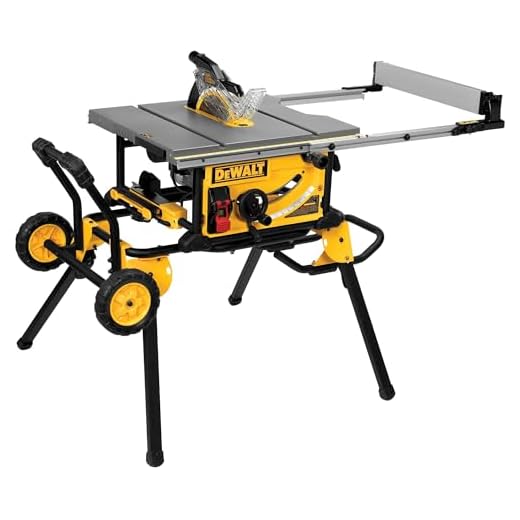
DEWALT 10-Inch Table Saw with Rolling Stand
I appreciate the rack-and-pinion fence and the generous 32-1/2" rip capacity — it makes large ripping tasks fast and accurate. The rolling stand and onboard storage make it an excellent all-around jobsite saw when you need mobility without sacrificing capability.
Overview and user fit
I see this as one of those workhorse jobsite saws that balances portability and capability really well. If you need to rip long boards or sheet goods on-site and want a fence you can trust, this model checks a lot of boxes.
Standout features and what they mean
For me, the fence is the star — it keeps long rips square without the fuss of knock-and-tap adjustments. The rip capacity opens up cabinet doors, trim, and shelving work at the jobsite without needing a full shop setup.
Practical notes
This saw excels when you need a portable solution that still handles larger rip cuts. Expect the typical jobsite compromises: lighter table mass compared with cabinet saws and entry-level miter-gauge quality. If you plan to do a lot of precision joinery, plan on a better sled or miter gauge upgrade; for ripping and general construction use, it’s excellent.
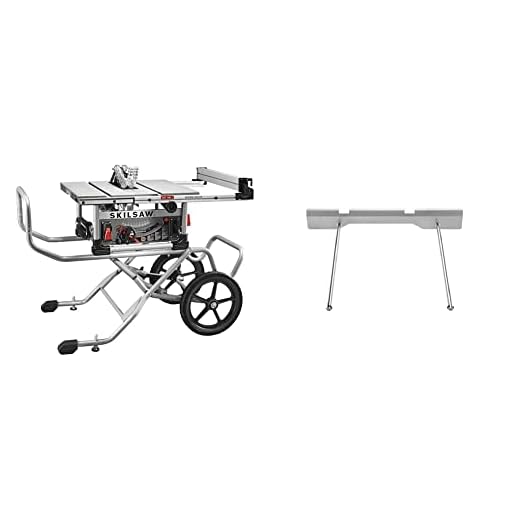
SKIL Worm Drive Table Saw + Rear Outfeed
I like that the rear outfeed adds 15" of usable in-line support — helpful when you’re breaking down sheet goods or ripping long stock. The worm-drive base saw remains the same dependable core, and the outfeed removes a common portability limitation.
Why add the rear outfeed
When I need extra outfeed support for long rips and full-sheet breakdowns, the rear outfeed is a simple answer. It’s especially useful when working alone — the extra support reduces tear-out and prevents the tail of a long board from tipping.
How it improves workflow
With the extra support I found fewer snags and less need for ad-hoc stands or helpers when breaking down plywood or dimensional lumber. It makes the saw behave more like a mini-table system rather than just a portable jobsite saw.
Practical trade-offs
The outfeed is simple but adds to the saw’s footprint for transport and storage. If you regularly handle long panels or want a one-operator solution for large cuts, the added convenience is worth it; if you rarely cut long pieces, the standalone saw may be the smarter, lighter option.
SKIL SPT99-11 Worm Drive Table Saw
I love the worm-drive torque — it eats dense timbers without bogging down and stays cooler for long cuts. The rolling stand and thoughtful tool storage make it a durable jobsite companion when you need sustained cutting power.
Why the worm drive matters
I chose this SKIL when I needed a portable saw that behaves like a workhorse. The worm-drive gearing gives more torque at lower RPMs, which feels especially confident when ripping hardwoods or stacked material.
Useful features and day-to-day benefits
In practice, those big wheels and the torque add up to a saw you can take into difficult jobs and still expect to cut cleanly. The table and fence are nicely thought out for repeatable work under tough conditions.
Limitations and user tips
It’s not the lightest jobsite saw — portability is good, but you’ll notice the weight when loading into a truck. Expect to spend a bit of time assembling the stand; having a second pair of hands speeds that up. If you value long-lasting torque on a mobile platform, this saw is one of the most practical options.
Metabo HPT C10RJS 10-Inch Table Saw
I value the long rip capacity and fold-and-roll stand for jobs where I need both portability and workspace. The motor feels strong and the saw is simple to set up, making it a dependable choice for contractors and small-shop woodworkers.
Where this fits in my shop
If I need a portable saw that still handles sizable ripping and panel work, this Metabo HPT hits the sweet spot. It’s designed around mobility without surrendering rip capacity and work surface.
Highlights and everyday performance
In use I’ve found it easy to move to the driveway or a jobsite and get cutting quickly. The motor keeps speed under cutting load and the fold-and-roll stand is one of the more convenient setups in this class.
Caveats and buyer tips
Some buyers have reported shipping damage or small broken plastic parts; it’s worth inspecting on arrival and keeping photos if you need to pursue replacement parts. Also, if you do precision woodworking regularly, plan on upgrading the miter gauge or building a sled. For contractors and hobbyists who value portability with real ripping capability, this model is a smart, practical option.
Makita 2704N Telescopic Table Saw
I appreciate the large machined aluminum table and telescopic rails when I need accurate, repeatable cuts on big panels. The ability to hook up shop vacuum and the electronic soft start make it a tidy, predictable performer for fine woodworking.
Why I like this one
I picked the Makita 2704N when I needed precision without moving to a full cabinet saw. The machined aluminum top and telescoping table allow me to handle large panels while maintaining tight tolerances.
Practical features that make a difference
In everyday use the soft start and brake reduce launch torque and make the saw feel controlled from the first second. The guard visibility is nice for learning and keeps debris out of your face while letting you monitor the cut.
Limitations and shop-fit notes
This model sits between a portable and a stationary saw — it’s not ideal if you need frequent transport. Also check electrical requirements closely; some configurations are 240V. If you want a reliable, accurate table saw for shop projects and you have the floor space, this unit is an excellent middle ground.
Grizzly G0771Z 10" Hybrid Table Saw
I like this Grizzly as a budget-friendly hybrid that gives you cast-iron mass and a T-shaped fence without the cabinet price tag. With careful setup it cuts confidently and handles thicker stock, making it a solid pick for serious hobbyists.
Who should buy this
I’d recommend the Grizzly hybrid to woodworkers who want a step up from portable saws but aren’t ready for a full cabinet saw budget. It gives more table mass and rigidity while staying within reach price-wise.
What stands out in daily use
When I set it up carefully and dialed the fence and throat plate, the saw ran accurately and smoothly. The heavier table reduces vibration compared to jobsite saws and gives better repeatability for joinery.
Practical cautions
Expect to spend some time on initial alignment and squaring — reviewers commonly mention minor QC or fit issues that need correction. If you’re comfortable tinkering and tuning, you’ll get a lot of saw for the money; if you want perfect out-of-box setup, budget for service or inspection.
DEWALT Folding Stand for 10-Inch Saws
I find this stand delivers excellent stability and portability for the price, especially paired with compact DeWalt saws. It's lightweight, folds flat, and makes jobsite transport painless while still giving a secure mount for the saw.
Quick intro and who should consider it
I picked this as a practical jobsite companion — it isn’t a power tool, but a good stand can make or break a portable saw setup. This DEWALT stand is built to be a lightweight, no-fuss solution for contractors and weekenders who move gear frequently.
What it does well
In practice the stand sets up quickly and keeps the saw stable during moderate rip and crosscut work. The fold-flat footprint makes it easy to toss in a truck or stash in a garage corner between jobs.
Limitations and real-world tips
If you want a taller work height or a stand that eliminates all wobble on uneven ground, you’ll want to add spacers or look at alternative stands. I also recommend checking compatibility with your exact saw model before buying — this one is intended for specific DEWALT jobsite saws. For the money, though, it’s very hard to beat on portability and price.
Final Thoughts
If I could keep only one saw in my shop it would be the SAWSTOP 10-Inch Industrial Cabinet Saw. Its blade-stopping safety system is a game-changer in a busy shop. Beyond safety, it’s quiet, stable, and powerful—perfect for cabinetmaking, production work, and any environment where I need consistent, repeatable cuts and peace of mind.
If you run a heavy-duty professional shop and want the absolute best in build and long-term accuracy, I’d pick the Powermatic ArmorGlide 10-Inch Cabinet Saw. The ArmorGlide table and cast-iron construction deliver rock-steady precision and durability. It’s the choice when longevity, tool-free conveniences, and pro-level performance are your top priorities.
Both of these are shop machines—heavy, precise, and made to stay put. Choose SAWSTOP if safety is your non-negotiable. Choose Powermatic if you want old-school mass and precision that will last decades.






Short review from my experience:
I bought the SKIL worm drive with the rear outfeed last season. It’s been surprisingly useful. The worm-drive keeps torque under load and the rear outfeed saved me on big plywood breaks.
Pros:
– Amazing torque for its class
– Rear outfeed actually works
– Sturdy stand, rolls well
Cons:
– Slightly heavier than I expected
– Blade changes are a bit fiddly compared to compact portables
Would buy again for jobs that need long rips.
Do you use the original blade or swapped to a thin-kerf for better cuts? I swapped mine and it improved feed and reduced tearout.
Nicely detailed — thanks! How’s dust control on that SKIL? I hate a clouded jobsite.
Dust was okay for me with a shop vac, but nothing like a cabinet saw. Good enough on site.
I went to a 40T thin-kerf for sheet goods — less resistance and cleaner cuts. Worth the swap imo.
Good point on dust — portables with rear outfeed tend to kick chips rearward. A decent vac and a shrouded blade make a big difference.
Great roundup — thanks! I’m torn between the SawStop cabinet saw and the Powermatic for a small production shop. Safety is huge for me, but Powermatic’s build sounds tempting. Has anyone compared noise and vibration between those two?
I went Powermatic for the ArmorGlide surface. Feels butter-smooth. No safety system like SawStop though, so strict shop rules for PPE and push sticks here.
If safety is your main concern, SawStop’s flesh-detection is a game-changer. Powermatic is slightly quieter and has a rock-solid table feel, but it lacks the active blade-stop. For vibration, both are excellent; SawStop’s heavier models are very damped.
I run a SawStop in my shop — it’s a bit louder than the Powermatic when under load but not annoyingly so. The peace of mind is worth it to me.
The Grizzly hybrid looks like a steal for hobbyists. I set one up last month and after a couple hours of tuning the fence it’s surprisingly accurate. If you’re on a budget but want cast-iron mass, this is a solid pick.
Agree. I added a decent blade and tightened the table bolts; night and day improvement. Just be patient during setup.
Warm is normal; if it trips frequently check belt tension and dust in the motor vents.
Totally — hybrids reward a careful setup. Tramming the blade and dialing the fence will get you performance closer to a cabinet saw without the price tag.
Any issues with motor overheating for you? Mine gets warm under heavy cuts but not alarming.
Quick note about stands: the DW7451 is lightweight, yes, but I wouldn’t trust it with improvised clamping or heavy infeed/outfeed tables. Great for portability, meh for permanent shop setups.
Good summary. The DW7451 is optimized for portability more than brute stability. For a semi-permanent shop, look for something with a wider stance or bolt-down points.
Same here — used it for a year on site, perfect. For garage-only setups I bolted a different table to it.
I’m all about safety — the SawStop seems overpriced until you imagine a finger accident. Anyone who has used one in a teaching environment? Does the cartridge replacement cost add up if it’s ever triggered?
I was worried about false triggers, but they’re uncommon. The techs at the dealer walked me through the replacement — not too bad if it happens once in many years.
SawStop is often chosen by schools and pro shops for that reason. Cartridge replacement after a trigger is a real cost (and still cheaper than a severe injury), but triggers are rare if you use push tools and featherboards. Many institutions see it as essential.
Thanks all — that’s reassuring.
Pro tip: train students on good techniques and the SawStop becomes insurance, not a frequent expense.
I teach a weekend class and we installed SawStop — we’ve had one trigger in three years. Cartridge cost was annoying but everyone appreciated the safety assurance.
I’m shopping for a first serious table saw and the roundup helped. Leaning to the Grizzly hybrid for budget reasons, but I’m wondering about resale value down the line — will it hold up if I upgrade to a cabinet saw later?
Grizzly hybrid tends to hold decent resale among hobbyists, especially if maintained. If you plan to upgrade, focus on keeping it clean, documented, and with any upgraded fence or blades included.
I appreciate seeing the Makita listed for dust control. Does anyone have tips for hooking it up to a small 2.5HP dust collector? I’m worried about losing suction with larger panels.
Minor nitpick: article could have included more on blade recommendations per saw class (cabinet vs jobsite). But helpful overall — I ordered the DEWALT stand from Amazon after reading this.
Yes please on blades — especially which ones for plywood vs hardwood vs crosscuts. That would be super helpful.
Good suggestion — we’ll add a blade guide for each saw in the follow-up. Thanks for the feedback and glad the DW7451 link was useful!
I chuckled at the ‘best for torque’ SKIL entry — true. Had one chew through some dense oak without hiccups. If you’re doing outdoor builds with big timbers, worm drive is underrated.
Loved the portable saw picks. I already own the Bosch GTS15-10 and it makes site work easy. Curious: has anyone used the DeWalt DWE7491RS and the Bosch side-by-side? Which one held up better after a year on the road?
Bosch stand is solid, but I found the DeWalt’s fence easier for quick rips. After a year both were fine — depends on how rough you are with transport.
Both are proven jobsite machines. Bosch has a slight edge in motor regulation, while DeWalt’s rack-and-pinion fence is faster to set accurately. For heavy daily setup/teardown, DeWalt’s rolling stand is super convenient.
Anyone else think the Makita is underrated? I use it for fine cabinet parts and the dust hookup plus machined table makes a huge difference. It’s not the cheapest but it pays off when splinter-free edges matter.
Yes — ZCI + a high-quality crosscut blade = beautiful edges. Totally worth the extra step.
Do you use a zero-clearance insert for the cleanest cuts? I found it helps a lot with tearout on veneered plywood.
Yep — the telescopic rails are a joy for panels. My only gripe is replacement parts availability where I live.
Agreed — Makita blends shop features into a smaller footprint. If dust control and accuracy are priorities, it’s a very reasonable middle ground.
Also consider scoring blades on delicate veneers. Less common for small shops but useful.
Small PSA: when using portable saws like the Bosch or DeWalt on site, always check the blade runout before big rips. Saved me from a few rough sheets. The rulers/fences can look true but a warped blade makes a mess.
I carry a small cheap digital caliper and a replacement blade in the truck. Honestly saves time and rework.
Good tip — blade condition and runout are often overlooked. A dial indicator or test cut on scrap quickly shows issues.
Wanted to ask about the Powermatic PM2000T mobility. The article says ‘thoughtfully designed mobility’ — is it realistically moveable by two people through a typical garage door? Or do you need more help?
I moved one with two strong folks and some furniture sliders. Takes planning but it’s doable.
Two people can move it through a standard garage door but plan the path. Wheels and the workbench setup help, but it’s still a heavy pro machine — you won’t be flipping it around alone.
Also check the caster lock and use a ramp or threshold bridge for smooth transitions.
Awesome, thanks — that helps with deciding where to put it in the shop layout.
Just a funny observation — saw shopping turns everyone into a gear-head philosopher. 🤣
But seriously: if you’re price-sensitive and need torque, consider the SKIL worm-drive SPT99-11. It surprised me with how steady it is under load.
Haha, it’s true — saw vendor theology runs deep. SKIL’s worm-drive is a practical choice when torque and value matter.
Amen. I used to argue fence types until I bought my Grizzly — now I just argue about blades 😂
Blade debates forever. Thin kerf vs full kerf, Cermet vs carbide… the rabbit hole is deep!
I’m leaning toward the Metabo HPT C10RJS for mobility with decent rip. Has anyone used its fold-and-roll stand on uneven driveways? Does it stay level enough to get accurate cuts?
Metabo’s adjustable foot is handy. For critical precision cuts, do a quick truing on a known-flat surface; the stand is fine for rough site work but don’t expect perfect leveling on rough ground.
I used it on a slight slope and it was okay. For prolonged accurate ripping I moved to a level platform, though.
The adjustable foot helps on small grade changes. I still shim on big slopes but for most driveways it holds pretty true.