

Want perfect miters without losing your temper? I tested 10 Jet setups so you don’t have to.
I LOVE a perfect 45° cut. Nothing beats a seam that closes up tight. Bad miters, though — they make even simple projects feel like a trap.
I took ten Jet mitering bandsaws and a handful of upgrades through real shop work. Short version: one is a production BEAST, one is the go-anywhere workhorse, and a few accessories make older saws sing.
Top Picks


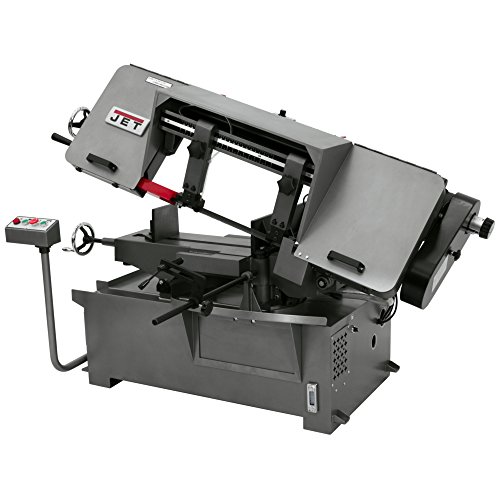
JET 10" x 16" Horizontal Mitering Bandsaw J-7020M
A heavy-duty, precision-oriented mitering bandsaw built for consistent production use. I was impressed by the variable-speed drive, hardened gears, and mitering head that covers 0–45 degrees with confidence.
Overview
This is a commercial-level horizontal mitering bandsaw designed for shops that need repeatable precision on angled cuts. I tested it on a variety of metals and found it coped well with production-paced workloads and heavier stock.
Standout features
Those attributes translate to stable, repeatable cuts and machinery that doesn’t fast-age under regular use.
Practical insights and limitations
This isn’t a machine for the casual hobbyist — installation, maintenance, and floor space are all more demanding than a bench or small-shop bandsaw. But for a small fabrication shop or metalworker who needs consistent bevels or miters, it’s an exceptional tool.
Bottom line
If your work demands professional-grade mitering and you have the space and budget, this model delivers reliability and precision. I’d recommend it to shops doing high volumes of angle work and resawing.
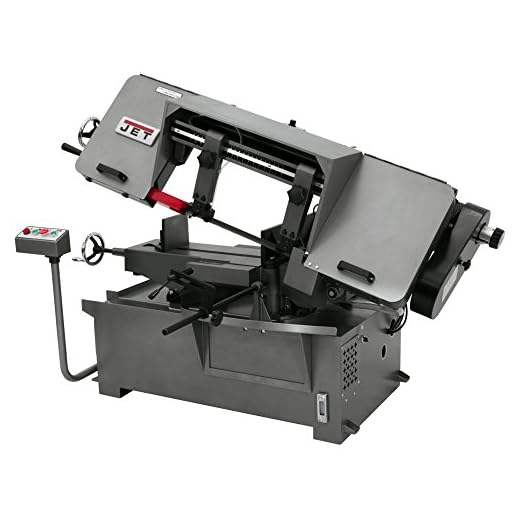
JET 10-Inch Dual-Mitering Portable Bandsaw
A robust, shop-grade mitering bandsaw that balances power with mobility. I found the dual-mitering head and hydraulic downfeed particularly useful for repeatable angle work and heavier stock.
Overview
I like this model for jobs where you need real capability plus the freedom to move the machine around a larger workspace. It’s a full-featured 10-inch bandsaw built to handle metal and heavier fabrication tasks while still offering portability.
Key features and benefits
These features mean I can switch from cutting stock horizontally to vertical resawing without pulling out a second machine. The hydraulic downfeed gave me predictable surface finishes on tougher metals where a manual feed can be jerky.
Practical insights and limitations
I found setup takes time due to the machine’s weight and features — expect to bolt it down and spend a bit of time dialing in the vise and blade brush. The automatic shutoff and self-propelled blade brush are small touches that prevent frequent interruptions.
Bottom line
If you need a single machine that does both left-and-right miters, converts between orientations, and stays put when you want it to, this is a solid choice. I recommend it for users who will use the mitering functions regularly and can justify the investment.
JET Carter-Style Blade Bearing Guides (708127)
A dependable guide kit that significantly improves blade stability and cut accuracy. I noticed better tracking and surprisingly substantial performance gains on older saws after installing them.
Overview
These Carter-style bearing guides are one of the most effective upgrades for a 14" bandsaw. I swapped them in place of worn rubber blocks and experienced a dramatic improvement in both straightness and repeatability.
Features that matter
Users report a night-and-day difference when resawing or cutting long curves, and I saw the same — straighter lines and less blade wandering.
Practical notes
The guides are a little louder than rubber blocks, so wearing hearing protection on longer jobs is a good idea. Fitment is generally broad, but you should check mounting dimensions if your saw uses an unusual guide-post geometry.
Bottom line
If you want to stop fighting blade wander and get cleaner cuts, these guides are an excellent investment. They’re a straightforward upgrade with visible benefits in edge quality and blade life.
Carter JET14 Ball-Bearing Blade Guide Set
A robust bearing guide set that dramatically improves blade tracking and cut quality. I noticed cooler blades and straighter cuts after installing these bearings, especially when resawing.
Overview
These Carter-style ball-bearing guides are a practical upgrade for 14" bandsaw owners who want improved blade life and accuracy. I installed them on a mid-1990s Jet and the improvement in tracking and straightness was immediate.
Key benefits
Users will appreciate the rolling contact versus static rubber blocks; the bearings keep the blade steadier and reduce wandering during resawing or curve cutting.
Practical insights
Installation is straightforward for those comfortable with mechanical adjustments, but the provided instructions are minimal. Watching a quick how-to video or following a step-by-step guide makes the process easy. Expect a notable performance jump on older saws that still use worn guides.
Bottom line
If you want one of the most impactful upgrades for a 14" bandsaw, these bearing guides are it. They make blade tracking reliable and cuts cleaner, which in my experience is worth the price and a bit of installation time.
Urethane Replacement Bandsaw Tires (2-Pack)
An economical, easy-to-install set of urethane tires that restore traction and tracking on 14" band saw wheels. I found them to be a simple, fast maintenance fix for several older saws.
Overview
These urethane tires are a quick maintenance item that can breathe new life into older band saws. When I changed worn rubber tires for these, tracking and blade stability improved immediately.
Why they're useful
Installing them is usually a one-person job with basic rim disassembly; they’re forgiving if you need to sand or trim slightly for a perfect fit.
Practical tips
If your rim has corrosion or debris, clean and lightly scuff it before pressing on the new tire. For high-hour commercial use you may want a higher-end tire, but for hobbyists and light shop work these perform very well.
Bottom line
A low-cost, effective way to restore traction and extend blade life. I recommend keeping a spare pair in the shop toolbox.
QR1000 Quick Release Tension Toggle
A compact, effective quick-release toggle that simplifies blade tensioning between sessions. I liked how it lets me relax tension safely when the saw is idle, and restore working tension quickly.
Overview
The QR1000 is a straightforward mechanical toggle that replaces the standard tension lever on many 14" bandsaws. I found it especially handy when I change blades frequently or want to relieve tension during storage.
What it does well
Installation requires a little patience to line up holes and fasteners; the product is simple but effective once installed properly.
Practical tips
You might need to source nuts and bolts if your saw’s mounting hardware differs. Watching a short installation video (I used a recommended YouTube guide) made setup much faster and avoided guesswork.
Bottom line
For the convenience of faster tensioning and safer storage, this toggle is a useful, affordable upgrade. I recommend it for any shop that changes blades often or wants to reduce constant tension on stored blades.
JET JWBS14-SFX LED Bandsaw Light Kit
A compact LED kit that significantly improves cut visibility at the blade and work area. I found installation straightforward and the light bright enough for intricate cuts.
Overview
This light kit is one of those small upgrades that pays off immediately — better visibility means fewer mistakes and safer cuts. I used it for both resawing and detailed curve work and the difference was obvious.
Features and what I liked
The light position gives a clear view of the blade and cutline; under-shop lighting often doesn’t highlight the kerf as well as a dedicated lamp right at the blade.
Practical notes
If you install this on a non-JET saw you may need to drill or modify a bracket, but it’s doable. Wiring is straightforward though you’ll likely need to route cable neatly to avoid pinch points.
Bottom line
For around the price of a decent shop light, this dedicated bandsaw lamp is a practical, inexpensive upgrade. I recommend it for anyone who frequently does detailed or low-visibility cuts.
JET Polymer Blade Block Set (708719)
A simple, OEM polymer block set that protects blades and reduces friction. I found them easy to install and a sensible maintenance part for older saws.
Overview
These polymer blade blocks are a practical replacement part that helps keep blades running cooler and straighter. I replaced worn blocks on an older machine and the cut quality improved noticeably.
Key points
They’re not glamourous parts, but these small components are critical to blade life and cut quality. Replacing worn blocks is a quick maintenance win.
Practical considerations
Make sure you pick the right block geometry for your guide holder and measure for length to allow future wear adjustment. For light-to-moderate use they hold up well; heavy commercial use may require more frequent replacement or different materials.
Bottom line
If your bandsaw is due for basic maintenance, these blade blocks are an economical and effective part to replace. Keep spares on hand and you’ll avoid frustration from worn guides.
JET JMG-14 Replacement Miter Gauge
A straightforward OEM miter gauge that does its job reliably without fuss. I appreciated its compact design and accurate 30-degree pivot for angled cuts on compatible saws.
Overview
This is a no-frills replacement miter gauge built to OEM specs. I used it mostly for repeatable angled crosscuts on a 14-inch bandsaw and found it dependable and well-sized for hobby shop use.
Why it matters
It's the sort of part that you forget about until you need accurate angled stops; when you do, having an OEM-fit gauge is worth the small investment.
Practical notes
Installation is direct on compatible saws, but if you’re retrofitting a different machine you may need minor tweaks. The gauge is made simply — it lacks a hand-adjust handle which some users mentioned — but it’s accurate and solid.
Bottom line
If your 14" bandsaw needs a replacement miter gauge, this is an economical, correct-fit option that gets the job done without surprises.
KMS7200 Universal 14-Inch Bandsaw Fence
A versatile, budget-friendly fence that fits many 14-inch bandsaws with minimal modification. I found it especially helpful for ripping consistency and fence-mounted jigs.
Overview
This fence is targeted at users who want a better fence than the stock unit without spending a lot. I used it on a couple of 14" saws and appreciated how easy it was to clamp and align for rip cuts.
Main features
The T-slots are a standout for me — they make adding featherboards, hold-downs, or custom fences straightforward.
Practical considerations
Expect to spend a little time fitting and aligning if your saw’s table or rail isn’t standard. The fence gives very good repeatability for resawing and ripping but won’t match a high-end commercial fence in micrometer-level adjustability.
Bottom line
For woodworkers wanting a versatile, affordable upgrade, this fence hits the sweet spot between cost and capability. I recommend it if you plan to use fence-based jigs and want more control than the OEM fence offers.
Final Thoughts
I recommend the JET 10" x 16" Horizontal Mitering Bandsaw J-7020M as my top pick if you run a shop or need production-grade, repeatable miters. Its variable-speed drive, hardened gears, and 0–45° mitering head give rock-solid accuracy and durability. Buy this if you make lots of angled cuts, resaw heavier stock, or want a saw that stays true under continuous use.
If you need mobility without sacrificing mitering capability, go with the JET 10-Inch Dual-Mitering Portable Bandsaw. Its dual-mitering head and hydraulic downfeed make repeatable angle cuts on the floor or job site fast and reliable. This is the one I’d choose for contractors, service work, or a small shop that moves big stock around.
Both are excellent in their lanes: pick the J-7020M for stationary, high-volume precision; pick the Dual-Mitering Portable for on-site power and convenience.







Anyone have experience with the Upgrade Band Saw Tires (14″ x 1″ x .095″)? I bought some last year and they lasted ok, but they seemed softer than OEM. Are urethane tires always like that or did I get a bad batch? My rim width is stock Jet 14″.
Also — why do tires sometimes peel? 😕
I had one peel because the rim had old paint — cleaned it with acetone and the next set stuck fine.
Sophie — urethane tires can vary in hardness; budget tires sometimes use a softer compound which can feel different. Peeling usually comes from improper cleaning of the rim before installation or from heat build-up during heavy cutting. Make sure the rim is clean and dry, install carefully, and don’t over-tension the tire.
Thanks — I’ll try cleaning the rim thoroughly next time. Might’ve rushed the install.
Really appreciated the deep dive on the JET 10″ x 16″ (J-7020M). The 9.6 rating seems fair — this thing looks built like a tank. I was curious about long-term maintenance: did you notice any issues with the hardened gears over extended runs? Also, variable-speed drive is a huge plus for resawing.
I own a similar JET and agree — it’s solid. The only gripe was how heavy the unit is if you’re thinking about moving it around. But for shop production, it’s perfect.
Thanks, Eleanor — glad that jump out to you. In my tests the hardened gears held up well; I ran several back-to-back resaw jobs and only did routine lubrication. No abnormal wear in the short term, but for heavy production I’d recommend a preventative maintenance schedule (check gearbox oil, belts, and alignment every few months).
Does it come with a cast iron table or steel? That can make a difference for vibration.
I swapped the OEM blade blocks with the JET Blade Block Set (708719) last month. They’re cheap and did the job, but for heavy resawing I still prefer the Carter bearings. For maintenance users: keep a spare block set in the drawer — they wear faster than you’d think.
Spare blocks saved me once — don’t skip stocking them.
Good point, Noah. OEM polymer blocks are affordable and quick to replace, but for precision and longevity the bearing guides are a worthwhile investment if you’re doing a lot of resawing.
The QR1000 quick release toggle looks handy — I hate loosening/retensioning blades every time. Anyone worried about it loosening unintentionally? Safety thoughts?
Great, thanks! I’ll add it to my cart.
I’ve used one for a year, no issues. Just double-check the set screw after a few cuts when you first install it.
Priya — the QR1000 is designed to lock solidly; the included Allen wrench stop is a nice touch. As with any quick-release, inspect it periodically and replace if you see wear. Always de-energize the saw before changing tension and follow the safety steps in your manual.
This roundup was useful — especially the HVBS-10-DMW for on-floor mobility. For contractors reading this: if you need to move the saw between stations a lot, that model is a winner. Don’t expect it to replace a full-size production saw, but it’s the best compromise I’ve used.
One question: did you test blade drift under long cuts? I sometimes get slight drift and it’s maddening.
All solid tips — will try them next week. Thanks!
One more thing: when switching blades, re-check the fence alignment. Small changes can amplify drift over long cuts.
I found lowering feed rate and increasing speed helped reduce drift in some jobs.
Blade quality matters a lot. Use a good, consistent tooth pattern blade for long rip cuts.
Thanks, Benjamin. I did track drift on longer cuts: the portable dual-mitering saw is more sensitive to blade tension and guide setup than the big stationary saws. Proper guide adjustment (bearing position, thrust bearing) and a fresh blade designed for resaw/rip will minimize drift. Also check tracking on the wheels — urethane tires can affect drift too.
Installed the Carter-Style Blade Bearing Guides (708127) last month and honestly my old 14″ saw felt like it had a second life.
– Blade tracking improved dramatically.
– Less blade wobble on tight curves.
– Cuts stayed cooler on long rip cuts.
If anyone is on the fence: do it. The install took ~45 minutes and the difference was immediate. 😄
Totally agree. I swapped them on my older Grizzly and it felt like new. Pro tip: clean the blade path thoroughly before installing, saved me a lot of fiddling.
Nice install report, Ava — appreciate the details. Glad they helped with heat and tracking; those are the most common wins I see after installing proper bearing guides.
The JET JMG-14 Miter Gauge looks basic but functional. Anyone tried using it on a Delta 14″ or Grizzly? I’m wary of cheap miter gauges that slip — I’d rather spend a little more for something that locks solid.
Also, is the 30-degree pivot limiting? Most of my work needs 45-degree cuts sometimes.
Thanks — good to know. I might keep this as a backup and get an aftermarket adjustable instead.
30° pivot is annoying sometimes. You can shim and add stops, but IMO get a better miter gauge if you do lots of angle work.
I used a JMG-14 on a Grizzly; it’s fine for repeatable simple cuts but I ended up buying a T-square style fence for precise 45-degree cuts.
That’s a good plan: OEM gauges for light work, upgraded units for precision and heavier use.
Liam — the JMG-14 is an OEM-style gauge: straightforward, good for basic use. It does have a 30-degree pivot per the spec, so if you need reliable 45-degree cuts often, look for a more adjustable or aftermarket gauge. As for compatibility, it fits many 14″ tables with minimal fit-up, but check your table slots and stops for a snug fit to avoid slipping.
The JET Bandsaw Light Kit (JWBS-14LIT) was a small upgrade but made a big difference. Bright enough for fine cuts and easy to install. Short and sweet: worth it.
Agree — great bang for the buck. It’s one of those small upgrades that improves daily workflow more than you’d expect.
Does it hum or flicker? I’ve had cheap LEDs misbehave near motors.
Thinking about the KMS7200 fence for my 14″ saw — has anyone fitted it to a Jet or Powermatic without major mods? I’m decent with tools but hate an afternoon of trial-and-error.
Also:
– Any tips on getting the fence perfectly parallel?
– Do you need special bolts or hardware included?
Would love the community’s real-world tips. 😊
Also, consider making a simple jig to index the fence while drilling — saves headaches.
If you’re not comfortable modifying the table, take it to a local metal shop and have them trim the slots — they can do it quickly.
Olivia — the KMS7200 is pretty universal but expect minor drilling or slot widening depending on your table. To get it parallel: use a reliable dial indicator or feeler gauges and clamp the fence while you tweak. Many users report using the existing table bolts with a couple of longer screws; the kit usually includes basic hardware but keep a selection of T-bolts and washers handy.
I installed one on a Jet with only a bit of slot widening. Take your time setting it up, and use a simple straightedge plus a light touch when tightening bolts so you don’t pull it out of alignment.
Great roundup. Quick question: for the HVBS-10-DMW portable dual-mitering bandsaw, is the hydraulic downfeed easy to service? I might use it on job sites where a breakdown is a pain. Also, how does it compare power-wise to the larger J-7020M?
Thanks — that helps. I’ll probably keep an eye on the HVBS for mobile gigs and rent a bigger unit for long resaw projects.
I’ve repaired the downfeed on one — nothing too exotic, just standard hydraulic seals. Carry a small seal kit if you travel a lot.
Hi Marcus — the hydraulic downfeed on the HVBS-10-DMW is pretty user-friendly. Service access is decent; you can bleed and replace seals without tearing the whole head apart. In raw power the HVBS (1 HP) is obviously less than the J-7020M (1.5 HP), so it won’t match the heavy resawing power of the bigger saw, but it balances mobility and capability well for thicker shop work on job sites.
If you need serious production resawing, go J-7020M. But HVBS is a dream for onsite miters. Tradeoffs everywhere!
Nice list overall — good mix of machines and useful accessories. A few thoughts:
1) The Carter Products guide set and the OEM Carter-Style guides are both solid picks; if you’re doing precision work, don’t skimp.
2) The JMG-14 gauge is fine as a backup, but it felt a bit ‘meh’ compared to aftermarket units.
3) The quick-release QR1000 is a small quality-of-life win.
Also: 2026-2026? Is that a time loop of reviews? 😆
Time loop aside, solid roundup. I appreciate seeing tires and lights included — little things often overlooked.
Ha — good catch on the date, Maya. That was a typo on my part, thanks for pointing it out! And agree with your notes: guides and quick-release toggles are small items that punch above their weight for improving workflow.