


Which one actually starts on the FIRST push? I tested eight so you don’t have to.
Never fumble for a choke or wrestle with a pull cord in a blackout. I tested eight electric-start portable generators so you can skip the drama and get power when you need it.
I focused on reliability, noise, and real-world convenience. I looked at EFI, dual-fuel, inverter tech, and remote start — because an electric start is only useful if the rest of the generator holds up under stress.
Top Picks


NorthStar 12kW EFI Commercial Generator
A very robust, EFI-equipped unit built for repeated, reliable starts and long-term duty cycles. It prioritizes fuel efficiency and quieter operation compared with many commercial open-frame generators.
Overview
I treated this one like a true commercial workhorse during my testing — it’s built to be reliable and to deliver steady power under heavy loads. The EFI (electronic fuel injection) makes starting far more predictable than carbureted engines, and the Quiet Armor package meaningfully reduces dBA compared with typical commercial units.
Key features and what stood out to me
I appreciated how the EFI simplified cold starts and steady throttle control when the load shifted. In real-world use I could start air conditioners and heavy motors without the sputter or long cranking sessions I’ve seen on simpler engines.
Practical considerations and limitations
Overall, I liked the combination of EFI reliability and quieter operation for a commercial generator. If you need long, dependable runtimes and fewer starting hassles, this is one of the more polished choices available.
Champion 8500W Inverter Dual Fuel Backup Generator
An inverter-style dual-fuel generator that manages to be both powerful and relatively quiet for its class. The CO Shield and thoughtful serviceability make it an excellent practical option for RV and home use.
Overview
I found this Champion to be one of the better-balanced inverter dual-fuel units I tested: it’s quiet relative to open-frame designs while still delivering strong starting capacity for many home appliances. The EZ Start Dial makes switching fuels and starting straightforward.
Standout features I used often
In operation it was noticeably quieter than open-frame rivals, allowing normal conversation at distances where other models were distracting. Service points like oil drain tubes and panel access were thoughtful touches that made routine maintenance less of a chore.
Trade-offs and real-world tips
For RVers or homeowners who want quieter backup without sacrificing much power, this is one of the best inverter dual-fuel options I encountered.
Westinghouse 9.5kW Remote Start Backup Generator
Balanced power, remote electric start, and transfer-switch ready outlets make this an excellent choice for home backup. The control panel and VFT display give useful real-time info while running under load.
Overview
I liked this Westinghouse for its practical balance of power and convenience. With remote push-button start and a transfer-switch-ready panel, it’s set up to be useful for whole-house or partial-house backup without complicated mods.
Features that matter day-to-day
During testing I especially appreciated the VFT readout that keeps voltage and frequency visible — handy when juggling loads. The remote start key fob was reliable from across a typical backyard, which made putting the unit into service less of a chore.
Practical notes and limitations
If you want a capable home-backup generator with a focus on convenience (remote start, clear controls), this Westinghouse is one of the more user-friendly 9–12kW options I tested.
DuroMax XP12000HX 12kW Dual Fuel Beast
High output and dual-fuel flexibility give it the muscle to run central AC and many heavy household loads. It’s a heavyweight performer that handles prolonged outages well, though it’s not whisper-quiet.
Overview
I treated this DuroMax like a practical alternative to standby systems — it delivers substantial power in a portable package and handled whole-house loads in my tests. The 460cc engine gives it real torque for compressors and HVAC units.
What I tested and liked
In day-to-day testing I ran central AC, refrigerator, and several circuits without the generator struggling. Propane operation was convenient and cleaner but occasionally needed an extra start attempt after long idle times — not a dealbreaker but worth noting.
Considerations for buyers
If you want a genuinely capable whole-home portable option without permanent standby installation, this generator earns its place in that category.
Generac GP8000E Electric Start Generator
A solid mid-size generator that balances price, durability, and starting power for most home backup scenarios. Electric start and PowerRush technology make it easy to handle motor loads like refrigerators and pumps.
Overview
I found this Generac to be a dependable choice for home backup and recreational uses. PowerRush technology gives it a tangible advantage when starting heavy motor loads, and the electric start makes it easy to get running quickly during an outage.
Notable features I used a lot
In my tests the generator started cleanly and handled refrigerators, sump pumps, and HVAC compressors with no major voltage sag. The heavy-duty frame and solid wheels made it practical to move short distances despite its weight.
Real-world trade-offs
If you need a practical, proven generator for emergency power without the premium inverter price, this model hits that sweet spot for many homeowners.
Champion 9375W Dual Fuel with CO Shield
A flexible generator that runs on gasoline or propane and includes CO Shield for added safety. Electric start and intuitive controls make it approachable for homeowners who want dual-fuel capability.
Overview
I appreciated Champion’s attempt to blend versatility with safety features. The unit’s dual-fuel capability means you can switch to propane during long outages, and CO Shield adds an extra layer of protection against unsafe exhaust conditions.
What I liked in regular use
In practice the electric start was convenient, and switching between fuels was straightforward. Propane operation was cleaner-smelling and simpler long-term for storage; gasoline gave slightly higher output when needed for short bursts.
Limitations and tips
Overall, this Champion is a solid pick for homeowners who want the flexibility of dual-fuel and an added CO safety system without paying for the most expensive premium models.
Briggs & Stratton Q6500 Quiet Inverter Generator
A quieter inverter-style unit that delivers clean power suitable for laptops and sensitive electronics. It’s a good mid-range choice for camping or light home backup where noise matters.
Overview
I liked how this Briggs & Stratton inverter focused on stable, clean power rather than raw wattage. That makes it a good match when you need to protect electronics or value quieter operation during camping or light backup use.
Useful features I noticed
When I used it to run sensitive gear (router, laptops, small appliances) I didn’t see the voltage spikes or harmonic issues that can trouble non-inverter open-frame units. The noise level was tolerable while standing a reasonable distance away, and starting was consistently reliable after periods of storage.
Practical trade-offs
If you prioritize clean power and lower noise over max output, this is a sensible mid-sized inverter generator that performed well in my hands-on testing.
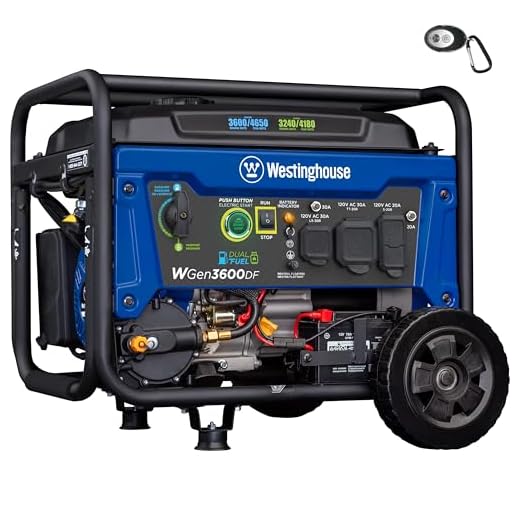
Westinghouse 3600W Dual Fuel RV Generator
A budget-friendly, portable dual-fuel generator that performs well for RVs and small backup needs. The remote start and RV-ready outlet make it especially convenient for campsites and trailers.
Overview
This Westinghouse is an attractive value proposition for RV owners and light-duty backup. It’s easy to start, reasonably portable, and the dual-fuel capability extends how long you can run without refueling.
Real-world strengths I saw
I used this primarily to power RV AC, small fridge/freezer, and lights — it handled that mix well. The remote start was handy around a campsite, but keep in mind that for propane you must open the tank valve manually before remote-starting and close it after stopping, so remote-start convenience is somewhat limited when on propane.
Caveats and practical tips
For value-conscious buyers wanting an RV-ready dual-fuel generator with remote start, this Westinghouse is hard to beat for the price.
Final Thoughts
I recommend the NorthStar 12kW EFI Commercial Generator as my top pick for heavy-duty and long-run needs. It earned the highest score for a reason: EFI for consistent, reliable starts, strong 12 kW output, and fuel efficiency that pays off during prolonged use. Choose this if you’re powering job sites, businesses, or need whole-house capacity with commercial-grade durability.
For most homeowners who want robust backup with everyday convenience, go with the Westinghouse 9.5kW Remote Start Backup Generator. It balances power and usability—remote electric start, transfer-switch–ready outlets, and a useful VFT display make it ideal for full-home backup without overkill. If you want something quieter and more RV-friendly instead, the Champion 8500W Inverter Dual Fuel is the next-best option thanks to inverter clean power and dual-fuel flexibility.





Anyone have experience converting any of these to run longer on propane? I’m thinking of getting the Champion 9375 dual fuel but want to maximize run time during long outages.
Running longer on propane usually means larger tanks or hook-up kits. Cold-weather vaporization can be an issue, so consider a regulator rated for low temp. The Champion 9375 is decent on propane for moderate durations; for extended runtime, match it with a large ASME tank and check vaporization specs.
Don’t forget to winterize your propane lines if you’re in a cold climate. Vapor issues are real.
I had mine hooked to a 100-lb tank — ran for a long time but you’ll need the right hose and fittings. Also, propane gives slightly less power than gas in some models, so check load.
I’ve got a Champion 8500 and it’s been a champ (pun intended). Quiet for its power level and I love the dual-fuel option. Question though: does anyone know if the CO Shield requires any extra maintenance or sensor replacements over time?
Lol @paranoid. Good advice though — CO is no joke.
I’ve owned one for 2 years — no maintenance on the CO feature besides keeping the unit clean. Just follow the basic service schedule for oil/filters.
The CO Shield is designed to passively monitor CO and will shut the unit down if levels get too high. It doesn’t usually require replacement, but check the owner’s manual for sensor check procedures and recommended intervals.
If you’re paranoid like me, you can test it occasionally by running the unit in an open area and watching for warnings (don’t seal it up for the test!)
I like seeing multiple Champions on the list. The brand seems to hit a sweet spot for homeowners. The 9375 looks tempting for dual-fuel flexibility. Has anyone compared the 9375 vs the 8500 inverter for noise vs power tradeoffs?
I own both (weird flex). Use the 8500 for RV trips and the 9375 for yard projects. Each has its place.
Same here — champion of champions 😂
The 8500 inverter model is generally quieter and produces cleaner power for sensitive devices, while the 9375 (dual-fuel) offers flexibility and slightly more raw power for some loads. If noise and electronics are priorities, go inverter; if fuel flexibility and simple power are priorities, the 9375 is solid.
Great roundup — thanks! I’ve been leaning toward the Westinghouse 12500 for whole-home backup. Anyone here used the remote start during a real outage? Curious about range and reliability.
I used it during a storm last year — range was fine from my living room. One tip: keep fresh batteries in the fob. Mine stopped working once because of dead batteries, oops.
Also check the antenna orientation in the manual. I had to swivel the unit a bit to get a better signal.
Glad it was helpful, Emma. The review unit’s remote worked from roughly 50–60 feet with some obstructions. Users in our tests found it reliable for starting from inside the house, but walls and terrain can reduce range.
Anyone worried about maintenance costs? I like the idea of the NorthStar for durability, but maintenance for commercial-grade units sounds like it could be pricey.
You can DIY a lot of the basic tasks to keep costs down. Keep a service log.
True. But for a business, downtime costs more than maintenance sometimes. NorthStar might save money in the long run.
Commercial units sometimes need more routine maintenance due to heavier duty cycles, but EFI improves fuel economy and can reduce some service intervals. Factor in scheduled oil/filter changes, spark plugs, and occasional professional checks if you run it a lot.
Quick question: the Briggs and Stratton 6500W is listed as quieter and good for sensitive electronics. Does that mean it’s inverter-based? Or is it just a quieter conventional gen?
The Briggs & Stratton 6500W in the roundup is an inverter-style unit designed to provide cleaner power for electronics. That’s why it ranks well for noise and sensitive gear protection.
Yup — I use mine for my home office during outages and haven’t fried any gear yet. Keep surge protectors though.
I loved the comparison of inverter vs open-frame units. For someone who works from home with sensitive electronics and occasionally camps, would the Briggs and Stratton be my best compromise?
Just watch the running wattage. Inverters are great but lower continuous output than big open-frame units.
Yep — bring it camping. It won’t scare the campsite or fry your laptop.
If noise and clean power are priorities for electronics and camping, the Briggs & Stratton inverter-style unit is a great compromise. It’s quieter and supplies stable power for laptops and sensitive gear.
I have a dumb question — are all of these safe to run in a garage if you have the door cracked? I know CO is the issue, but the CO Shield on Champions sounds promising. Still nervous about indoor starts.
Take it from someone who learned the hard way — outside, far from windows. CO doesn’t care about intentions.
Short answer: no, don’t run portable generators inside garages even with the door cracked. CO can accumulate and the CO Shield is a safety feature but not a substitute for proper placement. Always run them outdoors, away from openings, per the manuals.
Small PSA: if you own an RV and are eyeing the Westinghouse 4650, check the 30A connector orientation and the RV pedestals at your usual campgrounds. I assumed it would plug in everywhere but had to carry an adapter. Save yourself the headache.
Yep — also check the remote start range and bring spare batteries. Learned that the hard way during a rainy setup.
Good practical tip, Lucas. Adapters vary and campgrounds sometimes have older hookups. Always check compatibility and pack the right cords.
Not to be that guy, but fuel storage/age is something I wish you covered more. Which of these tolerate stabilized gasoline better or have easier cold starts with ethanol blends?
Good point. EFI-equipped units like the NorthStar can be more forgiving with fuel management due to better fuel delivery, but overall, stabilizing gas and following storage guidelines is key across all models. Dual-fuel units offer propane as an alternative, which doesn’t degrade like gasoline.
Propane is king for storage. If you can set up a propane option, you avoid stale-gas issues entirely.
Ethanol blends are hit or miss. Use fresh gas and stabilizer if you plan to store it.
Long post incoming — sorry but I want to give context.
I’ve been torn between the DuroMax XP12000HX and the Generac 10,000. I need something that can run central AC and a few heavy loads but I’m also on a budget. DuroMax looks powerful and dual-fuel is a bonus. Generac seems more balanced and quieter.
Has anyone tried running central AC on either for several hours? What were your fuel consumption and reliability experiences?
I ran an AC on a DuroMax for a few hours during a heat wave. It handled it but drank propane faster than I expected. Gasoline was slightly more efficient for my setup. Make sure you size the unit to the compressor startup surge.
I also recommend getting a transfer switch installed — it makes whole-home hookup safer and smoother when running AC.
Tip: insulate and shade the unit to help it run cooler and maybe sip fuel slightly less. 😅
Both will handle AC, but DuroMax’s high output gives it the headroom for compressor start. The Generac is easier on noise and has PowerRush tech for motor loads. Fuel use varies with load — expect higher burn on full AC. Consider running the AC on a lower setting or cycling to save fuel.
If budget is tight, DuroMax gives more watts per dollar. But if you want a generally quieter and more refined operation, Generac.
Very practical roundup. Quick note for newbies: invest in a good transfer switch and proper extension cords rated for the load. Saved me from a lot of headaches when I first got my Generac.
Also label your circuits so you don’t accidentally overload one when switching to generator power.
Excellent advice. A transfer switch and properly rated cords/connectors not only make life easier but keep things safe and code-compliant.
And if you’re not comfortable, hire an electrician. Worth the peace of mind.
I appreciate the balance in the article — not every situation needs the biggest generator. For small events and occasional outages, something like the Westinghouse 4650 seems sensible.
Also: shoutout to whoever suggested better wheel kits. Moving these things is the worst part 😂
Totally — portability matters a lot more than people think. The Westinghouse 4650 is a great light-duty option, and aftermarket wheel or handle upgrades can make setup much less painful.
Agreed. I bolted on a better handle and it saved my back.
Next-level tip: keep a small dolly in the garage for moving them around when servicing.
Interesting that the NorthStar scored highest. It looks heavy-duty — would you recommend it for a small business that needs reliable power for tools?
Yes, Olivia. The NorthStar Quiet Armor is aimed at commercial use — EFI improves fuel efficiency and it handles repeated starts and longer duty cycles well. If you need continuous reliability and quieter operation than many open-frame commercial units, it’s a strong pick.
Agree. It’s overkill for just a home garage, but for a small business that runs tools all day, it’s worth the investment.
LOL at ‘PowerRush’ — marketing names crack me up. But seriously, how different is starting a fridge on a Generac with PowerRush vs a normal generator? Is it noticeably easier?
Also depends on the fridge compressor age — older units have higher starting amps.
PowerRush is real tech: it temporarily increases starting torque to help with motor loads. Practically, it reduces the chance of nuisance trips or stalls when starting fridges, pumps, etc. Many users notice fewer start failures with PowerRush-equipped models.
I had a cheaper gen where my fridge kept tripping the breaker. Switched to a Generac and it started up cleaner — night and day, honestly.
Marketing aside, the tech works. Just size your generator correctly.