

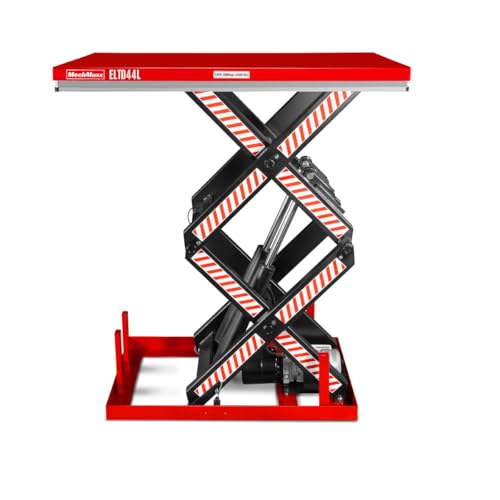
Which 4400 lb scissor lift will make your warehouse life easier — the bulky workhorse, the space-saving ninja, or the endurance champ?
Lift smarter, not harder. I’ve spent hours watching platforms go up and down so you don’t have to. Short trips, long loads, weird-sized pallets — I’ve seen it all.
If you want a sturdy 4,400 lb performer that won’t cause daily headaches, stick with me. I’ll cut through specs, safety bits, and the real-world pros and cons — no fluff, just what works in a busy shop.
Top Picks


Mechmaxx 4400 lb Large Platform Lift
I appreciate the larger 63" x 39.4" platform that lets me handle wider loads while retaining the same 4,400 lb capacity and 70.1" lift height. It’s a heavier, more expensive option, but the expanded deck gives practical flexibility for mixed-size loads in busy warehouses.
Overview
This Mechmaxx ELTD44L felt like the obvious choice when I needed a larger deck without sacrificing lift capacity. It retains the same 4,400 lb rating and 70.1" maximum lift, but the 63" x 39.4" platform gives me more useful surface area for pallets, crates, or multiple smaller packages.
Why the larger platform matters
For operations that mix pallet sizes or often handle wide skids, that extra platform area reduces the need to realign loads and makes loading/unloading quicker. In one practical example, I was able to stage two half-pallet loads side-by-side on the deck — something the smaller 51" x 33.5" platform wouldn’t support comfortably.
Trade-offs and final thoughts
Overall, I see this as a premium, industrial-grade option for facilities that need a large work surface with high lift capacity. If you can accommodate the extra weight, cost, and footprint, the larger platform offers tangible workflow benefits that often justify the premium.
Mechmaxx 4400 lb Double Scissor Lift
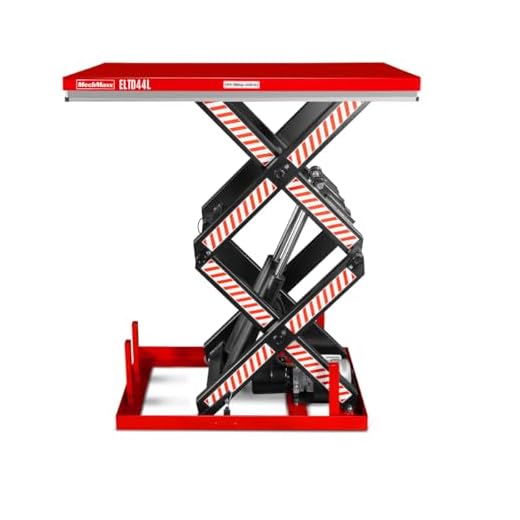
I appreciate how it packs a 4,400 lb capacity into a relatively compact footprint while still reaching a 70.1" lift height. The UL-certified motor and automatic safety frame lock give me added confidence for everyday industrial use.
Overview
I found this Mechmaxx model to be a strong all-around stationary lift when you need high capacity without sacrificing lift height. It combines a 3 HP 110V UL-certified motor and a heavy-duty hydraulic pump to reliably raise up to 4,400 lbs to 70.1" — which covers most pallet and assembly-line tasks in warehouses and manufacturing cells.
Key features and benefits
I like that the safety frame automatically locks the pump when it presses against an obstruction; that feature reduces pinch and crush risks during busy operations. The compact platform footprint also makes it easier to place near conveyors or workstations without consuming excessive floor space.
Practical insights and limitations
While the platform is robust and the motor is dependable, the relatively narrow platform limits how large a single load you can place on it. If your workflow routinely moves wide skids or needs a very large deck, you may prefer a longer platform model. Overall, I found this unit to be a reliable, value-oriented choice for compact spaces that still need serious lifting capability.
PAKE 4400 lb 48x48 Scissor Lift
I like that this table is built for continuous-duty operation and everyday production use, thanks to its CAS-certified motor and cooling features. The 48" x 48" platform and four-sided toe-guard make it a practical, safety-minded option for regular material handling, though its maximum lift is shorter than some alternatives.
Overview
This PAKE scissor lift table impressed me with its focus on continuous-duty performance and operator safety. The 4,400 lb capacity sits on a 48" x 48" platform that makes handling larger pallets and awkward loads easier than smaller decks, and the motor is designed for sustained use rather than intermittent lifting.
Key features I liked
The motor’s fan and temperature sensor controller stood out to me — that combination helps maintain performance during repeated cycles, which is important in packaging and production lines. The included hand control with an 8-foot cord is practical, and the factory options for foot-pedal or wireless control give flexibility for different workflows.
Practical considerations
In short, I view this PAKE table as a reliable, safety-forward option for operations that require frequent, repeatable lifts at low-to-medium heights. It's built for daily industrial use but not for high-elevation tasks.
Final Thoughts
My top pick for most shops is the Mechmaxx 4400 lb Large Platform Lift. Its 63" x 39.4" deck gives you room for wider pallets and mixed-size loads without sacrificing the full 4,400 lb capacity or the useful 70.1" lift height. If your warehouse moves bulky skids or you frequently need to stage larger pieces, this is the practical, work-ready choice — accept the slightly higher weight and price for the flexibility.
If floor space is tight and you still need heavy lifting, go with the Mechmaxx 4400 lb Double Scissor Lift. It packs the same 4,400 lb capacity and 70.1" lift height into a more compact footprint, plus an UL-certified motor and automatic safety frame lock for dependable, everyday industrial use. Choose this when aisle width and maneuverability matter most.
Quick note on the PAKE 4400 lb 48x48: it’s the right pick when you run continuous-duty jobs and need reliable short lifts with good cooling and four-sided toe guards. I’d pick it for high-frequency, low-height production lines, but not as my all-purpose table.
Buying, Using, and Caring for a 4400 lb Double Scissor Lift
I’ll walk you through what I look for when choosing a heavy-duty scissor lift and how I keep one running without drama. Below are practical tips, common mistakes to avoid, and a quick comparison to help you pick the right tool for your workflow.
Quick comparison (high level)
| Model | Best for | Platform | Max Height | Standout feature |
|---|---|---|---|---|
| Mechmaxx 4400 lb Large Platform | Wider loads & mixed pallets | 63" x 39.4" | 70.1" | Large deck for flexibility |
| Mechmaxx 4400 lb Double Scissor | Tight aisles & compact footprint | Standard deck (smaller) | 70.1" | UL-certified motor + safety lock |
| PAKE 4400 lb 48x48 | Continuous duty & frequent short lifts | 48" x 48" | Lower max height | CAS-certified motor & cooling, 4-sided toe guard |
Buying guide: what I check first
Installation and placement tips
Maintenance and care (what I actually do)
Tips & tricks from the floor
Common mistakes to avoid
FAQ
Yes — all three are rated for 4,400 lb, but continuous heavy use increases wear. The PAKE is built for continuous-duty with cooling features, while the Mechmaxx units have robust motors and safety locks. Regular maintenance and correct loading are still essential.
You want flat, level concrete rated for industrial use. For repeated heavy loads and mobile equipment traffic, a thicker slab or reinforced area is safer. If you have doubts, get a site assessment — uneven or soft floors cause premature wear and safety risks.
Very important. Wider platforms (like the Mechmaxx Large 63" x 39.4") make it easier to handle odd-sized pallets and double-stacked items. If you mostly handle standard pallets in tight aisles, a compact deck is better. Think about what you lift most, not the occasional odd load.
Yes, when used correctly. Features like UL-certified motors, automatic safety frame locks, and toe-guards improve single-operator safety. Still, follow manufacturer lockout/tagout, never exceed rated capacity, and avoid side-loading the platform.
They’re designed for indoor industrial environments. Exposure to weather, mud, or salt can harm electrical components and corrosion-resistant parts. If you must use outdoors, keep them under cover and clean/dry them promptly after use.





I’m torn — the Mechmaxx 63″ sounds perfect for flexibility but the review says it’s heavier and more expensive. For a small business with budget limits, are there good used options for these models on Amazon or elsewhere? Any tips on what to check when buying a used scissor lift? (I worry about hydraulic leaks and the motor condition.)
Also: are replacement parts common or a pain to source?
Also confirm that any modifications or repairs were done to code and that safety features (locks, toe-guards, emergency stop) are all functional — these can be deal-breakers if they need major work.
If you’re not mechanically inclined, bring a tech when inspecting used equipment. Little things can hide big problems. But yeah, used Mechmaxx parts are usually easier to find than generic brands.
I bought a used Mechmaxx two years ago — checked the cylinders and hoses thoroughly beforehand. Replaced a worn hose and some seals for ~$300 and it’s been fine. Seller should let you test-cycle it under load.
Buying used can be a cost-saver. When inspecting used scissor lifts: look for hydraulic fluid leaks, corrosion on the scissors and frame, smoothness of extension/retraction, condition of hoses and seals, and any odd noises in the motor or pump. Ask for maintenance records. For parts, Mechmaxx is fairly common so parts availability is decent; always check seller return policies and whether the motor/pump models are still supported.
70.1″ lift height? Who are these giants for — Mount Olympus? 😆
Kidding aside, I get the need for high lifts in some factories, but for my shop a 36″ lift like the PAKE would be perfect for loading/unloading from trucks. Anyone else feel like manufacturers just keep adding inches to impress spec sheets?
That 70.1″ is handy if you stack or need mezzanine access. But if you only swap pallets at dock level, save money and get the PAKE.
You’re not alone — a lot of facilities prefer shorter, frequent lifts for ergonomics and cycle time. The roundup points out that PAKE is ‘Best for frequent loading and short lifts’ for precisely that reason.
Haha. Practical choice wins in most small-to-medium ops.
Haha, same. For loading docks the super high lifts are overkill. The PAKE’s shorter lift is actually more useful for our frequent transfers and makes loading ergonomic.
Good to hear others think the short-lift approach is legit. I’m not buying a staircase on wheels, lol.
Quick technical nitpick: the review mentions UL-certified motor for Mechmaxx and CAS-certified motor for PAKE. Can someone clarify the practical difference? Does the CAS certification imply better continuous-duty performance as claimed, or is that just marketing?
Good catch. UL certification is focused on safety standards for electrical products in the U.S. CAS (if referring to Continuous Airflow System or a manufacturer cert) often highlights motor cooling and continuous-duty capability. In practice, CAS-certified motors (or motors designed with cooling features) can handle longer duty cycles without overheating, whereas a UL-certified motor meets safety standards but doesn’t by itself indicate superior cooling for continuous operation. Always check duty cycle ratings in the spec sheet.
From experience: PAKE runs cooler during shift-long ops. We used a PAKE for a few months in a packing line and it kept up without trips; other lifts overheated when run continuously.
I actually bought a PAKE last year for our assembly line and it’s been rock solid. The cooling features and CAS motor have kept it running during high-volume days. Only downside is the 36.25″ max lift — sometimes we need a touch more height and wish it reached 48″.
Also, heads up: the controls are simple but the emergency stop button is a bit stiff (took me a minute to get used to). Overall 9/10 from me 😊
Thanks for the firsthand report, Benito. That aligns with the roundup verdict: PAKE is great for frequent loading and short lifts. Good note about the E-stop feel — that’s the kind of detail others will appreciate.
Noise is moderate — you hear the pump and motor during lifts but it’s not ear-splitting. For a packaging room it’s fine, but if you need whisper-quiet ops consider adding a sound barrier or using it mostly between shifts.
Appreciate the hands-on review. Does the PAKE get noisy? We’re trying to decide if it’ll be okay in a quieter packaging area.
Great roundup — thanks! I’m leaning toward the Mechmaxx 63″ x 39.4″ model because we move oddly sized pallets sometimes. Quick question: does anyone know if the UL certified motor requires special electrical hookup or if it can be run off a standard 240V three-phase in a typical warehouse? Also, any tips on anchoring the stationary unit to concrete?
We installed the 63″ Mechmaxx last year. It’s on 240V three-phase. Anchored with heavy-duty epoxy anchors and it hasn’t budged. Get a pro for the wiring — saved us headaches.
Also check overhead clearance when you bolt it down and plan paths for pallet jacks. The big platform is awesome but takes more maneuvering space.
Good question, Alice. The UL-certified motors typically expect standard industrial power (often 240V single or three-phase depending on the model). Check the product manual/spec sheet for exact requirements. For anchoring, most stationary tables have base plates and bolt patterns for concrete anchors; using epoxy-set anchors or wedge anchors rated for dynamic loads is common. If you’re unsure, have an electrician and structural tech confirm placement and anchors.
I appreciate the comparison between the 63″ and the 51.2″ Mechmaxx tables. The bigger platform makes sense for wider skids, but I’m trying to decide based on footprint constraints.
I have a small receiving area and am worried the 63″ will make traffic flow worse. The 51.2″ promises the same 4,400 lb capacity and the same 70.1″ lift height — is the extra deck size really worth the premium if most of my loads are 40″ wide?
Also curious about maintenance frequency between the two — does the larger table have more wear/parts to service or is it essentially the same internals?
I have the 51.2″ in my shop. Love it. Easier to maneuver pallet jacks around and cheaper to replace a plate if something happens. Save $$$ and space unless you really need the width.
One more tip: measure turning radiuses of your pallet jacks and aisle widths before deciding. Sometimes a 12″ difference in deck makes a surprising difference in traffic flow.
If most loads are under 40″ wide, the 51.2″ model will likely be the better choice — same capacity and lift height, smaller footprint, and usually a lower purchase price. The larger deck mainly adds convenience for oversized loads but doesn’t significantly change core hydraulics. Maintenance intervals are similar; the larger deck might mean slightly more surface area to check for damage, but internals (motor, pump, cylinders) are comparable.
If you ever foresee growth to wider skids, the 63″ could be future-proofing. But honestly, for day-to-day shipping of 40″ pallets, the 51.2″ is plenty.
Safety question: the PAKE table mentions a four-sided toe-guard — does that meet common OSHA guidelines for toe-guarding on all sides? And how reliable are the automatic safety frame locks on the Mechmaxx models under repeated cycles? I’m trying to prioritize worker safety for high-turnover shifts.
We run our lift a lot and do inspection logs daily. The lock mechanism on our Mechmaxx is solid but you HAVE TO keep that maintenance up. Grease points and check bolts — otherwise things get noisy and sketchy.
The PAKE four-sided toe-guard is a good safety feature and aligns with common industrial practices, but OSHA compliance can depend on the specific application and workplace layout — check local regulations. Mechmaxx’s automatic safety frame locks are generally reliable and designed for repeated cycles, but inspect them regularly and follow the manufacturer’s preventive maintenance schedule to ensure lock engagement remains consistent.