


Which 80-Gallon Two-Stage Will Keep Your Shop Humming (and Your Neighbors Less Annoyed)?
I love a compressor that runs like a champ and hides in the corner.
You’re in the middle of sanding, painting, or firing up three tools at once. You need AIR that is RELIABLE, serviceable, and doesn’t quit when demand spikes. I value quiet where possible, but I value uptime more.
I dug into eight 80-gallon two-stage units and focused on real shop needs: longevity, steady CFM, serviceability, and practicality. Short verdicts ahead. No fluff. Just what I’d buy for a real workshop.
Top 8 Picks




Campbell Hausfeld 80-Gallon Horizontal 5HP
I recommend this for primary shop air where reliability and serviceability matter; its cast-iron pump is built to deliver thousands of hours of run-time. The horizontal layout is easy to service and install in many shop configurations.
Overview
I regard the Campbell Hausfeld CE7050 horizontal 80-gallon compressor as a classic shop centerpiece: heavy-duty, serviceable, and designed to be the primary air source for automotive and light industrial shops. The horizontal tank and cast-iron pump are built for longevity and straightforward maintenance.
Key features and benefits
The horizontal arrangement simplifies piping runs and routine service access — features mechanics and shop owners appreciate when uptime matters.
Limitations and practical notes
It takes significant floor space and weight-bearing capacity, so plan shop layout and foundation in advance. Noise and vibration are normal for cast-iron two-stage pumps; I recommend placing it where noise and vibration are least disruptive.
Bottom line
If you want a dependable, long-running compressor to be the heart of your shop, this Campbell Hausfeld horizontal unit is one of the most practical and proven choices I’d recommend.
Industrial Air Vertical 80-Gallon Two-Stage
I like this for heavy shop use — the cast-iron pump and Baldor motor offer proven longevity and steady CFM delivery. It’s a good pick when you need reliable multi-tool performance with ASME-certified safety standards.
Overview
I consider the Industrial Air IV5048055 to be a solid, no-nonsense shop compressor built around longevity. The vertical cast-iron two-stage pump and Baldor motor make it a workhorse for repair shops, small fabrication shops, and professional garages that need dependable, continuous performance.
Key features and benefits
Those specs mean fewer slowdowns during high-demand tasks and less downtime for maintenance. The motor and pump combination target longevity rather than the lowest initial price.
Limitations and practical notes
The unit’s weight and size mean you should plan for professional delivery and a dedicated floor footprint. It’s also on the louder side compared with modern “quiet” compressors, so shop placement and hearing protection are practical considerations. Shipping there have been occasional negative delivery experiences, so insist on proper handling.
Bottom line
If you need steady high-CFM performance and a compressor built to last under frequent, heavy use, this Industrial Air model is a dependable option I’d recommend for professional settings.
Campbell Hausfeld 80-Gallon 2-Stage 3-Phase
I respect the design choices that favor longevity — a cast-iron two-stage pump and NEMA-rated motor make it ready for daily shop service. It’s a great fit for established shops with three-phase power and heavy workloads.
Overview
I view this Campbell Hausfeld 80-gallon vertical two-stage as engineered for professional and commercial environments. The 3-phase motor and commercial-grade construction target shops and operations that run daily and require dependable compressed air for a variety of pneumatic tools.
Key features and benefits
This combination gives steady airflow for simultaneous tool use and a design that emphasizes reduced downtime and safe operation.
Limitations and practical notes
The biggest caveat is electrical requirements: three-phase service is common in shops but not every garage has it. If you don’t have three-phase power, you’ll need an inverter or service upgrade, which adds cost. The unit is heavy and will require appropriate delivery and mounting.
Bottom line
If you run a regular shop and have three-phase power, this model is a solid commercial pick that balances CFM, pressure, and robust construction for long life.
Campbell Hausfeld 7.5HP Vertical 80-Gallon
I value the vertical footprint for shops where floor space is limited and still want strong two-stage performance. It’s a solid industrial option that balances power and practicality for high-demand tasks.
Overview
I see this Campbell Hausfeld vertical 80-gallon compressor as tailored to commercial or shop environments where floor real estate is a premium. The 7.5 HP two-stage design gives it the muscle for continuous use while the vertical format keeps the footprint compact.
Key features and benefits
For shops that need power without sacrificing valuable floor area, the vertical Campbell Hausfeld is a practical compromise: strong output in a tighter package.
Limitations and practical notes
Expect typical industrial noise and the need for a solid, level mounting area. This isn’t a light plug-and-play consumer unit — it’s intended for users comfortable with heavier equipment and standard safety checks. I also recommend verifying the electrical configuration for your facility before purchase.
Bottom line
If you need a powerful two-stage compressor but have limited floor space, this is one of the better vertical designs to consider — reliable performance in a compact footprint.
Horizon 5HP 80-Gallon Two-Stage
I appreciate its industrial-focused design and robust components that suit a busy shop environment. It balances capacity and durable construction for long-term reliability in medium-to-heavy applications.
Overview
I see this Horizon-branded 5HP 80-gallon two-stage unit as a shop-focused machine that prioritizes longevity and steady performance. It’s built to sit in a garage or small industrial environment and provide reliable compressed air for multiple tools and intermittent heavy use.
Key features and benefits
Those features translate to practical benefits: fewer motor starts during cyclical work, stronger recovery for air-hungry tools, and less chance of pressure drop under multi-tool loads.
Limitations and practical notes
I’d flag price and availability as the main trade-offs here. The unit sits at a higher price point, which is appropriate if you value longevity and heavy-duty parts, but may be harder to justify for occasional users. I also recommend confirming local service/support options before buying — heavier units like this benefit from nearby parts and techs.
Bottom line
I’d recommend this model if you need a robust, long-lived vertical compressor and are prepared to invest for durability. For casual use or tight budgets, you’ll find less expensive options that trade some longevity for lower upfront cost.
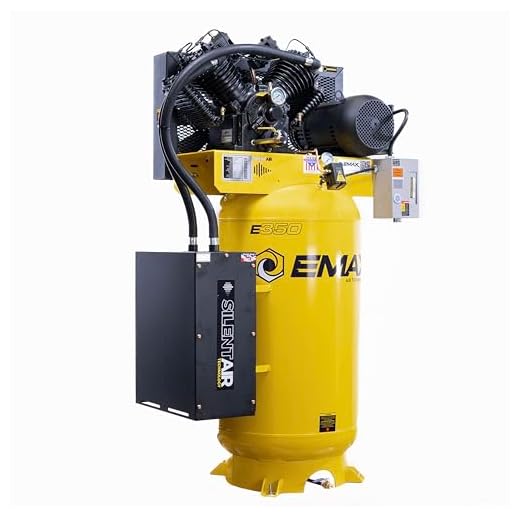
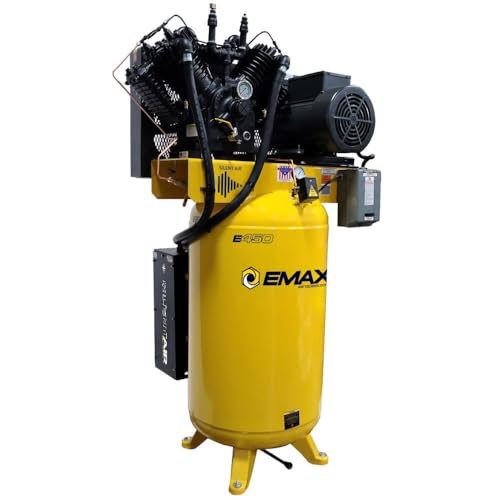
EMAX 7.5HP 80-Gallon Quiet System
I like that it pairs a strong motor with sound-mitigation features, making it suitable for workplaces where noise matters. It’s a heavier industrial unit, so installation planning and space are important considerations.
Overview
I see the EMAX E350 as a product that tries to bridge industrial throughput with quieter operation. The combination of a 7.5HP motor, pressure-lubricated pump, and a claimed whisper-quiet system make it attractive to larger shops that also care about operator comfort.
Key features and benefits
If you’ve got a larger shop but want to reduce the normal roar of heavy compressors, this model attempts to deliver both power and a more tolerable sound profile.
Limitations and practical notes
The unit is very heavy and requires proper handling and a suitable foundation; check that your delivery method can handle the weight. Also, I recommend measuring installed noise levels on-site — manufacturer noise claims can differ from real-world figures depending on room acoustics and setup.
Bottom line
For larger, noise-conscious shops that need strong continuous airflow, this is a sensible choice — just plan for installation logistics and verify performance in your environment.
CooFel 6.5HP 80-Gallon Oil-Free
It offers oil-free delivery and solid SCFM at 90 PSI for a reasonable price, which is attractive for smaller manufacturers or hobbyists. Be aware of the three-phase electrical design and confirm compatibility with your shop before ordering.
Overview
I view this 80-gallon CooFel oil-free compressor as an affordable, quiet-seeming option for small shops and light industrial use. It emphasizes oil-free operation (useful for finishing work), an 80-gallon reservoir for steadier pressure, and a compact footprint.
Key features and benefits
This makes the unit attractive where clean air (no oil contamination) and reasonable noise control are priorities, such as woodworking shops or paint booths.
Limitations and practical notes
The unit is primarily designed around three-phase power; if your workspace only has single-phase power you’ll need an inverter or service change. The brand has less long-term, widely published field data, so I recommend planning for closer inspection and a conservative maintenance schedule early on.
Bottom line
If you want oil-free air with good CFM at a lower price, and you can accommodate the electrical requirements, this model is a sensible budget-conscious pick — just verify power compatibility and local service options first.
VEVOR 6.5HP 80-Gallon Oil-Free
It delivers impressive airflow and a fast recovery time for the price, especially when you need oil-free air for painting or sanding. Build quality and noise can vary between units, so expect some variability in user experience.
Overview
I view the VEVOR 80-gallon oil-free compressor as a budget-minded, high-output option aimed at users who want strong performance without the maintenance of oil-lubrication. It emphasizes value and plating-throughput (fast recovery) for jobs like painting, sanding, and general shop work.
Key features and benefits
For the price, you get a unit that pumps quickly and sustains higher pressures during continuous tasks. Several reviewers reported painting projects completed without pressure drop, which highlights the practical throughput advantage.
Limitations and practical notes
My caution is around consistency: there are a few reports of noise increasing after weeks of use and isolated reliability issues. If you rely on the compressor for daily, multi-shift production, I’d budget for more frequent inspection or consider a more premium brand with a longer proven track record. Also verify electrical compatibility for your shop: some units require 220V single-phase or three-phase setups.
Bottom line
If you want big airflow on a smaller budget and prefer oil-free air, this model is a compelling value play — but be realistic about potential variability and service expectations.
Final Thoughts
I recommend the Campbell Hausfeld 80-Gallon Horizontal 5HP as my top pick. I picked it for its cast-iron pump, proven long-life design, and a horizontal layout that’s easy to service and install in a typical shop. If you run daily shop air, want straightforward maintenance, and need a workhorse that keeps tools happy during long shifts, this is the unit I’d choose.
If your shop demands heavier continuous use and you want a vertical configuration with rugged components, go with the Industrial Air Vertical 80-Gallon Two-Stage. Its cast-iron two-stage pump and Baldor motor deliver steady CFM for running multiple tools at once, and it’s built to handle heavy shop schedules with ASME safety standards—perfect for fabrication shops, busy garages, or pro shops that can’t tolerate downtime.







LOL at the idea of me installing an 80-gallon monster in my apartment. But seriously, the VEVOR oil-free option looks tempting if you need oil-free air for paint. Anyone had luck with build quality from Vevor on Amazon?
Had a Vevor at a small shop once — performance was solid but had a couple of rattles. It got the job done; for daily pro use I’d choose a brand with local service.
Vevor tends to be hit-or-miss — good specs for the price (fast recovery, high SCFM), but user experiences vary. If you buy via Amazon, check return options and the seller rating. For critical paint work I’d rather pay a bit more for consistent build quality.
Picked the EMAX E350 after reading this — love that it’s quieter. Install was heavier than I expected (bring friends!), but OMG no more earplugs during long jobs. Worth the investment if noise matters. 😎
Side note: the oil-free 86dB 80-gallon option looked tempting but I wanted the high CFM + quieter operation. Anyone else switch from oil-free to oil-lubed and regret it?
Glad it worked out, Lucas — thanks for the report. Oil-lubricated pumps often offer longer life and smoother operation, but oil-free is great when contamination-free air is required. No one-size-fits-all; match to your shop’s needs.
I moved from oil-free to oil-lubed for better duty cycles. No regrets — quieter and more consistent CFM, but you do have to keep up with oil changes.
I liked the write-up on the Industrial Air IV5048055 — Baldor motors are a name I trust. Quick maintenance/Qs (and apologies for the wall of text, apparently I like asking questions lol):
– How often are the pumps and valves on these cast-iron two-stage units serviced? Is it yearly? 2 years?
– Are replacement parts (valves, belts, gaskets) easy to source on Amazon or do you need factory parts?
– Anyone experienced with ASME-certified tanks failing? I know it’s rare but would like real talk on longevity.
Also, does anyone keep a maintenance log for oil-lubricated compressors? I feel like I should be more disciplined… typos incoming
I service mine every 6 months and have zero issues after 5 years. Small shops can be surprised how cheap a filter change is vs a failed pump.
Great maintenance questions, Emily. Typical schedule: check oil monthly (top off/change yearly depending on hours), inspect belts and filters every 3-6 months, and do a more thorough valve/piston inspection at ~2,000–4,000 hours or per manufacturer recommendation.
OEM parts are best for longevity; some generic parts fit but may shorten service life. ASME tanks rarely fail if drained and kept corrosion-free — annual drain and interior inspections if possible. Keeping a maintenance log is an excellent idea for tracking hours and service dates.
I keep a simple spreadsheet with run hours and oil changes. Saved me once when I noticed rising oil consumption and swapped a gasket before it got catastrophic.
Adding: don’t skip tank inspections if your shop environment is humid. Rust is a compressor’s worst enemy.
Parts are usually available from Industrial Air dealers; Amazon has belts and generic filters but valves/pistons? Better to get OEM. Also: pipe a water trap and separator in-line for less tank corrosion.
Nice list. A few thoughts from my side:
1) The three-phase Campbell Hausfeld commercial unit looks like a beast — perfect if you already have 3-phase service.
2) If you don’t have 3-phase, the single-phase EMAX with the whisper-quiet tech might be more plug-and-play.
3) How important is 175 PSI vs 145 PSI? I mostly run sanders and a couple of impact guns — curious if the extra PSI is overkill.
Also, installation questions: does anyone recommend a certified electrician for swapping to 3-phase vs using a VFD? Costwise, is it worth it for a small shop?
VFDs can introduce heat and require ventilation; also some manufacturers void warranties if not using proper setups. Shop around and talk to the compressor dealer.
Short answer: CFM > PSI for tool use. If you have decent CFM at 90-120 PSI you’re good. Higher PSI = more stored energy but diminishing returns for most hand tools.
Good breakdown, Daniel. For sanders and impact guns, 145 PSI at solid SCFM is typically enough — CFM at working PSI is the critical spec. 175 PSI gives more headroom and faster recovery, but you pay for the capability.
Regarding electrical: converting to 3-phase (or using a VFD) is something an electrician should handle. A VFD can let you run a 3-phase motor on single-phase power and is often cheaper than running new 3-phase service, but check compatibility with the compressor motor and warranty.
I upgraded to 175 PSI because I use multiple tools at once. It’s saved me from bleeding pressure mid-job. But if you’re mainly single-tool, 145 is fine.
Really appreciate the roundup — I’ve been eyeing the Campbell Hausfeld 80 Gallon Horizontal (CE7050) for my garage. The cast-iron pump and serviceability sold me.
Quick question: how noisy are these horizontals compared to the EMAX with the “whisper quiet” system? I work on weekend projects and don’t want to wake the whole neighborhood 😅
Anyone running the CE7050 in a 2-car garage with insulation?
I considered the EMAX for noise but chose the Campbell for reliability. If you can tolerate a bit more noise for long-term durability, the CE7050 is worth it.
Great question, Sarah — thanks for asking. Horizontals like the CE7050 can be a bit louder than compressors with specific noise-reduction features (like the EMAX), but the difference often depends on installation (isolation pads, placement). If noise is a big concern, put it on rubber mounts and away from shared walls.
I have the CE7050 in a detached garage. It’s definitely audible but not ear-splitting. With a cheap isolation pad it gets way better. The sound profile is more of a steady hum vs the sharp whine of smaller pancake compressors.