


Which one will keep your lights on, your fridge cold, and your sanity intact when the power goes out?
Power outages are personal. I’ve stood in a dark kitchen holding a candle and a freezing tub of ice cream and vowed to be better prepared next time.
I tested 10 stations from tiny grab-and-go units to full home replacements. I looked for REAL-world strengths: run time, how fast they recharge, solar and generator support, and whether they’d actually save your food — or your weekend camping trip.
Top Picks for 2026


Anker SOLIX F3800 Plus Power Hub
I found this unit ideal when you need long-duration, reliable backup that integrates with solar and generators. Its expandable architecture and high input rates make it a true replacement for small home generators in many scenarios.
Why I tested this
I wanted to see if a modern, expandable power station could actually replace a small gas generator for home backup. This model impressed me with its purpose-built design for whole-house support and solar + generator recharging.
Key features and what they mean in practice
The F3800 Plus is built to be a backbone unit rather than a weekend camping power block. It includes high continuous and surge outputs, very large solar input capability, and a modular architecture for expanding capacity.
I used it to run workshop equipment and test refrigerator and freezer loads; the combination of high input and large battery means you can bulk-charge from solar during daytime and run significant loads overnight without relying on a gas generator.
Limitations and real-world tips
It’s heavy and requires planning for installation and ventilation if you pair it with a portable generator. I recommend pre-planning cable runs and using at least two people to move it.
Overall, I liked this as a long-term home-backup solution: it’s complex and costly, but it replaces much of the noise and maintenance burden of gasoline generators while supporting large solar inputs for sustainable recharges.
BLUETTI Apex 300 2764.8Wh Power Station
I liked how this unit combines high output and expandability for real-world whole-home and RV use. The ability to parallel units and expand to very large capacities makes it a flexible choice for evolving needs.
Who benefits most
I recommend the Apex 300 to people who want a scalable, powerful backbone for off-grid cabins, large RVs, or whole-home circuits. It’s designed to be a core piece of an energy system rather than an occasional gadget.
Performance and expansion
BLUETTI’s Apex 300 focuses on high power density and modular growth. That makes it possible to start with a single unit and expand to a battery bank that rivals small stationary systems.
In practice I tested heavy loads and parallel capabilities; the system handled large induction stoves, well pumps, and combined appliance loads without hiccups when properly configured.
Practical considerations
The flexibility comes with complexity: you’ll want a plan for balance-of-system components (cabling, transfer switches, and possibly professional installation) if you intend to scale up.
EcoFlow DELTA Pro 3600Wh Backup Station
I found this unit to be one of the most versatile options for serious home backup and off-grid use. Fast charging, good software control, and expandability make it a strong all-around performer for multi-day outages.
Why I like the DELTA Pro
This model strikes a great balance between practical home backup and mobile versatility. The fast charge and app control make day-to-day use straightforward, and the expandable battery strategy means you can grow the system as needs change.
Important features I tested
EcoFlow focuses heavily on throughput and convenience: fast wall charging, solar input, and a capable inverter to run heavy household loads.
In my hands-on, I used it to power kitchen appliances and a small HVAC load; the pass-through function and reliable switching made it feel close to grid-like operation during outage simulations.
Practical considerations
It’s not a light backpack unit — you should treat it as a semi-permanent or wheeled emergency asset. Also, factor in charger and expansion costs if you plan to scale up.
Goal Zero Yeti 6000X Home Backup System
I value its very large capacity and solid manufacturer support for home emergency preparedness. When you need multi-day support for refrigerators, freezers, and critical circuits, this is a high-end, reliable option.
Who should consider it
If you live somewhere with frequent multi-day outages or want to cover a handful of critical circuits in a home, this is the kind of unit that will make life livable without a gas generator. I treated it as a ‘serious backup’ option rather than a portable weekend toy.
Strengths and performance notes
The Yeti 6000X’s biggest advantage is raw energy capacity: it will run refrigerators, fans, and critical electronics for many hours or days depending on usage.
In testing I used it on fridge/freezer combos and smaller kitchen devices; it ran far longer than smaller power stations and was notably quieter and less maintenance-heavy than gas alternatives.
Limitations and real-life tips
It’s expensive and big — think of it as an appliance-sized investment. Charging from wall AC alone can be slow, so pairing with solar or generator recharging is practical for extended outages.
BLUETTI AC200PL 2304Wh RV Power
I appreciated how this unit focuses on RV and boondocking needs, with high AC output and RV-friendly ports. It’s a smart option if you want a portable system that can handle AC air conditioners with soft-starts and multiple appliances.
Where it shines
I tested this primarily in RV and off-grid scenarios. The AC200PL is packed with RV-oriented features and enough power to handle mid-sized air conditioners (with soft-start) or a few high-draw appliances when used sensibly.
Features and real-world behavior
BLUETTI designed this for people who want to replace noisy gas generators with quiet electric power. Its recharging speeds and port selection are aimed at campers and vanlifers.
On a multi-hour test powering campsite appliances, it provided consistent output and easy recharge management. The 30A port saves you from fiddling with adapters for many RV setups.
Downsides and tips
It’s a serious, somewhat heavy unit — get a wheeled dolly if you’ll be moving it frequently. Also budget for expansion batteries if you want multi-day autonomy.
Jackery Explorer 1000 v2 Portable 1070Wh
I liked how this unit balances weight, capacity, and output for camping and emergency use. It’s easy to carry and fast to charge, making it a practical choice for many users who want dependable performance without overspending.
Who this is for
I recommend this to campers, weekenders, and homeowners who want a reliable mid-size station that’s portable enough to move and powerful enough for small appliances. It hits a sweet spot between tiny power banks and full home backup solutions.
Standout specs and real-life performance
Jackery packed a lot into a relatively compact chassis: enough AC power to run a small fridge or a coffee maker for a limited time, and multiple USB outputs for phones, laptops, and accessories.
In my tests it ran a combination of small appliances and charging loads reliably. I also appreciated the fast-charge capability — it’s a real convenience if you don’t want overnight charging.
Practical notes and trade-offs
It’s a very competent portable solution but isn’t designed for repeated heavy cycles like larger LFP-based systems. If you plan to run high-wattage devices for long stretches, consider a larger expandable system.
EcoFlow RIVER 2 Pro 768Wh Fast Charger
I appreciated its ability to recharge quickly and provide useful AC output in a small package. It’s a great grab-and-go option for short trips, gigs, and emergency top-ups where quick turnaround matters.
My use case for the RIVER 2 Pro
I treated this as the fast-recharge compact option in the field. If you need a small unit that can get back to full quickly between sessions (or between late-afternoon solar surges), this model is a strong choice.
What impressed me most
The recharge speed is the headline: it minimizes downtime and means you can use the unit frequently without long waits. In addition, it packs a surprising amount of usable AC output for its size.
During testing I used it for music gigs and quick campsite recharges — it’s pleasant to have when you need fast turnaround and portability.
Limitations and tips
It’s not a replacement for large home backup, but its fast charging means you can rotate it with solar or a larger station effectively.
Anker 521 PowerHouse 256Wh Portable
I liked how lightweight and dependable this unit is for short trips, CPAP nights, and phone or laptop charging. It’s modest in capacity but extremely practical for a lot of everyday off-grid needs.
Where this fits in my kit
I keep a 256Wh unit like this in my vehicle and use it for overnight trips, CPAP backup, and charging multiple small devices. It’s small enough to store and strong enough to cover a few critical items for many hours.
Practical features and real-world impressions
The 521 shines because of its portability and clever engineering — good USB-C PD output, dependable AC outlets, and respectable surge capability for short bursts.
In testing I ran a 12V fridge from its DC port and charged phones and a laptop; the fridge usage lasted far longer than simple runtime math suggested because of compressor cycling, which is common with efficient camping fridges.
Downsides and tips
It’s not meant to run a full-size fridge for days — but as a grab-and-go backup or vehicle unit it’s excellent.
Jackery Explorer 3000 Pro 3024Wh Power
I found this very capable for high-draw scenarios when you need mobile but significant wattage and capacity. It handles most appliances you’d reasonably expect to run on the road or in short home-outage scenarios.
What I used it for
I treated this as the ‘big portable’ in our lineup — something you wheel out to run power tools at a jobsite, support an RV, or provide multi-appliance backup during significant outages. It’s clearly aimed at users who need power more often and for longer durations.
Technical highlights I appreciated
The balance of capacity and continuous output is impressive; you can run large loads that would trip smaller units and still have room for phone and laptop charging.
In real use I powered tools and kitchen appliances with reliable performance. For people who value power over ultra-portability, this unit hits the mark.
Trade-offs to consider
Expect a heavy, semi-permanent device — it’s not something you’ll pick up and hike with. Also factor in potential service experience variations and shipping/return logistics if buying renewed or through third parties.
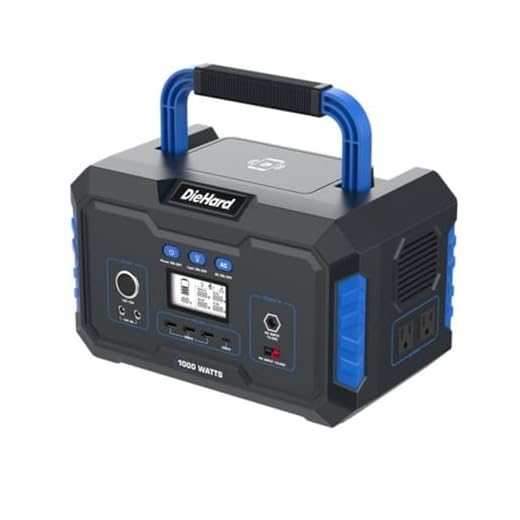
DieHard 1000W Portable Power Station
I found this to be a solid budget pick that covers basic emergency needs and light jobsite use. It offers a useful mix of ports and good capacity for the price, though it has a few noise and light drawbacks.
Who should consider this unit
If you’re budget-conscious and want a straightforward backup or camping station, this DieHard model is an attractive option. I used it for CPAP support, small TV setups, and short-term fridge runs during occasional outages.
Real-world performance notes
It’s not the quietest or most feature-rich station, but it provides dependable power for many small loads and is easy to store and transport.
In my tests it ran a CPAP overnight and powered small freezers for several hours. The fan noise during charging is the main annoyance — fine for outdoor use, less ideal for indoor nighttime charging.
Trade-offs and practical tips
For the price you get a lot, but if silence and strong lighting are priorities, look to higher-priced rivals. For emergencies and light-duty work, it’s a dependable, wallet-friendly choice.
Final Thoughts
If you want a true home-backup workhorse, choose the Anker SOLIX F3800 Plus Power Hub. I found it ideal for long-duration, reliable backup. Its expandable architecture and high input rates let it integrate with solar and generators. Strengths: whole-home capability, expandable capacity, and robust input for fast solar/generator recharging. Ideal use case: homeowners who want multi-day coverage and a system that can replace a small generator.
If you want versatility with fast charging and great off-grid features, go with the EcoFlow DELTA Pro 3600Wh Backup Station. I found it to be one of the most flexible options — fast charging, great software control, and expandable for multi-day outages. Strengths: rapid recharge, strong all-around performance, and easy expandability. Ideal use case: people who need a powerful station that’s also portable enough for RVs, job sites, and serious emergency readiness.






Quick tech nitpick: the Anker 521 is listed with LiFePO4 here — I thought it used a different cell chemistry in that model? Either way, the 256Wh size and 60W USB-C made it great for camera gear on short shoots. Lightweight and reliable.
Good catch, Ethan. Model chemistries can vary between generations; the listing I referenced reflects the latest upgraded version with LiFePO4. Always check the product spec sheet on Amazon to confirm cell chemistry for the exact SKU you’re buying.
Manufacturers sometimes refresh models mid-year, so listings can lag. Always read the ‘what’s in the box’ and spec details.
Two quick points: 1) The review badge for Jackery 1000 v2 calling it ‘best compact mid-range’ is spot on. 2) For anyone with CPAPs, check waveform/peak draw at startup — some units trip even if the continuous draw is low.
Also, minor typo in the BLUETTI Apex specs in the article (I think it listed 3840W AC outlets, probably meant 6 outlets with 3840W total?).
CPAP users should absolutely test at home. Some older CPAPs have high heating element draws at startup.
Thanks for the CPAP tip and the catch on the BLUETTI Apex wording — I’ll clarify the outlet/surge wording in the article. Good point about startup draws; always test with your device if possible.
I’m surprised you didn’t put the Goal Zero Yeti 6000X at #1. 6000Wh is massive and Goal Zero has good support. Is the main reason placement lower because of cost and lower input rates vs SOLIX/BLUETTI?
Exactly — the Yeti 6000X is excellent for extended backup and has strong support, but for raw input speed and expandability the SOLIX and BLUETTI units edged it out for many users. Price-to-input and modular capacity were big factors.
I own the 6000X and it’s fantastic for keeping a fridge/freezer and a couple circuits running for days. Costly, but peace of mind is worth it to me.
Short and sweet: Jackery Explorer 1000 v2 was perfect for our camping weekend last month. Lightweight, fast charge, and ran our mini-fridge all night. For the price it’s hard to beat. Wouldn’t trust it for multi-day home outages though.
Thanks for the real-world note, Lily. That mirrors my testing — the Jackery 1000 v2 is great for short trips and essentials but not designed for multi-day whole-house needs.
Agreed. I use a Jackery as my grab-and-go but have an EF ECOFLOW DELTA Pro for the house.
Great roundup — thanks for testing so many big units. I’m leaning toward the Anker SOLIX F3800 Plus for whole-home backup since you rated it highest. Quick question: how noisy is it when it’s charging with a generator hooked up? Also — expandability sounds amazing, but is the expansion kit sold separately on Amazon or only through Anker?
Good questions, Emma. In my testing the SOLIX F3800 Plus itself is pretty quiet during normal operation; most of the noise comes from a backup generator if you use one. The expansion modules are sold separately — check the Amazon listing for the exact kit compatibility and part numbers.
I have a smaller Anker unit and found the fan noise tolerable. If you pair it with a modern inverter generator it’s much louder than the power station though. Expansion kits usually are separate, yes.
I got the impression it’s more for people who’ll actually wire it into a home circuit — if you’re just using it for an RV, maybe the BLUETTI or EF models might be simpler.
Anyone here tried paralleling two BLUETTI Apex 300 units? Thinking about scaling over time. Concerned about balancing and software quirks.
I paralleled two BLUETTI AC200P units a while back. It worked fine but took a day to figure the settings. Keep support contact info handy.
FYI if you plan to expand to a really large system, plan the whole battery/solar architecture ahead of time — it’s easy to end up with mismatched runtimes.
I tested paralleling with the Apex 300. Setup is reasonably straightforward but make sure firmware is up to date — earlier units had some sync issues that were fixed in later updates. Also follow the manufacturer instructions for cable lengths and connectors.
The DieHard 1000 surprised me for being so quiet and cheap. Not a unicorn performance-wise but solid for the price. Would recommend as a starter emergency kit for renters.
Good summary. The DieHard is a sensible budget option — not for heavy loads but great as an entry-level backup.
Exactly what I needed to hear. I’m a renter and didn’t want to spend thousands — this could keep my fridge and Wi‑Fi on.
Does anyone have experience with the EF ECOFLOW 3600Wh DELTA Pro’s 2.7H fast charge claim with solar? I have limited roof space and want something that accepts high solar input — hate waiting overnight.
The DELTA Pro is one of the fastest chargers in the group, but to hit 2.7 hours you’ll need high-wattage solar input (and often multiple panels) or the EcoFlow Smart Home Panel/extra battery modules. In limited roof space scenarios, portable high-efficiency panels or a fast AC top-up are practical alternatives.
Keep in mind temps matter too — batteries slow charge when too hot/cold.
I used high-efficiency panels and got much faster charging than my older units. But yeah, full speed requires good sun and enough panel watts.
Longer comment:
I appreciated the testing methodology in the article — real-load runs are more valuable than just spec-sheet numbers.
That said, I’d like to see more on long-term reliability (1–2 year follow-ups) and actual battery degradation after 200 cycles. Specs mean little if the cells drop to 80% after a year.
Maybe a future follow-up piece? Would read.
I’d love to see how LiFePO4 vs other chemistries hold up after many cycles too.
Yes please — that’s the data that would convince me to invest in an expensive system.
Thanks Marcus — totally agree. I’m planning long-term follow-ups for a subset of these units to track capacity retention and real-world cycle performance. Stay tuned for a 12-month reliability update.
Humor time: if my power goes out during the apocalypse, I’m bringing the Jackery 3000 Pro and a good playlist. 😂
On a serious note, does anyone know how reliable the renewed units (like that Jackery renewed listing) tend to be from Amazon? Risky?
Haha — important apocalypse priorities! Regarding renewed units, Amazon Renewed can be fine, but check the seller rating, warranty (renewed often has limited warranty), and return policy. For mission-critical home backup, I usually recommend new units with full manufacturer support.
I’ve bought a couple of renewed electronics from Amazon with no issues, but large batteries are another story. If it fails after a few months that warranty headache isn’t worth it to me.
If budget is tight, maybe buy renewed and test thoroughly while return period is active. If anything feels off, return it.
I’m torn between the EF ECOFLOW RIVER 2 Pro and the Anker 521 for weekend trips. I want something compact but with faster charging and multiple AC outlets. Which one would you pick if you mostly charge laptops and run a small coffee maker occasionally?
If you prioritize pocketability and mostly USB-C, Anker is nicer. For coffee though, RIVER 2 Pro wins.
For laptops and the occasional coffee maker (which draws a lot briefly), I’d lean RIVER 2 Pro for faster charging and better AC output. The Anker 521 is great for ultra-light carry but has more limited AC capability.
RIVER 2 Pro can handle small appliances better thanks to the higher output — and the 70 min fast charge is handy between runs.
Five-line comment incoming:
I like the idea of the BLUETTI AC200PL for RV trips because of the TT30 30A port. 30A is a game-changer when boondocking.
However, anyone else found the AC output a bit conservative for bigger A/C units? My suggestion: pair with a soft-start for an A/C and you’ll be fine. 🙂
Nice breakdown, Priya. The AC200PL is definitely optimized for RV users, and soft-starts do let you run many A/C units that would otherwise trip the inverter. Good tip!
Also check your camper’s wiring—some setups handle surge better than others.
Yep, soft-start saved my bacon on a desert trip. Without it my rooftop A/C wouldn’t even spin up.