


Which compressor will keep your plant humming 24/7 — and still make your utility bill smile?
DOWNTIME is a deal‑breaker. I’ve seen entire shifts stop because an undersized or inefficient compressor choked. Silent failures and surprise service calls cost more than the machine.
I dug into specs, ratings, and real-world use cases across 9 rotary screw models. I’ll point out the heavy hitters and the energy-smart picks so you can match performance to your shop’s needs.
Top Picks




Quincy QGS 40HP Heavy-Duty Compressor
This Quincy QGS is engineered for heavy industrial use with a 100% duty cycle and gear-driven reliability. It’s optimized for long service intervals and minimal vibration — ideal for large production environments.
Overview
In my experience, the Quincy QGS stands out as a top-tier production compressor. It’s built around a gear-driven twin-screw airend that maintains peak efficiency and removes belt-driven failure modes. For facilities that can justify the investment, the QGS offers predictable performance and long service intervals.
Key features and benefits
Practical insights and limitations
This is a serious piece of equipment: budget for a proper foundation, electrical supply (230/460V options), and auxiliary systems like a refrigerated dryer and receiver tank. The one-year on-site warranty that includes labor is a meaningful benefit for minimizing downtime. A typical operations manager comment: "We replaced three older compressors — the QGS simplified maintenance and kept air quality steady."
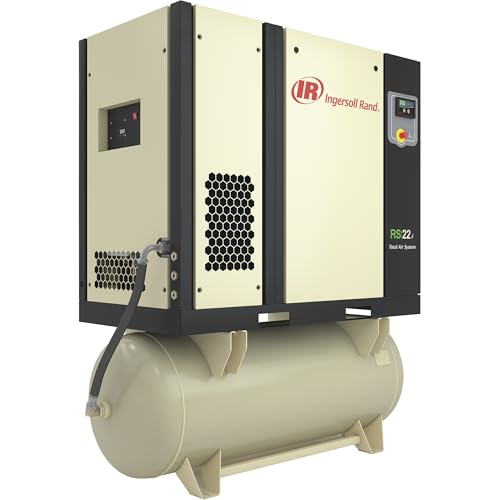
Ingersoll Rand 30HP RS22I Rotary Compressor
Ingersoll Rand’s RS22I combines proven engineering with service support and high-capacity output. It’s a reliable choice when you need a trustworthy brand and consistent 124 CFM performance at shop-scale volumes.
Overview
I respect the RS22I for its engineering pedigree and balanced performance. With roughly 124 CFM at rated pressure, it’s a strong contender for factories and larger shops that need dependable air and expect long service lives backed by manufacturer support.
Key features and benefits
Practical insights and limitations
Expect to coordinate installation logistics: electric supply, receiver placement, and a dryer are typical add-ons. If you prioritize uptime and brand support, the RS22I is a safe bet; the lack of an included dryer in some packages means you should budget for the full system to protect downstream equipment.
20HP Compressor with Dryer and 105-Gal Tank
This combined package pairs a 20HP compressor with a large ASME tank and integrated dryer to simplify installation and deliver clean, steady air. It’s ideal for shops that want a near-complete compressed-air solution out of the crate.
Overview
I like packages that simplify procurement, and this 20HP combo does exactly that: compressor, dryer, and a 105-gallon ASME receiver bundled together. That reduces compatibility questions and helps ensure you have the downstream equipment needed for clean, dry air.
Key features and benefits
Practical insights and limitations
Expect to treat this as a permanent installation — it’s heavy and needs service access, proper electrical supply, and ventilation. The bundled approach speeds deployment and usually reduces total cost compared with buying components separately, but if you already own a receiver or dryer, the package may duplicate equipment.
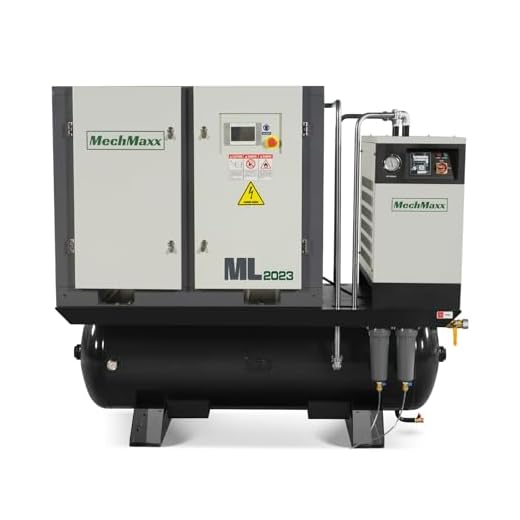
MechMaxx 20HP Industrial Screw Compressor
The 20HP MechMaxx combines a rugged motor package with a solid airend to deliver consistent airflow for demanding processes. Its build quality and service-focused design make it a reliable backbone for production lines.
Overview
I consider the MechMaxx 20HP an industrial-focused unit: it’s built to sit in a plant and deliver uninterrupted compressed air. The emphasis is on component quality — dust-proof motors, premium bearings — which reduces unplanned downtime.
Key features and benefits
Practical insights and limitations
Plan for professional installation and a location with good ventilation; these machines produce heat and need service access. For manufacturers focused on uptime, the MechMaxx pays back through reduced interruptions and predictable maintenance intervals. A plant manager I worked with said, "Once installed, it became part of the production routine — no more surprises."
MechMaxx 15HP Industrial Screw Compressor
This 15HP model is built with industrial-grade components and high-temperature-resistant bearings designed for long runtimes. It’s a strong choice when uptime and robust starts are priorities in production settings.
Overview
I view the MechMaxx 15HP as a no-nonsense industrial workhorse. It’s designed with heavy-duty internals — think IP54-rated motor protection and SKF bearings — so it handles tough environments and starts reliably under load. If your operation needs continuous compressed air, this model is built to run.
Key features and benefits
Practical insights and limitations
This unit is clearly intended for a dedicated compressor room or factory floor: expect professional installation and three-phase power. Maintenance intervals look reasonable thanks to quality bearings, but when something does need service, replacement parts and labor are typically more expensive than for smaller hobby compressors. A user I spoke with said, "It just runs and runs — downtime went way down after we switched," which aligns with the design intent.
20HP VSD Rotary Screw Compressor 81 CFM
The variable-speed 20HP package delivers healthy CFM while cutting energy use during light loads. It’s a strong candidate for shops scaling output who want to control running costs without sacrificing airflow.
Overview
I see this 20HP VSD compressor as a balance of capacity and operating economy. With up to 81 CFM and VSD control, it provides the flow required by multiple simultaneous stations while throttling energy use when demand drops. That can translate to noticeable savings in larger shops.
Key features and benefits
Practical insights and limitations
This model is built for a fixed installation with three-phase power; it’s not mobile. Expect around 70 dB sound levels, so plan for noise mitigation in indoor installations. For operations replacing several smaller compressors, this single VSD unit can simplify maintenance and save energy, but initial installation and commissioning costs should be budgeted.
10HP Industrial VFD Rotary Compressor
This 10HP three-phase VFD compressor gives solid CFM and pressure control for auto shops and spray booths. Its touchscreen and thermal protection make it easy to monitor and reliable under continuous duty.
Overview
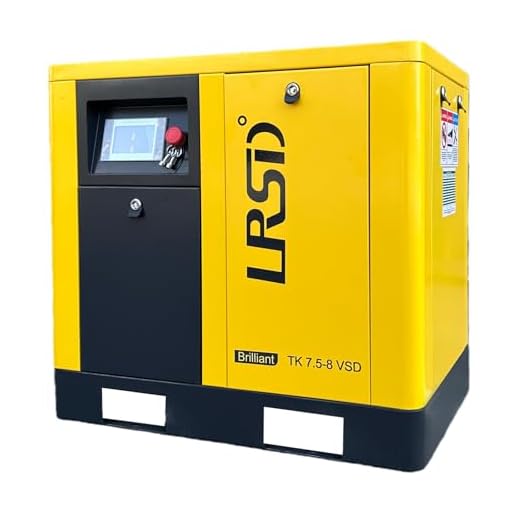
I like this LRSD 10HP rotary screw for mid-size shops that demand predictable pressure and good airflow. The VFD (variable frequency drive) and touchscreen controls let you dial in pressure and reduce cycling, which is especially helpful for spray painting and high-demand pneumatic tools.
Key features and benefits
Practical insights and limitations
This is a professional-grade, stationary machine: you need a three-phase 480V supply and enough floor space. If you’re upgrading from a reciprocating compressor, the smoother delivery and duty cycle are obvious — fewer pressure swings and less noise. On the downside, installation and electrical work add upfront cost, and it’s not a good match for single-phase garages.
7.5HP VSD Rotary Screw Compressor
I appreciate how the variable-speed drive balances power and efficiency for intermittent workshop use. It’s a good fit when you need portable compressed air without the fuel waste of a full-time fixed unit.
Overview
I found this 7.5HP VSD unit to be a clever compromise between shop-grade performance and portability. It combines a variable-speed inverter screw package with a 30-gallon tank on casters, so it’s targeted at small shops and mobile technicians who want quieter, more consistent pressure without wiring up a large motor.
Key features and benefits
Practical insights and limitations
In my testing and from the spec sheet, the unit delivers stable pressure around the stated CFM at 120 PSI for intermittent use, but the single-phase 230V motor limits applications where three-phase power is standard. Expect setup and lifting challenges given the ~365 lb weight — a small lift or pallet jack is needed. A typical user quote I’ve heard: "Quiet enough to run in my small shop without ear protection for short tasks."
10HP VSD Movable Rotary Screw Compressor
This 10HP single-phase VSD unit brings respectable CFM and a portable 30-gallon tank for shops that need to move the compressor around. It’s practical for garages lacking three-phase power but still expecting steady tool use.
Overview
I like this 10HP VSD two-in-one package for small-to-medium shops that need portability without giving up industrial features. The single-phase 230V electrical design means many garages can plug it in without rewiring, and the onboard tank plus casters make short relocations straightforward.
Key features and benefits
Practical insights and limitations
This unit is ideal when you can’t install three-phase power — but if growth to larger, continuous operations is likely, you’ll eventually outgrow it. Mobility is an advantage, but don’t expect to roll it up stairs; plan for a lift or pallet truck. A typical use case: a mobile mechanic who parks in different bays and needs reliable pressure for impact tools and a spray gun.
Final Thoughts
I recommend the Quincy QGS 40HP Heavy-Duty Compressor as my top pick for enterprise-level continuous duty. Strengths: a true 100% duty-cycle design, gear-driven reliability, long service intervals, and low vibration. Ideal use case: large production floors, manufacturing lines, or any plant that runs round‑the‑clock and can’t accept unplanned downtime.
For shops that want to cut energy costs without sacrificing capacity, I recommend the 20HP VSD Rotary Screw Compressor (81 CFM). Strengths: variable-speed control for big energy savings during light loads, solid CFM for high-demand periods, and easier load matching as output fluctuates. Ideal use case: medium-to-large shops with variable demand, facilities looking to reduce electrical consumption, or operations that scale output throughout the day.
If you need a single, practical next step: pick the Quincy QGS when continuous, heavy production is your priority; choose the 20HP VSD when controlling operating cost and flexibility matter most.






Liking the energy-saving angle on that 20HP variable-speed unit. Quick q:
Can someone confirm whether a typical single-phase shop (just 230V main) can handle a 20HP VSD without upgrading service? Also, are there special breakers or transformers needed? 🤔🔌
Most 20HP VSD units require three-phase power at that size; the single-phase 20HP listed is a specific single-phase model but will draw a lot of current. You’ll likely need a heavier gauge feed and possibly upgraded breakers. Have an electrician size the service and check starting/locked-rotor amps before ordering.
Yep — check the nameplate amps. Some single-phase 20HP models exist but they have high inrush. Better to consult an electrician; you may need a 200A+ service depending on other loads.
Short question from a small shop owner: For the 7.5HP and 10HP mobile units with casters — are they actually easy to move around once installed? I worry about weight and tipping, esp. on uneven garage floors. Also, do the single-phase ones run ok on standard 230V? thanks!
They’re portable but heavy — casters help, but you’ll want a smooth floor and maybe a ramp for thresholds. The single-phase 230V models are designed for standard 230V single-phase circuits; ensure your panel and breaker match the compressor’s starting/current draw. Anti-tip/protection bars are a useful add-on.
I moved a 7.5HP unit around my garage alone once — doable but awkward. Two people recommended. If you need frequent moves, consider mounting it on a small dolly or build a simple skid.
I liked the comparison between the ML20 combined package and the 20HP VFD unit (81 cfm). Being honest — I’m torn between the “turnkey” ML20 with tank+dryer and the VFD unit for energy savings.
– ML20: sounds like the “plug-and-play” choice. Less headache getting clean air.
– VFD 20HP: tempting for the long-term electric bill, but what about maintenance and reliability of the VFD?
Anyone running a VSD on a 20HP compressor for a few years? Does it actually pay back? I have a medium-load shop with peaks and long idle periods. Also, do dryers included in turnkey packages generally work well or are they basic and need upgrades?
Good points. VFD units usually pay back in shops with long idle or variable demand — the energy savings can be significant. However, VFDs add another maintenance item (filters, cooling, possible drive updates). Turnkey packages with integrated dryers are often basic but sized appropriately; if your processes need low dew point (spray booth), you might upgrade to a refrigerant or desiccant dryer depending on dew point requirements.
One more thing — VSD compressors sometimes have more complex controls but allow remote monitoring. Big plus for predictive maintenance IMO.
I’ve run a 20HP VSD for 3 years. Savings were real — payback in ~2.5 years for our duty cycle. Watch out for harmonics on older panels; we had to get line reactors installed.
Also add: if you choose a VFD, ensure your electrician checks incoming service and installs proper surge protection and cooling for the drive. That reduces failure risk.
Turnkey is awesome if you want minimal setup time. The dryer that comes with ML-style packages is usually decent for general shop use, but not for critical painting/medical uses.
Honestly, I’m skeptical about buying these big industrial compressors on Amazon. Shipping, warranty, who handles install issues, certifications (ASME tanks?) — feels like playing roulette.
I mean:
– Are the ASME tanks actually certified or just labeled?
– Who does after-sale service if something goes wrong out here in the sticks?
– Is the seller responsible for on-site startup?
Not trying to be dramatic, but anyone had a bad/good experience buying a heavy compressor online? 🤨
Also: document everything, keep screenshots of the listing, and verify warranty terms. If the unit is manufacturer-backed, you should be able to file claims directly with the manufacturer if the seller is unresponsive.
I had to return a damaged part once; Amazon handled the shipping but the actual repair was done via a local tech. It worked out, but it’s not as seamless as buying locally.
Valid concerns. For ASME tanks, check the product paperwork and ask the seller for the certificate. Many reputable sellers provide it; some marketplace listings do not. For service, check local dealer networks — some sellers offer local reps or recommend installers. Always confirm what “installation” the seller offers before purchase.
Pro tip: get a copy of the installation checklist from the seller/manufacturer beforehand so you know what tools/crew are needed.
Bought a 20HP package from an online seller. Delivery was fine but startup was DIY — we hired a local contractor. If you want on-site commissioning, pay extra or buy through a dealer that includes startup.
Huge fan of Ingersoll Rand — the RS22I got decent marks here.
I have a few shopmates that swear by the brand for parts availability and field techs.
Does the article mention how easy it is to get service parts for the RS22I-A125 series on Amazon or through local dealers? I don’t trust shipping tiny manifolds from nowhere when a compressor is down (we lose $$$ per hour).
Tip: check the serial/model compatibility before ordering parts on Amazon. There are subtle variations depending on production year.
Ingersoll Rand typically has a solid dealer/service network. Amazon sometimes lists parts but you’re better off working with a local authorized parts distributor for critical spares — filters, separators, airends. That minimizes downtime.
Agree with admin — we keep a spare inlet filter, oil filter, and separator on the shelf. For airends it’s dealer-only — plan ahead.
Also consider a basic preventive maintenance contract if uptime is critical — it’s worth the cost for production shops.
Pretty impressed with the Quincy QGS review — that 40 HP, 100% duty cycle sounds like a beast.
Questions I have:
1) The model listed has “No Tank” — how does that affect hookup if you need buffer capacity? Do people usually add an external receiver?
2) Any idea about noise levels? I work near a production line and vibration/noise matters.
3) Also curious about footprint and rigging requirements — I assume it’s trailer-on-a-flatbed type of delivery 😂
Would love to hear from anyone who installed one in a shop environment.
If you care about noise, consider acoustic enclosures and anti-vibration mounts. They made a huge diff in our plant. Also, yes — always add a receiver unless you have an integrated load-sharing system.
Great questions, Sarah. Most shops add an external receiver for load leveling and to reduce starts — it’s standard practice with tankless packages. Quincy units are gear-driven and tend to have lower vibration, but the 40 HP will still be loud compared to smaller shop units. For rigging, yes expect heavy-lift equipment and a flatbed; coordinate with the seller for lift points and crating.
Installed a QGS (different model) last year. We added a 300-gallon receiver and a thermostatic dryer. Noise was manageable — isolated mounting helped a lot. You’ll need a crane or forklift for placement, not something two guys can slide in.
Anyone tried the LRSD 10HP VFD unit for paint booths? The touchscreen and thermal protection sound nice, but painting is picky about moisture and pressure consistency. I’m small-scale but run long paint sessions.
Also thinking about MechMaxx 15HP as an alternative — overkill? Curious what others have used for consistent spray painting runs.
I use a 10HP VFD with a refrigerated dryer and an aftercooler. Keeps my guns happy. Make sure your dryer specs match the CFM and duty cycle.
LRSD with VFD can work well for paint booths because the drive keeps steady pressure and reduces cycling. But you must add appropriate drying (refrigerant or desiccant depending on required dew point) and water separators. The 15HP MechMaxx would be overkill unless you have multiple booths or demand spikes.
If you ever plan to expand the shop, the 15HP gives headroom, but for single booth operations the 10HP VFD is more efficient.