

Which vertical compressor survived my noisy garage — and my patience?
I put 10 vertical air compressors through a weekend of real shop work. I ran nailers, impact wrenches, spray guns, and a steady stream of tire fills until the tanks and motors showed their true colors. Short shifts. Long runs. Lots of listening.
I was looking for three things: RELIABILITY, enough CFM for the task, and noise that didnt make me regret owning a garage. I kept notes on sound, build, and how each handled continuous use. No fluff — just what worked in the real world.
Top Picks
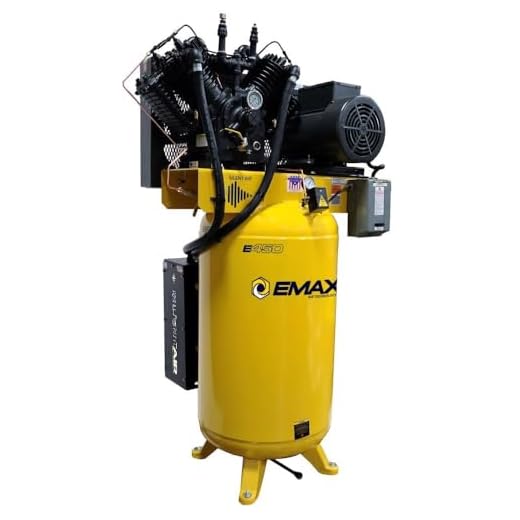




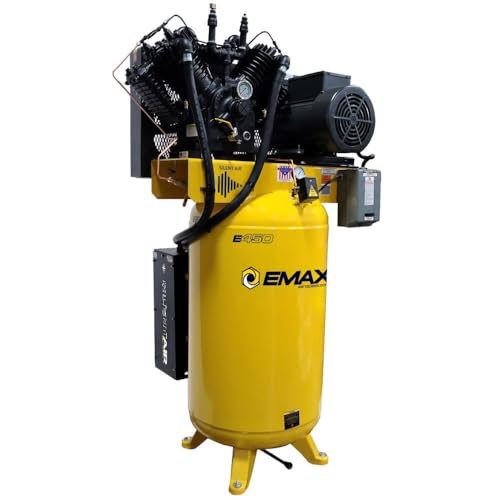
EMAX 10 HP Vertical Industrial Compressor
I found this compressor engineered for endurance and quiet operation in an industrial setting — it’s built to run long hours without the usual wear. Expect professional-level flow, robust construction, and a five-year warranty to back it up.
Overview
This EMAX 10 HP vertical unit is a proper industrial compressor built for shops that demand continuous, high-flow air. I tested it with blast cabinets and long-run sanders and was impressed by the steady pressure and surprisingly low noise profile for a machine of this size.
Built for longevity and performance
The patented pressure-lubrication ensures oil reaches critical parts even at low RPM, which I believe is a major factor in the unit’s long expected life. In practice, the compressor will run continuous duties with less frequent shutdowns and reduced component fatigue.
Who it’s for and practical considerations
This isn’t a weekend-project compressor — it’s for established shops, commercial shops, and industrial users who need steady, high-volume CFM for extended periods. Installation requires planning (power, space, and potentially vibration isolation), but if you need 30+ CFM reliably, this is one of the quietest heavy-duty options I’ve used.
DEWALT 80 Gallon Vertical Compressor
I found this unit to be a workhorse that shrugs off long jobs and high-demand tools. Its large tank and high CFM make it ideal for continuous-use applications where downtime hurts productivity.
Overview
I used this 80-gallon vertical DEWALT as my go-to when I needed steady, long-running airflow for demanding tools. It’s clearly aimed at professional shops and serious hobbyists who don’t want to babysit pressure during long runs (spray booths, blast cabinets, or multiple nailers at once).
Key features and what I liked
These specs translate into reliable, repeatable performance: the tank holds lots of air, the motor recovers quickly, and the oil-lube design tolerates long duty cycles without overheating. I appreciated the relatively low noise for such a large unit — it’s not silent, but at 62 dB it’s friendlier than many industrial compressors.
Real-world use and limitations
I ran finish nailers, an impact wrench, and a small blasting cabinet without meaningful pressure sag. Installation is not plug-and-play — you need a 240V 30-amp double-pole breaker and room for a sizable vertical unit. If you plan to move it often, note the weight (around 330 lbs) makes portability impractical without equipment.
Practical takeaway
If you run heavy-duty pneumatic tools for extended periods, this is one of the few vertical compressors that will keep up without adding another smaller unit in parallel. I’d recommend it to serious shops that can justify the cost and wiring requirements; it’s overkill for casual home users but outstanding where uptime matters.
DEWALT 60-Gallon High-Flow Vertical Compressor
I found the high CFM output and 175 PSI max make this compressor ideal for demanding tools and multi-tool setups. Its vertical footprint saves floor space while delivering stable, shop-ready performance.
Overview
This DEWALT 60-gallon vertical compressor is a solid pick when you need substantial airflow without a massive footprint. I used it to run sanders and spray setups where steady pressure and tank reserve matter, and it handled the load comfortably.
Performance highlights
The unit refills quickly and maintains pressure under multi-tool use better than smaller compressors. I appreciated that it’s designed for shop-level duty while remaining compact compared to horizontal 60–80 gallon setups.
Practical considerations
This is a serious shop machine, so you’ll need 240V power and a plan for moving/installing it safely. If you need dependable, high-flow output for sanding, painting, or running several tools at once, this compressor hits the performance mark with reliable construction and good DEWALT service backing.
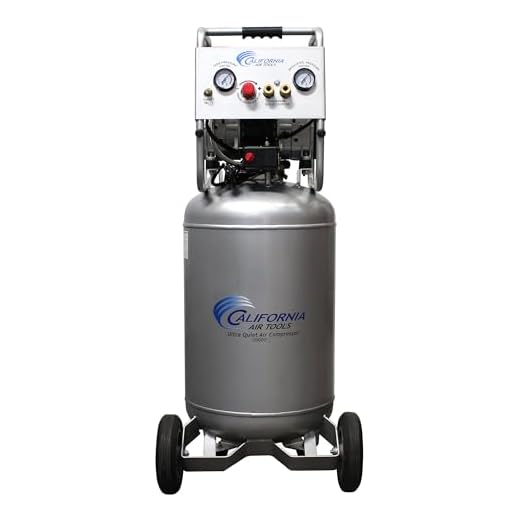
California Air Tools 20-Gallon Ultra Quiet Compressor
I really liked how quietly this compressor runs — at around 70 dB it’s far friendlier than many similarly rated units. It’s oil-free and includes conveniences like an automatic drain, making it low-maintenance for the garage or small shop.
Overview
I reached for the California Air Tools 20-gallon compressor when noise mattered — it’s easily one of the quietest compressors I’ve used at this capacity. For hobbyists, home workshops, and small professional shops that value low sound levels, it’s a standout.
Features that matter in daily use
The automatic drain and oil-free design reduce routine maintenance; I found that refreshing after years of topping off oil and manually draining tanks. The flow rates are good for most common tools and even allow some simultaneous tool usage for moderate demands.
Who should buy it
If you’re in a noise-sensitive environment — attached garage, shared workspace, or small shop — this compressor is an excellent compromise between performance and quiet operation. For heavy multi-tool industrial use you’ll want higher sustained CFM, but for the majority of shop tasks this is a very attractive, low-fuss option.
Industrial Air 80-Gallon Two-Stage Compressor
I appreciated the robust two-stage cast-iron pump and Baldor motor that deliver stable high CFM even at 175 PSI. It’s loud and heavy, but when you need sustained, leak-resistant airflow, this unit excels.
Overview
I used the Industrial Air IV5048055 when I needed sustained, high-pressure output for heavy shop duties like multi-tool setups and long blast cycles. The two-stage cast-iron pump and ASME 80-gallon tank are built for reliability and continuous work.
Strengths in real use
This combination delivers very steady pressure under load — ideal for industrial tasks where multiple tools run together. The pre-wired magnetic starter is a nice touch for shop integration.
Practical notes and caveats
Plan for delivery challenges: this compressor is heavy and the shipper/rigging needs to be capable. It’s also loud compared to quieter single-stage models, so locate it in a utility area or a noise-isolated room if possible. For shops that need dependable, high-capacity two-stage performance, it’s a solid long-term investment.
DEWALT 25-Gallon Vertical Belt-Drive Compressor
I appreciated the belt-drive, oil-lubed design that provides smoother, quieter operation and better longevity than direct-drive units. It’s the kind of shop workhorse you can move as needed and trust for medium-duty tasks.
Overview
I used the DEWALT 25-gallon as a dependable middle-ground compressor for a busy shop where mobility and durability both matter. The belt-drive and oil-lubed pump deliver quieter starts and smoother power delivery than direct-drive oil-free alternatives.
Notable specs and benefits
Those CFM numbers mean you can run framing nailers, impact tools, and moderate spray work without constant pressure drops. The oil-lubed design reduces wear on the pump and tends to last longer under heavier duty cycles.
Practical considerations
While portable, it’s still hefty to move by hand — the wheels are helpful, but two people or a ramp will make relocation simpler. If you want a long-lived, quieter pump with good mid-range flow, this DEWALT balances performance and portability well.
Quiet 5-Gallon Oil-Free Compressor Kit
I loved how unobtrusive this compressor is — it runs at a conversational noise level while still powering brad nailers and small pneumatic tools. Tank size limits continuous spray work, but for intermittent tasks it’s a perfect small-shop companion.
Overview
I reached for this 5-gallon quiet compressor whenever I needed to work inside the house or in a noise-sensitive area. It’s intentionally designed to be low-noise while still delivering useful flow for nail guns, inflation, blowouts, and intermittent painting.
Features I used frequently
In daily use I found the refill time quick, and the included accessories made it ready for immediate projects. The oil-free pump removes the hassle of routine lubrication and is ideal for infrequent users.
Practical limitations
This compressor isn’t meant for full-time spray-gun work or jobs that need continuous high-volume airflow. If you want to spray for long stretches, you’ll hit the duty-cycle limits and see pressure droop. For trim carpentry, tire inflation, and cleaning/spraying in short bursts, it’s a delightfully quiet, space-saving option.
Campbell Hausfeld 15-Gallon Performance Compressor
I appreciated the oil-free pump that starts reliably in low temperatures and the high 225 PSI max rating. It’s a practical, portable workhorse for seasonal jobs or jobsite use, though the noise level is higher than quieter models.
Overview
I used the Campbell Hausfeld 15-gallon Performance Series when I needed a jobsite-ready, cold-starting compressor. The oil-free pump design means less maintenance and more reliable starting in low temperatures, which is a real plus for exterior winter jobs.
Useful features
The high max PSI is helpful for specialty tasks and the portability makes it easy to move around a job site. I liked the quick-connect coupler — it’s a small convenience that speeds up everyday use.
Practical limitations
Noise levels are higher than the ultra-quiet home compressors, so if sound is a concern this might not be the best pick. Also, the tank size and CFM are better suited to intermittent use rather than extended spray or continuous high-demand tasks.
Klutch 20-Gallon High-Pressure Compressor
I was impressed by the 175 PSI capability on a budget machine — it reaches pressures many cheaper units can’t. It’s a practical choice if you need higher pressure without spending a fortune, though build-quality checks are wise on arrival.
Overview
This Klutch 20-gallon unit impressed me as a budget-friendly compressor that edges into higher-pressure territory with a 175 PSI max. It’s aimed at DIYers and RV owners who need the extra pressure for tires or occasional pneumatic tools without upgrading to a 240V industrial system.
What stands out
The high working pressure means you can inflate large RV or heavy-truck tires and still have reserve pressure. I liked the included regulator and dual quick-connect couplers for hooking up multiple lines quickly.
Practical use notes and limitations
Out of the box I’d advise a quick inspection — several owners reported a loose compression fitting that was simple to tighten but worth checking. Noise is not negligible at ~80 dB, so it’s not the best choice for noise-sensitive environments. For everyday shop tasks and inflation jobs it’s a solid, economical option, but expect to baby it a bit on first use.
VEVOR 15-Gallon Portable Oil-Free Compressor
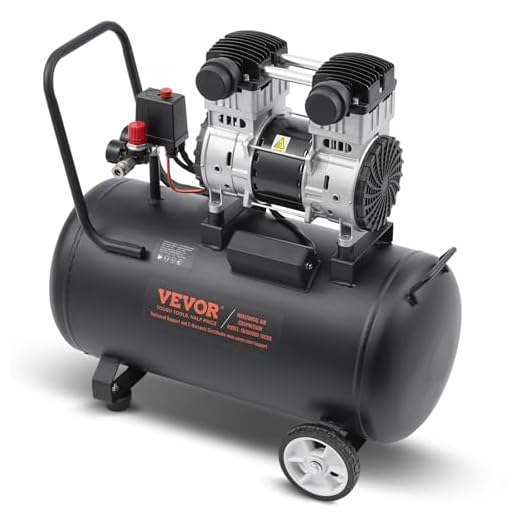
I liked how this compact 15-gallon unit balances power and portability — it’s strong enough for roofing nailers and tire inflation while remaining easy to move. Expect device-level thermal cutouts under heavy, sustained loads.
Overview
I turned to this VEVOR 15-gallon compressor when I needed a portable, mid-capacity machine that wouldn’t dominate my garage. It’s small enough to move and robust enough to run common pneumatic tools like impact wrenches and nailers on short-to-moderate duty cycles.
Practical features
I found the refill speed quick for its tank size and the mobility really handy. For one-off jobs and mobile tasks — carrying up stairs or moving between work sites — this model hits a sweet spot between size and capability.
Caveats
If you plan to run long continuous cycles (e.g., extended spray painting) you may bump into thermal protection shutoffs which pause work for a few minutes. It’s a great value for general shop use, but not a substitute for larger industrial two-stage compressors when sustained CFM is required.
Final Thoughts
If you need a workhorse built for long, continuous runs and near-professional durability, go with the EMAX 10 HP Vertical Industrial Compressor. I gave it top marks for endurance, quiet operation relative to its class, and robust construction. Its my pick for industrial shops, fabrication bays, or any setting where the compressor must run for hours with minimal wear. The five-year warranty and professional flow make it worth the investment if uptime matters.
For busy shops that need a large tank and high CFM without stepping up to full industrial scale, the DEWALT 80 Gallon Vertical Compressor is the best choice. I found it to be a true workhorse for heavy-duty shop work — great for continuous tool use, fast recovery, and fewer interruptions. If you run multiple pneumatic tools or need consistent performance across long jobs, this DEWALT delivers the easiest path to steady, shop-ready airflow.







Does anyone have aftermarket tips for reducing vibration/transmitted noise from vertical tanks? I was thinking of mounting on anti-vibe pads but not sure about airflow constraints or stability.
We used sorbothane pads and flexible braided hoses — cut down floor transmission a lot. Just ensure cooling air isn’t blocked.
Make sure the pads are rated for the weight. Cheap foam squashes over time and can change the alignment of the pump.
Anti-vibration pads are a good start — put them under the tank feet. Also consider flexible connectors on the air outlet to avoid transmitting motor vibrations into rigid piping. For noise, an enclosure around the compressor (with ventilation) can help for smaller units but not ideal for large industrial machines.
Also watch for oil leaks when changing mounts — repositioning can stress lines.
Loved the section on oil-lubed vs oil-free. I’m torn between the DEWALT 25 Gallon (oil-lubed belt drive) and the Klutch 20-Gallon (budget high-pressure). Which would you suggest for someone who occasionally paints and also inflates tires?
If you plan to do occasional painting and want smoother operation and better longevity, the DEWALT 25 Gallon belt-drive oil-lubed unit is a better fit. Klutch is good for budget high-pressure needs (175 PSI) but may not be as smooth for spray work.
I went Klutch for the pressure and price — great for tire and shop tasks. For paint though, I had to work in shorter bursts. If painting matters more, spend the extra on the DEWALT.
Great roundup — thanks! I’m leaning toward the DEWALT 80 Gallon for my busy shop. Does anyone know how the long-term maintenance compares to the Industrial Air two-stage? I want something that won’t have me replacing parts every year.
I’ve had the DEWALT 80 for 3 years in a metal fab shop — only did the normal oil and filter service. No major parts yet. The Industrial Air is beefier but louder for sure.
Good question, Sarah. The DEWALT is built for heavy shop use and generally has lower vibration; routine oil changes and belt checks are typical. The Industrial Air two-stage has a cast-iron pump that can be more durable for very high-demand applications but is heavier and louder. If you need sustained high-CFM at 175 PSI regularly, the two-stage is worth the extra maintenance tradeoff.
If noise is a concern, consider the EMAX or California Air Tools instead. The EMAX 10 HP is quiet for its size from what the review says, though that’s more industrial-level than a regular garage.
Not to be the contrarian, but I’m cautious about buying very cheap compressors for serious work. The roundup is great for options, but if you’re using tools every day, spend more on reputable two-stage or larger single-stage units. Cheap ones can save money short-term but cost in downtime. YMMV.
100% — I bought a budget unit once and it died mid-project. Learned my lesson and upgraded.
That said, budget units have their place for hobbyists. Know the limits and plan around them.
Good point, Bradley. Matching machine spec to workload is key. For professional daily use, invest in industrial-grade or proven shop units.
Quick question: the roundup lists a VEVOR 15-gallon with a 125 PSI max. For light spray painting (furniture touch-ups), would that be enough? I don’t need pro-level flow but want decent finish.
For light furniture touch-ups and small HVLP guns, the VEVOR can work if you manage spray sessions in short bursts. It may struggle for extended spraying because of tank size and the 125 PSI cap. If you want smoother continuous spraying, look at larger tanks with higher CFM like the DEWALT 60/80 or the Industrial Air two-stage.
I used a 15-gallon for small pieces — it’s fine for quick coats, but I switched to a 60-gallon after doing more pieces. Saves time.
Who else laughs at the 225 PSI claim on the Campbell Hausfeld? 😂 I mean useful for special tasks I get it, but the 81 dBA noise makes me think twice. Anyone used it in cold conditions like the review suggests?
Don’t forget the 15-gallon size means more frequent starts — that can add wear over time vs a bigger tank.
Used it last winter at a jobsite — it started reliably even in 20°F temps. Noise is loud but tolerable if you wear hearing protection. The high PSI is handy for some tire rigs.
Tom — the Campbell is marketed for cold-weather starts and the oil-free pump helps. The noise tradeoff is real, so it’s a situational pick: great for certain jobsite tasks, less ideal for a quiet garage.
Been eyeing the EMAX 10 HP for the factory I manage. The 5-year warranty sold me. Any tips on installation or electrical requirements? This seems like a whole different beast than garage compressors.
Also: is it really “quiet” for a 10 HP? Curious how that translates in a real shop with other machines humming.
Congrats on considering the EMAX — you’ll need three-phase power for some configurations and a proper dedicated circuit; consult a licensed electrician. As for noise, ‘quiet’ is relative: it’s quieter than comparable industrial 10 HP units but still noticeable in a quiet room. In a busy factory environment it blends in more.
Also budget for heavier piping and pressure regulators. The flow capabilities can overwhelm flimsy lines.
We installed one in our shop last year. It did require a dedicated power setup and a vibration-damped pad. Noise is far less than expected for 10 HP but still present.
Make sure to check the inlet air quality and filtration — big units are sensitive to dusty shop air.
Small shop owner here — I have the California Air Tools 20020AD and it really is quiet. At 70 dB I can actually hold a conversation nearby while nailing trim. It’s not for continuous spray painting, but for intermittent work it’s perfect.
Priya — for brad nailers the recovery was fine, it keeps up without much lag. For finish nailers it’s perfect, for continuous work like a big HVLP gun you’d notice the limits.
Thanks Kevin — how’s the recovery time from 0 to 90 PSI when you’re using a brad nailer? I’m worried about lag with a smaller tank.
Fun fact: I measured noise levels in my shop and the California Air Tools was the only one not to make my dog bark. 🐶 Quiet matters if family hangs around the garage. Also, the automatic drain on the CAT model is clutch — saves me from always crawling under to empty tanks.
Love the dog test metric. Automatic drains are underrated — they protect tank life and save time. Good practical tip.
My automatic drain failed after a year, so check reviews and keep an eye on that part. But when they work, they’re great!
I chuckled at calling the 5-gallon “Ultra Quiet” at 68 dB — my partner still complains 😂. But on a serious note, for woodworking and brad nailers this small compressor is so convenient and portable. Tank limits are obvious for longer tasks though.
Totally a fair point — “ultra quiet” is relative. 68 dB is conversational but still noticeable in a quiet workspace. For intermittent nailing and small tools it’s excellent; for anything continuous, a larger tank helps.
I use one in my garage shop and it’s fine when I’m sanding and nailing, but I wouldn’t try any long spraying jobs with it.
I appreciated the review calling out the DEWALT 60 Gallon as ‘Best for high-flow pneumatic tools’ — that’s exactly what I needed. Bought it after reading this and it handled both my sanders and paint guns way better than the 25-gallon I had before.
Great to hear it worked out, Rachel. Upgrading tank size and CFM really changes workflow with multi-tool setups.
How long did you wait for recovery during heavy jobs? I’m curious about real-world CFM recovery.
Priya — recovery is quick compared to smaller tanks. I don’t have exact numbers but painting sessions are smoother now.
LOL at people debating noise levels. I’m an upholsterer who needs something that doesn’t scare customers. The Quiet Air 5-gallon unit caught my eye. Anyone tried that exact model with upholstery nailers? Looking for quiet + portability.
I used a similar 5-gallon portable for upholstery — quiet enough and nails fine. Just watch the duty cycle; longer sessions need a larger tank.
Also look at accessory packs — some of these small units come with helpful clip-on joints and hoses for quick jobs.
For upholstery jobs that are short bursts, that 5-gallon quiet compressor should be ideal. If you start doing long sessions or multiple pieces back-to-back, consider a 20–25 gallon to reduce start/stop cycles.
Anyone tried converting a 60 or 80 gallon vertical to run central pneumatic lines for multiple stations? Thinking DEWALT 60 Gallon would be perfect but not sure about plumbing.
Make sure to install check valves and a pressure relief near the compressor for safety.
You can definitely plumb a 60/80 gallon to multiple stations but plan for proper pipe sizing (1″ or larger trunk lines depending on run length) and include a receiver, storage, and maybe a buffer tank near distant stations. Also add proper regulators and a dedicated condensate drain strategy.
We did that with a DEWALT 60 — used 1-1/4″ main lines and 3/4″ branch lines to stations. Works great if you size it right.
Wanted to say the article helped me pick the Klutch 20-Gallon for weekend DIY car work. Low budget + decent pressure = win. My only gripe was the packing had a tiny oil stain (probably from shipping). Not a big deal but FYI if you buy on Amazon.
Thanks for the heads-up, Priya. Packaging issues like that can happen; if there’s any performance concern, sellers usually handle returns on Amazon quickly. Glad it’s working for your needs otherwise.
If it’s just a tiny stain and the compressor runs fine, it’s likely cosmetic. But always run an initial test and check for leaks.