


Which mag drill eats steel for breakfast — and which ones just bring donuts?
I hate hand-drilling steel. One slip and the part — or my patience — gets ruined. I wanted power, repeatability, and a magnet that actually stays put.
I tested eight kits and accessories across real shop and jobsite work. Some were rugged pro tools, some were bargain surprises, and a couple were niche helpers that saved my day on specific jobs.
Top Picks



Milwaukee 14" Magnetic Drill Press Kit
A powerful, dependable mag drill well suited to fabrication shops and heavy jobsite work. It combines a strong permanent magnet with sufficient travel and torque for most structural drilling tasks.
Built for production and demanding jobs
I turned to this Milwaukee when the work required punching dozens of holes through structural members. The permanent magnet grip is reassuringly strong, and the unit stayed locked and true under load. The 14" overall height and 5-3/4" travel give scope for deeper work than the compact class.
Performance and handling
In heavy use the motor stayed cool and the feed was predictable. I appreciated the free adjustment to dialing speeds based on cutter and material. The unit’s weight (30.5 lb) makes it stable but means you need a plan for transport—two-man carry or a dedicated case is handy.
Practical drawbacks and buyer guidance
This isn’t a light daily carry tool; if you need overhead portability you might prefer a smaller mag drill. However, if you want a durable workhorse for shop environments and heavy fabrication, this one’s a top pick and worth the investment for longevity and consistent performance.
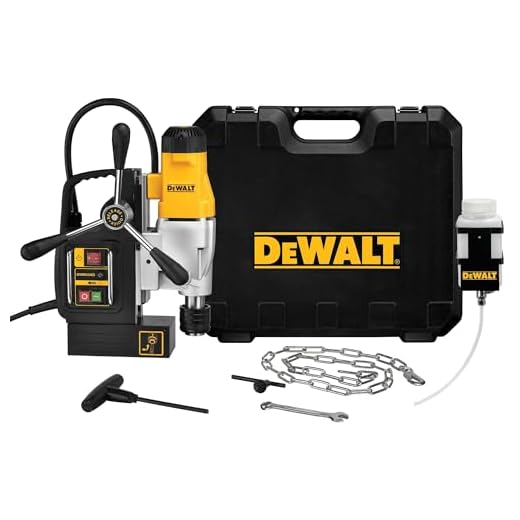
DEWALT DWE1622K 2" 2-Speed Mag Drill
A balanced mag drill that brings power, useful features, and proven durability to the trade. The quick-change system and 2-speed motor make it flexible for both cutters and twist bits.
A reliable mid-range professional mag drill
I rely on this model when I need a versatile, purpose-built tool that won’t slow the crew down. The 2-speed design and quick-change chuck let me switch between annular cutters and standard twist bits quickly—huge time-saver on mixed jobs.
Real-world use and strengths
On jobsite structural drilling it held well and powered through common mild steel tasks. The quick-release feed handles and magnetic coolant tank worked well for handheld orientations; I appreciated being able to position the tank where it interfered least with my setup. Users should expect a few thousandths of runout — normal for this class and acceptable for structural work.
Considerations before buying
If you need the absolute lowest runout for precision milling-like work, a bench machine or larger collector-grade mag drill is better. For general structural, retrofit, and fabrication tasks, this Dewalt balances features, portability, and price very well.
Makita HB350 Compact Magnetic Drill
A compact, portable mag drill that balances power and weight for on-site and overhead tasks. It performs reliably on thin-to-moderate steel and is easy to move between jobs.
Compact, jobsite-ready mag drill
I like this unit for jobs where portability and overhead access matter. The HB350 is noticeably lighter than many full-size mag drills, which made it much easier for me to set up in tight spaces and lift for above-head drilling.
Where it excels and practical uses
I found it best-suited for light structural work, retrofit jobs, and situations where carrying weight is a real concern. It won’t replace an industrial mag drill for heavy plate, but for pipeline, scaffolding, and light fabrication it’s very handy. In one session I used it to punch multiple holes in 3/8" plate and the speed was consistent.
Limitations and what to expect
If your work routinely demands 2"+ cutters or deep, large diameter holes, this one will feel underpowered. The smaller magnet and lower torque mean you’ll need to plan for more conservative feeds and potentially more frequent cutter changes. For hobbyists and many tradespeople, though, the tradeoff for weight is worth it.
VEVOR 1450W Portable Mag Drill Kit
A surprisingly capable mag drill considering its price, offering strong magnet hold and a 1450W motor that tackles larger holes. It’s a great entry-level pro tool, though a few fit-and-finish items need attention.
Big motor and solid value
I was impressed by how much torque the 1450W motor delivered for the price. It handled 1–2" coring tasks that would usually need a pricier unit, and the variable speed plus reversing give flexibility for different cutters and materials.
Practical observations and tuning
Out of the box some units may need minor tweaks: I had to re-seat an adapter and tidy an electrical connector on one review unit. The magnet is impressively strong; I comfortably drilled through common structural plates with no lift. The included coring set is a nice starter pack for hobbyists or small shops.
Who should consider it
If you want high raw power without the premium brand price tag, this is a compelling choice. Expect to do a quick bench check and minor adjustments before putting it into critical production use.
S&F STEAD & FAST 1-1/4" HSS Cutter
A solid, affordable annular cutter that delivers clean, repeatable holes in mild steel and thin plate. It’s a reliable workhorse for fixture building and repetitive fabrications.
Affordable, accurately machined annular cutter
I reached for this cutter when I needed a cost-effective way to punch multiple identical holes. It’s CNC machined from M2 high-speed steel (HSS) and felt solid in the chuck with minimal runout.
Real-world performance and tips
In practice it cut quickly through mild steel and produced clean slug-free holes. I recommend using the correct pilot pin and steady coolant to extend life. For example, when making a run of holes on a mild-steel fixture plate I got consistent results with moderate feed and plenty of lubrication.
Limitations to consider
If you frequently drill stainless or heavily work-hardened materials, this HSS cutter will blunt quicker than carbide or cobalt alternatives. For occasional work or production of dozens (not thousands) of holes, it’s an excellent balance of price and performance.
VEVOR Low Profile 1300W Mag Drill
A compact mag drill designed for tight spots where standard units won’t fit, offering respectable magnet hold and a useful feature set. Watch the chuck dimension and shaft length to ensure it fits your setup.
Purpose-built for low clearance work
I pulled this unit out when I needed to drill inside a narrow channel where a standard mag drill couldn’t fit. The compact footprint and lighter weight made positioning easy and allowed drilling that would otherwise have been difficult.
Field notes and practical fit checks
One quirk I ran into was the spindle/chuck depth relative to the magnet base—on some samples the spindle sat lower than ideal, reducing the available feed travel when the magnet was locked. If you plan to buy, measure your required clearance and verify the chuck-to-base relation before relying on it for production.
Final take and target user
This unit is a smart pick if you frequently need to access tight cavities or work on equipment where clearance is the limiting factor. For general heavy drilling, a larger mag drill will provide more torque and travel, but for constrained-area work this VEVOR shines.
Makita 191L24-0 Screw Auto-Feed Attachment
A useful auto-feed adapter for compatible Makita screwdrivers that speeds repetitive drywall and decking work. It can be clunky at times and needs tuning, but it cuts labor on long runs of screws.
Handy auto-feed for ribbon screw tasks
I used this attachment for hanging drywall and doing large decking runs where I wanted to minimize hand-feeding screws. When it works smoothly it’s a real timesaver—especially when working solo.
Field experience and caveats
My experience mirrored other users: on many runs it functioned well and sped things up, but it can feel clunky and occasionally jammed—usually due to feed alignment or worn ribbons. I recommend cleaning and inspecting the feed periodically and keeping spare nose pieces or ribbons on hand.
Who benefits most
If you hang a lot of drywall or do repetitive screw work, this attachment can pay back quickly in saved time. For occasional users, the convenience is nice but the potential for jams means you should expect a learning curve and maintenance.
Greycore 1-1/2" Self-Feed Wood Bit
A stout single-cutter self-feed bit that makes quick, aggressive cuts in softwoods and many hardwoods. It’s ideal for rapid bore-throughs but needs a powerful driver and attention to heat under heavy use.
Fast, professional self-feed design
I used this bit on several door and cabinet install jobs where speed mattered. The aggressive feed screw really does pull the bit through material, so you make clean pockets quickly—provided your drill has enough torque.
Practical tips and durability notes
When I ran it on soft pine it tore through effortlessly and the screw kept feeding. On dense hardwoods the bit heated more, and one of my feed-screw tips failed after repeated heavy use—this is a known failure point, so I recommend having spare feed screws on hand. Proper cooling and slower feed rates help in hardwoods.
Who should buy this
If you do a lot of repetitive wood boring—installing hinges, door hardware, or running large screws into framing—this bit speeds things up. Don’t expect it to behave like a metal annular cutter; it’s a woodworking specialist.
Final Thoughts
If you want one clear winner for heavy shop work and serious structural drilling, pick the Milwaukee 14" Magnetic Drill Press Kit. It earned that spot because of raw power, a strong permanent magnet, and the travel/torque to chew through bigger holes without drama. Buy this if you run a fabrication shop or you often drill thick structural steel — it’s built to last and keeps you productive on long runs.
If you want the best jobsite all-rounder that balances portability and features, grab the DEWALT DWE1622K 2" 2-Speed Mag Drill. Its quick-change system and two-speed motor make it flexible for both annular cutters and twist bits. I recommend this for field crews, steel erectors, and anyone who needs a reliable, easy-to-move unit that handles most everyday drilling tasks.
Quick note: for tight or overhead work, the Makita HB350 Compact Magnetic Drill is my go-to compact option. And if you're on a budget but need power, the VEVOR 1450W is a surprisingly capable value pick — just check fit and finish before you commit.
FAQ
Auto-feed mag drills advance the cutter automatically so you don't hand-crank through the cut. I care because it saves time, gives consistent hole depth, and reduces operator fatigue on repetitive work. It’s worth it when you’ve got lots of holes to drill or when precision and repeatability matter.
Only if you regularly drill large-diameter holes or need extra stroke for thicker flanges and plates. The 14" Milwaukee gives more travel and torque for big cuts. For lighter duty, a smaller drill like the DEWALT or Makita compact is easier to carry and still handles most shop jobs.
Not always. Check arbor compatibility (pilot pin size and taper or thread), cutter diameter limits, and machine speed range. I always match the cutter's pilot pin and arbor to the drill and confirm the RPM range is appropriate for the cutter diameter and material.
Yes—with caveats. The VEVOR 1450W gave me good power and magnet hold for the price, so it’s a solid entry-level pro option. But expect a few fit-and-finish quirks. Inspect tolerances, clutches, and the magnet face before heavy production use.
Clean contact surfaces first — remove paint, rust, and scale until you have bare, flat metal. Use a shim or sacrificial plate if needed. I also use strap clamps for critical lifts and check the magnet hold before powering up the cutter.
They’re not mag drills, but they solve the same time-and-effort problem for screw-driving work. The Makita auto-feed attachment saved me hours on decking and drywall runs — it’s clunky sometimes, but when it clicks, it shaves big time off repetitive screw jobs.
Tools are a system. The S&F HSS annular cutters and Greycore self-feed wood bit show that the right cutter matters as much as the drill. I reached better cycle times and cleaner holes using a purpose-built cutter. Use HSS annular cutters for mild steel; the aggressive Greycore wood bit is great for fast wood boring but needs a stout driver.
Yes — secure your work, clamp where possible, use pilot pins for chip evacuation, wear eye and hearing protection, and keep coolant or lubricant flowing for long cuts. I also pull power before adjusting tooling and confirm magnet hold between each hole.







Quick question: Does the 14 in. H Magnetic Drill Press Kit feel overkill for occasional fabrication at home? I’m mostly doing small brackets and a few hinges.
For light, occasional shop work the 14 in. H mag drill is probably more than you need. A compact model like the Makita HB350 or the VEVOR low-profile might be a better fit — lighter and easier to store.
If you have the space and plan to grow your projects, the bigger unit gives flexibility. But for occasional bracket/hinge work, it’s bulky.
Loved the bit review — that S&F STEAD & FAST 1-1/4″ annular cutter is now my go-to for repeated holes. Clean cuts and it holds up surprisingly well. Price-to-performance is great.
One caveat: if you’re doing thicker or stainless, step up to a more specialty cutter. But for mild steel I’m very pleased.
Keep coolant clean and use light pecks if you’re burning. Good coolant and moderate feed rates = longer life.
Anyone noticed faster wear when using with older/or non-optimal coolants? I’m switching coolant brands and want to avoid torching the cutters.
Totally. I used the S&F for a batch of brackets and the edge finish saved me a ton of deburring time.
Good callout on material — the S&F is best for mild steel and thin plates. We noted in the review that it’s a workhorse for repetitive fabrications.
I laughed at the Makita 191L24-0 auto-feed review — “saves time on ribbon screw jobs” is 100% accurate but god is it clunky sometimes. Tuning takes patience.
Still, when it’s set up it cuts labor on decking. Anyone got setup tips?
Tighten and center the guide before each run, and test on scrap to dial feed depth. A little patience up front saves a lot of frustration mid-job.
Apply a tiny bit of grease to sliding parts. Not too much, just enough to keep things smooth. Also make sure your driver has consistent clutch settings.
Great roundup — thanks for testing all of these. I’ve been debating between the DEWALT DWE1622K and the Makita HB350 for overhead work.
I like that you highlighted the quick-change system on the DEWALT; that seems handy when switching cutters. But the Makita’s compact size is appealing for tight spaces. Anyone here used both on a scaffold or overhead plate?
Used both on a couple of jobs. Makita = lighter and easier to balance. DEWALT = more confidence on thicker sections. If you mostly do thin plate go Makita, otherwise DEWALT.
If you work overhead often, the Makita HB350’s lighter weight really helps reduce fatigue. The trade-off is slightly less torque than the DEWALT, but for thin to moderate plate it does well.
I second Michael — Makita for ease, DEWALT when you need that extra oomph. Also, make sure your harness/rigging accounts for the weight difference.
Minor gripe: I wish the roundup did a deeper dive on lead times and availability for replacement parts (pilot pins, magnets, etc.).
I owned a older mag drill and waiting for a pilot pin replacement killed downtime. A little marketplace intel would be super helpful.
Fair point, Rachel. We tried to include part availability notes where common, but we’ll add a quick replacement-parts section in the next update. Pilot pins and cutters are the usual bottlenecks.
Yes, and some manufacturers use proprietary bits or pins which are annoying. I always stock a spare pilot pin and a couple of common cutters to avoid stalls.
I picked up the VEVOR 1450W last month because the price was ridiculous. For what it is, it’s impressive — the magnet hold is solid and it chewed through 1.5″ holes like a champ.
Cons: the finishing on some parts felt cheap and the coolant line was fiddly. But honestly for my small shop it’s been a workhorse. Would recommend it as an entry-level pro tool. 👍
Derek — I monitor temp and give it short breaks during long runs. The included cooling help works but I added a small external pump for continuous coolant and that fixed the heat build-up.
Nice tip on the pump. I bodged something similar with a maid sink pump lol, worked great 😂
Totally agree. I had to shim the base on mine to get perfect contact on an uneven plate. Once sorted, it’s been super reliable.
Did you have any issues with overheating on long cuts? I worry about heat when doing big holes with cheaper machines.
Thanks for the hands-on note, James. That’s exactly the experience we saw — good power for the price, but check the fit-and-finish and be ready to tweak the coolant setup.
I’m a fan of compact mag drills for site installs. The VEVOR Low Profile unit in the roundup sounds perfect for equipment installation where access is tight. Anyone confirm magnet holding power on vertical vs overhead?
In our testing the low-profile VEVOR had respectable hold on flat, clean surfaces. For vertical/overhead, clean the surface well and consider additional straps if safety is critical.
Also watch the chuck length as the review warned — shorter shank needed for some tight setups.
Clean, flat steel only. Pitted or painted surfaces will reduce holding force — I use thin shim stock to get a better contact if needed.
This roundup helped me finally pull the trigger on a mag drill. Ended up choosing the DEWALT DWE1622K for its two-speed and quick-change system. So far, zero regrets.
A couple of things for others: use cutting fluid religiously, clamp what you can, and tape a small magnet tray near your setup so you don’t lose screws and pilot pins. Also, the DEWALT is a bit heavier than the Makita but I like the extra torque.
Great to hear it’s working well, Tom. Those are solid tips — especially the magnet tray hack. Congrats on the new tool!
Tom — thanks for the note about weight. I’ll keep that in mind when choosing my unit.
Also fwiw, if you’re doing a lot of work, invest in decent PPE. Nothing ruins a day like a stray shard 😬
Nice — the two-speed is what sold me on DEWALT for heavier work too. Post a pic of your setup if you get a chance!
Absolutely — gloves, eye protection, and a face shield for big holes. Safety first folks.
Has anyone used the Greycore self-feed 1-1/2″ bit in hardwoods? The review says it’s aggressive — I need to bore several holes in oak for furniture joinery and I’m wondering if it’ll catch or burn.
PS: I love aggressive bits but hate smoke 😅
Greycore is designed for aggressive feed in softer woods. For oak you’ll need a very powerful driver and frequent clearing to avoid heat. Consider slower feeds and intermittent breaks, or a more specialized hardwood bit.
Used a similar single-cutter on oak — needed a heavy-duty driver and to clear chips often. Pre-drilling pilot holes helped reduce stress.
If you care about finish, you might try a spiral auger bit or a brad-point. Less aggressive but cleaner in hardwoods.