


Battery power, brute force, or good old elbow grease — which Greenlee punch earned a permanent spot in my bag?
Tools don’t care if you’re tired — but some make the job feel a lot easier. I tested ten Greenlee punches so my back and my patience wouldn’t have to.
From battery-hydraulic magic to trusty Slug-Buster classics, I looked at power, portability, and how clean each hole came out. I kept it simple, short, and a little sarcastic when a tool deserved it.
Our Top Picks



LS50L11B Battery-Powered Knockout Driver Kit
This battery-hydraulic driver blends power with portability, letting one person punch 1/2"–2" knockouts quickly and ergonomically. Smart features like auto-stop and 360° swivel head make angled and overhead work dramatically easier.
Why I like this driver
I reach for the LS50L11B when I need the speed of hydraulic punching without dealing with hoses and a separate pump. The lithium-ion battery gives a clean, cordless workflow and the head design opens up holes in tight spaces that used to require creative positioning.
Real-world performance
In practice the auto-stop is a simple feature that pays back in reduced wear and fewer misfires — when the punch completes the tool stops so you don’t have to guess. The swivel head is invaluable for boxing and panel work where alignment is awkward. I’ve used this on both mild steel and aluminum with consistent results.
Considerations
Battery runtime is finite — average use cases will be fine, but for long continuous production runs swap batteries or keep a charger handy. If tool telematics (cycle counts, peak force) are important, the i-Press/Gator Eye integration is a nice pro-level touch.
Final thought
For electricians who want cordless hydraulic performance and great maneuverability, this is easily one of the best all-around knockout drivers I’ve used.
7310SB 11-Ton Hydraulic Knockout Kit
This 11-ton kit combines the muscle to punch through thicker materials with portability and one-person operation. It’s an excellent middle-ground for contractors who need hydraulic force without complicated hose setups.
Purpose and capability
I recommend the 7310SB when you need hydraulic power for a wide range of conduit sizes — from 1/2" up to 4". It’s rated to punch up to 10-gauge mild steel and 12-gauge stainless in many cases, which extends its usefulness beyond lighter manual sets.
How it performs on the job
The kit’s hydraulic pump and ram make one-person operation practical even on larger sizes. I found the labeled carrying case useful for part identification on the fly, and the punch results are consistently clean with minimal burrs.
Practical considerations
The weight and size mean you’ll want it truck-mounted for frequent use; it’s not as pocketable as a manual slug-buster kit. You also pay for the extra capability, but if you regularly encounter thicker materials the productivity gains often justify the investment.
Summary
If you need a robust, portable hydraulic knockout solution that covers a broad size range, the 7310SB is a top-tier, reliable choice.
ESP710L11 Structural Stud Punch 1-11/32
This unit delivers high-capacity, fast punching for structural studs and is built to stand up to frequent jobsite use. It's expensive but justifiable if you need the speed, durability, and large-hole capability.
What this tool is for
I reached for this punch when I needed to make large, precise holes in structural studs where speed mattered. The ESP710L11 is purpose-built to punch 1-11/32" (34.1 mm) holes in 16 and 18 gauge structural steel and gets the job done in seconds.
Key features and real-world use
In the field I appreciated the consistent, burr-free holes and the reduced manual effort compared to step drills or hole saws. If you are running a high volume of stud penetrations (e.g., commercial framing runs), this one saves real time and fatigue.
Limitations and practical notes
It’s not a light weekend project tool — the price and weight reflect a professional, production-focused design. Expect to plan logistics (transport, battery/charger if applicable, or power source) and treat it as a shop or truck-mounted item rather than something you casually carry to every small job.
Final takeaways
If you have frequent structural-stud work and want repeatable, fast results I recommend this as a premium pick. For occasional home or light trade work, a manual punch or step bit may be more cost-effective.
7238SB Slug-Buster Knockout Punch Kit
This kit is a staple on many electricians' belts because it punches clean holes across common materials and sizes. The high-leverage ratchet makes manual punching fast and reduces fatigue compared with older manual methods.
Who this kit is aimed at
I view the 7238SB as a go-to manual knockout kit for electricians and handymen who need reliable 1/2"–2" knockouts without carrying hydraulic gear. It’s the sort of kit I reach for when I'm doing panel or box work where a compact manual solution is fastest.
In-use impressions
The ratchet wrench gives excellent mechanical advantage and the slug-splitting profile is a genuine time-saver — slugs usually fall out rather than needing fight-out. I also liked the laser markings and knurled edges for grip and fast identification.
Practical limitations
You do need a pilot hole large enough for the draw stud to pass through; some reviewers recommend a step drill for the pilot. If you’re doing very high-volume knockout work, hydraulic or battery-hydraulic drivers will be faster, but this kit is a fantastic balance of portability, capability, and price.
Bottom line
For most on-the-go jobs where a compact, rugged manual kit is ideal, this is one of the best manual slug-buster options available.
7906SB Quick Draw 90 Hydraulic Knockout Kit
The Quick Draw 90 head and 8-ton hydraulic force make this kit excellent for confined or awkward locations. It’s a great choice when you need right-angle access without hoses and separate pumps.
Main use case
I use the 7906SB whenever I need a hydraulic knockout in a tight spot where a straight head won't fit. The right-angle Quick Draw 90 design is tailored to panels, enclosures, and other confined places where maneuverability matters more than absolute tonnage.
Jobsite performance
The integrated design means no hoses to route, and punch cycles are smooth and controlled. I found it especially handy in retrofit jobs and switchgear work where access is the primary constraint.
Things to keep in mind
For very thick stainless or very large diameter punches, an 11-ton unit may be more appropriate. Also, the tool’s integrated nature makes it less modular than separate pump-and-ram systems, but that trade-off is worth it for convenience in many cases.
Conclusion
If you often face tight working angles and need hydraulic power without fuss, this kit balances accessibility and force very well.
7235BB Slug-Buster 1/2"–1-1/4" Manual Set
This smaller slug-buster set gives you the most common sizes in a compact kit and is ideal for electricians who want portability without sacrificing the Slug-Buster advantages. It’s straightforward and dependable when paired with the KRW-1 wrench.
Who should consider this kit
I recommend the 7235BB to techs who want a compact manual set covering the most frequently used conduit sizes. It’s a lightweight, portable selection for box and fixture work where a hydraulic system would be overkill.
Hands-on notes
When paired with a KRW-1 ratchet wrench the kit is efficient for day-to-day box punching. The slug-splitting profile really reduces the slug-removal hassle — many times the slug falls out without prying.
Limitations
You must own or purchase the appropriate ratchet wrench to use the punches. For heavy production or larger knockout sizes, hydraulic or battery-hydraulic drives will save time despite the higher cost.
Summary
For lightweight, frequent jobsite use where portability and clean results matter, this set is an excellent value.
K2P-3/4 Slug-Buster 3/4" Knockout Punch
This 3/4" Slug-Buster offers good compatibility across materials and makes slug removal easier thanks to its split profile. There have been some catalog/label substitutions in the market, so check fitment if you need a specific revision.
Where I use this punch
I use the K2P-3/4 when I need a dependable 3/4" conduit punch that makes slug removal fast. The Slug-Buster profile is great for repetitive box work where easy cleanup matters.
User experience and compatibility notes
In practice the punch delivers clean holes and the slug-splitting action is genuinely helpful. One caveat I've seen in the marketplace: older and newer catalog numbers and dies can be interchanged but sellers sometimes substitute older parts without clear notice — always verify what you're getting.
Final thoughts
If you want a reliable 3/4" punch that minimizes slug fuss, this is a solid option — just double-check the part number if matching to a specific die or a new product line.
710 Manual Metal Stud Punch 1-11/32
This is a lightweight, straightforward stud punch that produces centered, clean holes in standard metal studs with one stroke. It’s an ergonomic manual choice when hydraulic or battery tools aren’t necessary.
Who this tool suits
I keep a 710 on hand for quick stud work where a single clean 1-11/32" hole is needed in 20 gauge (0.9 mm) steel studs. It’s the kind of manual tool I use when speed and portability beat raw power.
On-the-job impressions
The automatic centering is honestly a time saver — holes line up without much measuring. The aluminum head gives good strength without too much weight, and the contoured handle improves leverage in tight positions.
Limitations and tips
This punch is built for stud gauge work; trying it on thicker or structural steel will quickly reveal its limits. For best results make sure the stud is properly supported and aligned before a full stroke.
Final note
If your day-to-day includes typical stud work, this is a reliable, light-duty punch that makes the job faster and cleaner.
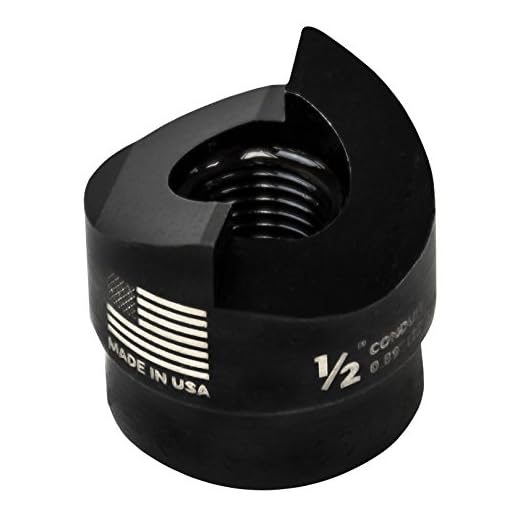
721-1/2 0.500 Conduit Punch Black
This punch is a straightforward replacement or spare for common 1/2" knockout needs and performs cleanly across common materials. It’s best used as part of a matched punch/die set rather than on its own.
Purpose and practicality
I treat the 721-1/2 as a spare or replacement punch for 1/2" conduit work. It’s built to the usual Greenlee standard and is a solid economical option when you need a single-size punch.
How it performs
Used with the correct die and draw stud, it cuts cleanly through mild steel and performs well on softer materials like aluminum or plastics. Several reviewers noted it cuts better than older-style punches and clears slugs more easily.
Practical reminders
Make sure you purchase the matching die and draw stud if you don’t already have them — this listing is punch-only. Also verify part numbers and compatibility if you’re mixing older and newer Greenlee product lines.
Bottom line
For a single-size punch that’s inexpensive and durable, this is a reliable little tool to keep in your kit.
35178 1-inch Knockout Punch (25.4 mm)
This single 1" punch is a no-frills solution for creating clean round holes and is useful when you need an exact 25.4 mm hole. It’s inexpensive and useful as a spare, but sizing differences from standard knockouts can confuse buyers.
Intended use and fit
I treat the 35178 1-inch punch as a simple, single-size tool for making a 25.4 mm hole. It’s a practical choice for one-off jobs or as a replacement punch in a kit.
Field notes
When used properly — threaded fully through the panel and tightened to completion — the punch yields clean holes. Some users who stopped tightening early experienced tearing or rough edges, so proper technique is important. On thin panels the cut slug usually falls free, but on thicker or unsupported sheets you may need to pry the slug out carefully.
Compatibility and caution
Note that some electrical knockout standards label holes differently; a nominal "1-inch" conduit knockout is sometimes larger than 25.4 mm. Verify the required hole size before purchasing. If you need standard conduit knockout dimensions, double-check the product description to avoid sizing surprises.
Summary
This is a straightforward, budget-friendly 1" punch for correctly sized applications, but it requires attention to proper setup and sizing to avoid poor cuts.
Final Thoughts
My top pick is the LS50L11B Battery-Powered Knockout Driver Kit. It earned the spot because it marries true portability with the muscle to punch 1/2"–2" knockouts quickly. The battery-hydraulic setup, auto-stop, and 360° swivel head mean I can work one-handed, overhead, or at odd angles without fighting hoses or asking for help. Buy this if you do frequent knockouts, work in tight or elevated spots, and want to speed up jobs while cutting fatigue.
For a clear second choice, I recommend the 7238SB Slug-Buster Knockout Punch Kit. This is the everyday workhorse for electricians — clean holes, reliable slug ejection, and a high-leverage ratchet that actually reduces fatigue. Pick this if you want a compact, dependable manual kit for routine panels and conduit work, or as a rugged backup when battery tools aren’t practical.







I liked that you included the small 1/2″ and 1″ punches — for someone who does low-volume installs, those single punches are perfect and I keep one in my pouch. Quick tip: mark the case with size labels so you don’t fumble in the dark.
Great idea, Hector — reflective tape = pro hack.
Labeling is underrated — saves time on job sites. Thanks for the tip!
I stick reflective tape on the edge of my case so I can spot it at night — works like a charm.
Anyone tried using the 7310SB for punching through thicker stainless? We do some commercial kitchen work and stainless is a pain. The 11-ton rating seems promising but I’m wary.
The 7310SB is capable of thicker materials, though stainless always demands tougher dies and patience. Make sure you’re using hardened components and don’t rush the stroke — multiple light passes are better than one forced attempt.
Used it on 14-gauge stainless occasionally. It worked but you will need to dress the edges afterwards. Consider heavier-duty dies if you do lots of stainless.
Also lubricate and inspect the slug-buster parts more frequently when running stainless to avoid premature wear.
Great roundup — thanks for putting this together. I’ve been on the fence between the LS50L11B battery punch and the 7310SB hydraulic kit. You rated the battery driver higher for portability, but can it really handle repeated 2″ knockouts on thicker panels without overheating? Anyone used both back-to-back?
Good question — the LS50L11B is surprisingly robust for its size. In my testing it handled a run of 2″ knockouts with periodic cool-downs fine. For continuous heavy-duty work, the 7310SB’s hydraulic force is more consistent though less convenient to carry.
I own the LS50L11B — it’s awesome for solo jobs and overhead stuff. For thick steel every single run? Not as fast as a full hydraulic pump, but still usable. Battery life was fine for a day’s worth of typical work.
If you’re doing repetitive 2″ in heavy gauge, go hydraulic. If you’re hopping around houses and doing occasional big holes, battery all day. Fwiw, the LS50L11B head swivel is a lifesaver in tight spots.
Big fan of the 7235BB compact set — perfect for my small crew van. I do mostly 1/2″ to 1-1/4″ conduit and the portability is clutch. One tiny gripe: the case could use better foam inserts to keep pieces from rattling.
I just wrapped mine in a towel 😂 saved my sanity and the tools. Cheap fix.
Thanks — good point about the case. Manufacturers often skimp on interior padding for compact kits, so adding a bit of foam or repo cases is a cheap upgrade.
I appreciate you calling out the catalog/label substitutions for the K2P-3/4. Bought one last year and it was a different revision — had to call Amazon for a return. Make sure to check the fitment as you said.
Thanks for sharing — frustrating when that happens. If you’re buying a specific revision, check seller photos and part numbers, and ask the seller if unsure.
I had the same issue. Amazon support sorted it but I lost a day. Always double-check the SKU and the measurements.
Long comment incoming — please bear with me, I had to explain this to a coworker and wanted to add it here too.
I started in electrical 8 years ago and the slug-buster sets (7238SB and 7235BB) were my first real tools. Over time I added a small hydraulic kit (7906SB) for awkward boxes and the battery driver for overhead panels. The difference in ergonomics is night and day:
– Manual is fast for a few holes, cheap, and portable.
– Right-angle hydraulic saves your shoulder in tight boxes.
– Battery is the compromise: fast, portable, but not as powerful as larger hydraulics.
If you’re building a kit, think of layers: a compact manual set for everyday, a hydraulic for problem jobs, and a battery punch for solo, varied work. TL;DR: mix and match based on job type, not ‘one tool rules all’.
I appreciate the detail — super helpful for planning purchases.
This is gold. I wish someone told me that when I started. Saved my back and my wallet later on.
Excellent rundown, Lydia. That layered approach is what I recommend to most pros as well — covers all scenarios without breaking the bank on a single solution.
Thanks everyone — these real-world experiences really help readers decide what’s right for them.
This is nitpicky, but the review badge for the 7238SB calling it ‘Reliable manual slug-buster kit for pros’ is accurate. I beat the heck out of mine and it keeps coming back for more. Anyone else have maintenance tips to make these last longer? I oil mine but don’t really do anything else.
Simple maintenance goes a long way: keep threads clean, lightly lubricate draw studs, store dies in their case to prevent nicks, and replace sharpening parts if you see burrs. Avoid dropping punches — dents kill alignment.
Use anti-seize on threads and keep the ratchet mechanism serviced. Also, a magnetized tray for parts when disassembling saves a lot of headaches.
Great tip on a magnetized tray — saved me multiple times picking up tiny slugs in the field.
Question — the Greenlee 710 manual stud punch looks nice and light, but how does it compare on durability vs the ESP710L11? I do framing and occasionally need larger holes in studs.
The 710 is a simple manual tool intended for standard stud work — lightweight and durable for its class. The ESP710L11 is a heavy-duty unit for high-capacity structural punching and will last longer under frequent heavy use, but it’s a different price bracket.
I used a 710 for years with no issues. If you’re punching tons of studs every day, consider the ESP710L11. Otherwise 710 is cost-effective and ergonomic.
Also, the 710 is waaay quieter 😅 if you’re working in occupied houses.
Short and simple: the 721-.500 punch is one of the best budget spares you can keep in the truck. Clean cuts, cheap, and replaceable. 👌
Generally yes if you’re matching the punch/die series, but check thread sizes and compatibility with your draw studs first.
Would they fit in the 7238SB kit? I’m thinking of adding a spare to mine.
Yep. Bought a couple extra for backup and they’ve saved me more than once.
Agreed — great spare to have on hand. Helpful for emergency replacements on site.
Loved the photos of the 7238SB slug-buster kit. I use a manual ratchet set on residential jobs — do you think stepping up to the 7906SB hydraulic right-angle would be overkill for remodels? I mostly do conduit up to 1″.
For mostly 1″ conduit in remodels, the 7238SB or the compact 7235BB is usually plenty. The 7906SB is excellent in tight angles, but it’s heavier and more than needed if you’re not doing thick-gauge or high-volume work.
I had a 7906SB for a while after a commercial gig and sold it when I went back to residential — totally overkill for small jobs. Keep the slug-buster if you like light weight and speed.
I like that you included the single 1″ punch. Not glamorous, but sometimes you just need that exact hole and nothing else. Quick Q: any tips on preventing deformation when punching through painted surfaces?
Also try a gentle touch with a burr file afterwards to clean up any paint flakes — prevents rusting.
Use a backing plate or clamp to support the sheet while punching and apply steady, even pressure. For painted surfaces, mask the area to reduce chipping and use a sharp, well-maintained punch.
Your ranking surprised me a bit — I expected the ESP710L11 to be top given it’s heavy duty. But calling out the battery-hydraulic convenience makes sense. For those doing structural gig after gig though, is the ESP still worth the price?
I paid up for the ESP for a commercial crew and didn’t regret it. The speed paid back the cost over a season of heavy work.
If your work is high-volume structural punching, the ESP710L11’s speed and durability make it worth the investment. The LS50L11B is ranked higher mainly for balance of portability and broad utility for solo tradespeople.
Totally depends on volume. For my one-person biz, battery wins. For steady production lines, ESP.
Tiny comment but the photo on the LS50L11B in your post made it look smaller than I imagined. How much does it weigh with battery? I carry my kit up stairs a lot and weight matters.
I swap to a lighter battery for long climbs — less run-time but easier on the knees.
With the battery it’s still lighter than most hydraulic pumps + hose combos. Exact weight depends on battery choose, but it’s optimized for one-person portability. Check the spec sheet on Amazon for the exact battery model weight.
Funny story: I bought a cheap knockoff punch once and the slug got stuck and jammed everything. Since then I only buy Greenlee or nothing. This article confirms why — quality matters. 😂
Ouch! Cheap knockoffs can cause real downtime. Greenlee’s engineering tends to minimize those jams, which pays off in the long run.
Same. Learned the hard way. Greenlee is pricier but worth the hassle avoided.
Alright, rant incoming — why are single punches like the 1″ and 1/2″ still so cheap but everyone charges an arm for the hydraulic kits? I get the complexity, but the markup seems wild sometimes.
Market for pro tools is smaller, so economies differ. Also brands like Greenlee build to last — that’s part of the premium.
Supply, manufacturing complexity, and tech in hydraulic systems drive the price. Also pro-grade warranties and materials add cost. Still feels rough when you just need a tiny part.