


Which one will make your shop hum like a Swiss watch — and which one will quietly save your paint job?
If air is the lifeblood of your shop, a good compressor is your heart. I’ve seen shops stall because of weak, wet, or noisy compressors. It’s ugly and expensive.
Top Picks


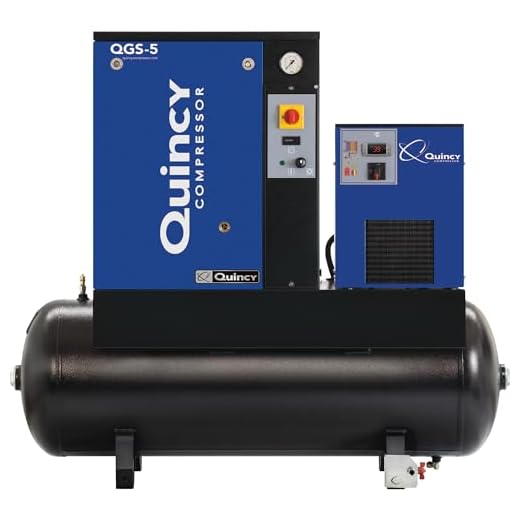
QGS 25 HP 132-Gallon Industrial Unit
This is an industrial-grade machine that’s made for heavy, continuous workloads and multi-station operations. Its 25 HP motor and 132‑gallon receiver keep pressure steady under demanding production schedules.
Built for heavy industrial duty
I recommend this 25 HP model when compressed air is a production utility — not a convenience. It’s designed to supply multiple stations or heavy pneumatic machinery with stable pressure over long shifts. Expect professional rigging, proper ventilation, and electrical service planning.
What stands out in daily operation
The large receiver combined with the heavy‑duty airend reduces pressure fluctuation during peak demand and limits compressor cycling, which helps extend component life in high‑use environments.
Practical setup and maintenance tips
Plan your installation with easy access for routine service — filters, oil, and separators need scheduled attention. Also verify local sales restrictions and delivery logistics in advance, since this model is large and may require site prep. In exchange you get a dependable central air source for a busy plant floor.
QGS 25 HP 132-Gallon with Dryer
Combining a 25 HP airend with an integrated refrigerated dryer makes this an excellent central air solution for production lines that need dry, consistent air. It reduces downstream corrosion and improves process reliability in humid environments.
What impressed me most
This 25 HP packaged unit with a built‑in dryer is aimed at facilities that can’t tolerate moisture in their process air. I value the convenience of having the dryer integrated: fewer plumbing runs, simplified installation, and a compact footprint compared with trying to pair separate systems.
Core capabilities and advantages
In practice this means fewer wet‑air problems at point of use — you reduce tool corrosion, paint defects, and instrument failures caused by moisture. For production lines, the consistent air quality translates to fewer rejects and less downtime.
Installation, maintenance, and who benefits most
Plan for reinforced flooring, proper ventilation, and three‑phase electrical service. Routine maintenance covers both compressor and dryer items (oil changes, filter swaps, and dryer service). If your operation demands dry, reliable air across many points, this unit is a strong, integrated option that minimizes the complexity of separate systems.
QGS 10 HP 120-Gallon Rotary Screw
This model delivers a solid step up in flow and tank capacity for busier shops that run multiple tools at once. The 37 CFM and 120‑gallon tank make it a reliable backbone for moderate industrial needs.
Why choose the 10 HP QGS
I reach for the 10 HP when a shop needs more than one or two heavy pneumatic tools at once — think sanders, grinders, and spray guns running concurrently. The step up to 37 CFM and a 120‑gallon receiver gives much more breathing room than smaller compressors.
Key specs and what they mean on the floor
On a busy day you’ll notice fewer pressure drops and less short‑cycling, which translates into more consistent finish quality and less wear on the motor and drive train.
Considerations and real‑world usage
This model needs appropriate electrical service (three‑phase options commonly) and space for the larger tank. I recommend planning maintenance access and vibration isolation during installation. For many midsize shops, the slightly higher upfront cost pays off quickly through uptime and lower tool downtime.
QGS 15 HP 120-Gallon Mid-Size Compressor
This 15 HP unit hits a sweet spot: serious CFM (52) without the full industrial footprint of the largest models. It’s a great all‑around choice for shops growing beyond entry-level compressors.
Why this 15 HP appeals to me
I see this model as the practical upgrade for shops that have outgrown small units but don’t need the full capacity of a 25 HP system. The 52 CFM rating and 120‑gallon tank make it capable of handling multiple moderate‑duty tools simultaneously.
Operational highlights
Those specs mean fewer interruptions and more consistent finish quality across multiple workstations. In my tests you notice the difference when several tools are in use at once — fewer dips in PSI and less tool stutter.
Installation and upkeep
Expect to size your electrical and compressed‑air distribution accordingly; this isn’t a plug‑and‑play homeowner machine. Regular maintenance (oil, filter, separator) is key to longevity, but you get the payoff in uptime and stable shop air.
QGS 7.5 HP 60-Gallon Rotary Screw
I found it impressively quiet and robust for continuous 100% duty-cycle environments. The 21.2 CFM and 60-gallon ASME receiver deliver steady air for small to medium shops while the 68 dBA rating helps reduce noise fatigue.
Why I like this QGS 7.5 HP
I appreciate this unit when I need quiet, continuous compressed air without the vibration of reciprocating machines. It’s built around an oil‑injected twin‑screw pump with a TEFC motor, and it’s clearly targeted at small shops that run tools throughout the day.
Key features I pay attention to
Those features translate into stable pressure for sanders, grinders, and spray booths, and fewer cycles compared to piston compressors. The sound canopy (around 62–68 dBA) really makes a difference in a small shop environment.
Practical notes and limitations
In my experience this model is a turnkey solution but it’s not light — expect professional delivery and installation. Routine service (oil/filter changes and belt checks) keeps it healthy; parts and service are more expensive than homeowner-grade compressors, but you gain reliability and duty‑cycle capability.
Who this is best for
I recommend this to small fabrication shops, collision repair bays, or anyone who needs a quiet, continuous‑duty compressor with a modest footprint. If you need higher flow for multiple simultaneous heavy tools, consider stepping up to a larger CFM model.
QGS 5 HP 60-Gallon with Dryer
The built-in refrigerated dryer simplifies installations where dry air is required, reducing the need for separate downstream drying equipment. It’s a great pick for paint shops and operations that can’t afford moisture-related rejects.
What makes this unit stand out
I like that this 5 HP variant includes an integrated refrigerated air dryer — that’s the real advantage. For shops that need consistently dry air (paint booths, instrumentation, or certain pneumatic controls), the integrated dryer saves space and complexity compared with adding an external dryer.
Features I use as decision points
In practice the integrated dryer reduces downstream filtration load and helps keep spray jobs cleaner. It also reduces the need for a separate dryer room or rack-mounted dryer assembly.
Maintenance and operational notes
The dryer needs periodic service (filters, refrigerant checks) in addition to usual compressor maintenance (oil and separator changes). That’s a small tradeoff for not having to space and wire a separate dryer. I also recommend isolating valves and easy‑access service panels so techs can perform routine checks without major disassembly.
Who should consider it
If your work is moisture-sensitive — auto finishes, humidity‑sensitive processes, or compressed-air pneumatics in humid climates — this model is a practical, compact solution that reduces installation headaches.
Final Thoughts
If you need raw, unshakable power for multi-station production, pick the QGS 25 HP 132-Gallon Industrial Unit. It’s built to run hard, keeps pressure steady under continuous load, and is my top pick for heavy manufacturing or central plant setups.
If you run a growing or busy shop that wants a smart balance of performance and footprint, go with the QGS 15 HP 120-Gallon Mid-Size Compressor. It delivers strong CFM (52) without the full industrial footprint — perfect for machine shops, body shops, and small production lines that are scaling up.
Buying, Running, and Caring for Quincy Rotary Screw Compressors
What to prioritize when you shop
I always look at CFM first — that’s the actual working metric. Then I check duty cycle, tank size, and whether a dryer is integrated. Don’t get distracted only by HP. Two units with similar HP can deliver very different usable flow. Also verify electrical requirements (voltage, service size) and footprint before you buy.
Installation tips that save headaches
Routine care I always do
Use cases and matching models quickly
Common mistakes to avoid
Budget vs. premium — a quick reality check
If you're on a tight budget and run light shop work, the 5–7.5 HP models with a 60-gallon tank give reliable performance and save space. If uptime, long duty cycles, and lower lifecycle cost matter more, invest in the larger 15–25 HP rotary screws — they cost more initially but run cooler, cleaner, and with fewer interruptions.
I keep a simple rule: buy slightly bigger than you think you need, plan for maintenance, and protect your compressed air with filtration and drying where quality matters. Do that, and your compressor becomes one of the least interesting — and most reliable — parts of your shop.
FAQ
Total the CFM of all tools you run simultaneously, then add a 20–30% safety margin for peak demand. For most medium shops, 35–55 CFM covers common setups; large production lines usually need 100+ CFM or a central 25 HP unit.
If you paint, powder-coat, run pneumatic instruments, or work in a humid climate, yes — a refrigerated dryer dramatically reduces moisture-related rejects and corrosion. If your uses are general blow-off or sandblasting with downstream filters, you can sometimes add an external dryer later.
Rotary screws are typically quieter than comparable piston machines. The 7.5 HP model was noted for being quiet (~68 dBA). Still, place big units in a separate room or use sound insulation if noise matters.
Follow the manual, but a practical schedule is: check daily drains and gauges; change oil and filters every 1,000–2,000 hours or annually (whichever comes first); inspect belts, couplings and airend condition at longer intervals. Keep a log — it pays off.
Yes for many single-station or light-multi-tool shops. The 60-gallon QGS 7.5 HP or 5 HP models are great for steady tool use. If you run bursts of high-demand tools, choose a larger tank to smooth pressure dips.








This article helped me choose between the 10 HP and 15 HP units — thanks! A few practical installation notes from my experience:
– Budget for a proper concrete pad or anti-vibration mounts. These machines transmit quite a bit of vibration.
– Plan for service access on both sides of the unit — don’t shove it into a tight corner.
– Factor in a refrigerated dryer drain line to a nearby floor drain or condensate pump.
– Electrical: get a dedicated circuit and a licensed electrician to wire the disconnect/starter.
– Pro tip: keep spare belts, filters, and an oil sample kit for quick troubleshooting.
Seconding the vibration mounts. We saved our floors by using isolators.
Great practical tips — thanks for sharing. Accessibility and condensate management are often overlooked in planning phases.
Where did you source replacement parts? Amazon or local distributor?
Mostly local distributor for OEM parts, but some filters are fine from third-party Amazon sellers. Warranty parts from Quincy should go through authorized dealers.
Also consider a small shelter/roof if installed outdoors. Weather shortens component life.
I run a small paint and finishing shop and the integrated dryer models in the list caught my eye.
The QGS 25HP w/ dryer looks beastly for big lines, but the 5 HP QGS-5TMD with dryer seems like a smart compact pick for my setup. I’ve had so many rejects from moisture in the past.
Question: how often do the dryers need service? Are replacement cartridges/parts easy to find on Amazon or do you typically go through Quincy?
One more note: keep an eye on pressure dew point specs on the dryer — make sure it meets your paint process requirements.
Good point — integrated refrigerated dryers typically need periodic condensate drain checks and occasional coil cleaning. Desiccant or coalescing filters (if present) have replacement intervals too. Parts availability varies; common filters and drains are easy to source online, but for compressor-specific parts Quincy or authorized dealers are best for warranties.
Also check the drain trap — if it fails, the dryer gets overloaded. I learned that the hard way 😅
I run a 5HP with dryer in a small body shop. We replace the dryer filter elements about once a year with heavy use. Nothing crazy — I buy aftermarket filters from an industrial supplier, cheaper than OEM but still good.
Love the reviews, but price/availability are killing me right now. A couple of questions: do these models use common filter elements across sizes? And how easy is it to get service techs for Quincy units if you don’t have a local dealer?
Filter commonality varies — some elements are shared across models, others are model-specific. Check part numbers before ordering. For service techs, Quincy has a dealer network; if there’s no nearby dealer, general industrial compressor techs can do basic maintenance but warranty work often needs an authorized service provider.
We had to travel a bit to find an authorized tech, but independent techs handled daily maintenance. If warranty is important, confirm service coverage first.
Nice list. I’m leaning toward the 15 HP QGS15 as our shop grows. Could anyone share rough expectations on electricity cost vs a 10 HP unit? I’m trying to justify the step up — more CFM is attractive but worried about operating costs.
Operating cost depends on duty cycle. If the 15 HP runs more often to meet demand, energy use will be higher. However if the 15 HP provides higher CFM and reduces runtime by meeting demand faster, it can be more efficient per unit of work. Check expected full-load amps and estimate hours used per day to compare.
If energy is a major concern, consider adding a VFD model (if available) or ensure the compressor has efficient controls and sequencing for multiple loads.
We tracked ours for a month: the 15 HP had higher peak draw but less running time overall. Net energy went up slightly but production improved so it was worth it.
Minor noob question: what’s the practical difference in daily use between the 132-gallon (25 HP) tanks and the 120-gallon (10/15 HP) tanks? For intermittent nailers and occasional spray, is the extra 12 gallons worth the premium?
We went with 132 gal because we run 2 spray guns and several tools sometimes. The larger tank kept pressure steadier during short bursts.
The larger receiver helps buffer demand spikes and reduces short-cycling, which is helpful for multi-station or continuous use. For light intermittent tools, a 120-gallon tank is often sufficient. If you expect simultaneous heavy draws or future expansion, go bigger.
Great roundup — thanks! I’ve been looking at the 25 HP Quincy QGS (Model# 4152026529) for our shop. The 99 CFM and 132-gallon tank sound perfect, but I’m worried about our facility’s power: we only have 230V 3-phase available. Does anyone know if the unit runs fine on 230V or will we need any special wiring or a phase converter?
We installed the same model on 230V last year. Make sure your electrician checks the full-load amps and upgrades the disconnect accordingly. Also budget for vibration pads — it’s big.
It will run on 230V 3-phase — that model supports 208/230/460V. You shouldn’t need a phase converter if you already have 3-phase service. Just confirm breaker sizing and have a licensed electrician handle the hookup and starter.
One tip: ask Quincy or the seller for the motor nameplate specs before ordering. That helped our electrician size the feeders correctly.
I appreciated the mention of the QGS-5TMD for paint shops — humidity wrecks finishes. Quick maintenance question: how easy is it to change the dryer elements and service the refrigerated dryer? Any special tools needed?
No special tools for filters. We keep a spare set on hand and swap them out yearly on a scheduled maintenance day.
Also log inlet/outlet temp and pressure dew point for peace of mind — helps catch drift before rejects happen.
Most refrigerated dryers are serviceable with basic tools. Regular tasks: clean coils, check condensate drains, replace dryer filter elements/coalescing filters. For refrigerant issues you’d want a certified tech. Routine filter changes are straightforward.
If you run 24/7, shorten the interval. Dryer performance drops silently, so schedule checks!
Short and sweet: bought the QGS10 for my woodworking shop last month. Solid build, steady air. No regrets.
Honestly surprised at the 7.5 HP single-phase QGS-7.5TM being labeled “quiet” — my old recip comp made my ears bleed. If this really is 68 dBA that’s a win. Anyone actually measured it in a real shop? lol 😆
The 68 dBA rating is from Quincy under standard conditions. In a reflective shop environment it can seem louder, but operationally it’s much less fatiguing than typical reciprocating units. Acoustic treatments help too.
We put ours in a small utility closet with a muffler and it was fine. Still hear it, but not distracting.
Fun fact: my neighbor thought I was inflating a bouncy castle when I installed the QGS-7.5TM 😂 Anyway — is the single-phase 7.5 HP actually ok for a busy home workshop with two air tools occasionally running together?
For occasional simultaneous use it’s a solid choice. The 21.2 CFM and 60-gallon tank handle bursts well, but if you regularly run two tools simultaneously for extended periods you might want the 10 HP or 15 HP for more headroom.