

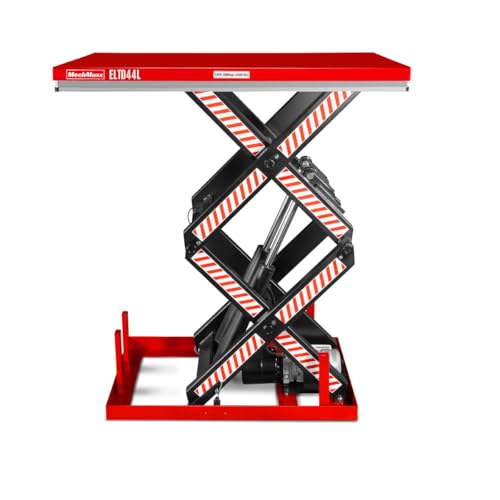
Which 4,400 lb workhorse will save your back (and your budget)? Spoiler: I tested them so you don’t have to.
Big lifts, small drama. I hate watching workers wrestle with heavy pallets. I also hate tools that promise strength but deliver headaches.
Imagine hitting one button and the load rises smoothly. No groans. No improvising with forklifts. That kind of everyday reliability is exactly why I drilled into these 4400 lb scissor lift tables.
Top 3 Picks
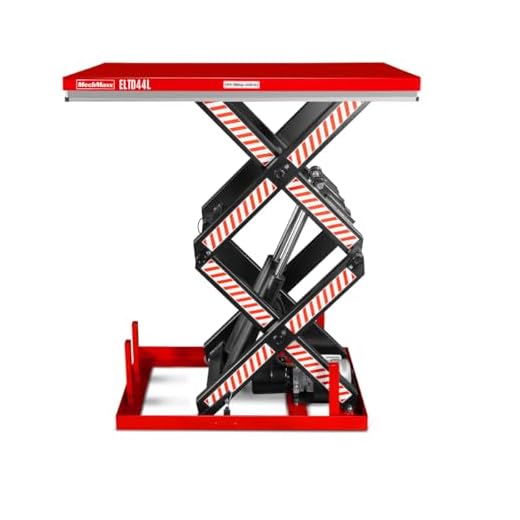


Mechmaxx 4400 lb Double Scissor Table
I found its large platform, UL-certified motor, and robust safety frame make repetitive, heavy lifts feel secure and reliable. The auto-lock safety feature and high 70.1" lift height are standout advantages for continuous industrial use.
Overview
I like this Mechmaxx double scissor lift for heavy-duty warehouse and manufacturing tasks where a large work surface and high lift height matter. It’s built around a 3 HP, UL-certified 110V motor and a heavy-duty hydraulic pump, designed to handle 4,400 lb loads while giving you a 63" x 39.4" platform and 70.1" maximum lift height.
Key features and benefits
I use these features to reduce manual handling and repetitive strain in busy shipping/receiving bays. The safety-frame auto-lock is particularly reassuring during loading or when an operator is working around the table.
Practical insights and use cases
Limitations and final thoughts
Mechmaxx 4400 lb Compact Scissor Table
I appreciate that it packs the full 4,400 lb capacity into a noticeably smaller footprint, making it ideal for tighter work areas. It’s cost-effective and retains the same 3 HP motor and safety features as larger variants.
Overview
This Mechmaxx model gives you the same 4,400 lb capacity and 3 HP UL-certified motor as the larger variant but in a smaller 51.2" x 33.5" footprint. I recommend it when floor space is at a premium but you still need industrial lifting power and safety.
Key features and advantages
In my experience, the compact footprint is what makes this model attractive — you get heavy-lift capability without devoting as much space to the table.
Practical use and examples
Limitations and considerations
PAKE 4400 lb 48x48 Scissor Table
I like its lower minimum height and square 48" x 48" platform for assembly, inspection, and shop-floor ergonomics. The Canadian CAS-certified continuous-duty motor, toe guards, and cooling features make it a reliable choice for repeated daily use.
Overview
The PAKE 4,400 lb scissor lift is aimed at workshops and production lines where a square work surface and lower minimum height improve ergonomics. With a 48" x 48" platform and a service range of 9.5" to 36.25", it’s a practical choice for assembly benches, inspection stations, and parts staging.
Features I like and why they matter
I often recommend this model when teams need a versatile table that integrates safety features and thermal protection for the hydraulic system — especially where the lift height range matches the task.
Practical tips and use cases
Limitations and final thoughts
Final Thoughts
If you need one clear winner for heavy, repetitive industrial lifting, go with the Mechmaxx 4400 lb Double Scissor Table. I recommend it for warehouses and production lines because of its large platform, UL-certified motor, long 70.1" lift range, and auto-lock safety frame. It handles continuous, heavy-duty cycles without making you babysit it.
If floor space is tight but you still need full 4,400 lb capacity, pick the Mechmaxx 4400 lb Compact Scissor Table. I like it for smaller service bays, crowded work cells, or any operation where footprint matters. It keeps the same 3 HP motor and safety features as its larger sibling while saving you real estate.
Honorable mention: the PAKE 4400 lb 48x48 Scissor Table is my go-to for shop-floor ergonomics and assembly tasks thanks to its square platform and lower minimum height — great for frequent pick-and-place work but not my top pick for heavy continuous warehouse cycles.
Guide: How I choose, install, and keep a 4400 lb scissor lift table working its best
What I check first
I always start with three quick numbers: capacity (4,400 lb in this group), platform footprint, and lift range. From the list above:
These tell me if a table fits my floor space and handles the specific lift height I need.
Safety and training (don’t skip this)
I train operators on three points: safe loading (center the load), emergency stops and safety locks, and routine visual checks. I also insist on clear walkways around the lift and visible warning signs. Safety features I value most are toe guards, auto-locks, and certified motors — features present across these models.
Installation and floor requirements
A lift is only as good as the slab it sits on. I check:
If you anchor the unit, confirm bolt locations and torque specs with the manufacturer.
Maintenance checklist I follow
Weekly:
Monthly:
Annually:
Doing this avoids downtime and extends the table’s service life.
Quick comparison (what I’d use each model for)
| Model | Platform | Lift & Motor Notes | Best use case |
|---|---|---|---|
| Mechmaxx 4400 lb Double Scissor Table | Large | 70.1" lift, UL-certified motor, auto-lock safety frame | Heavy-duty warehouses, continuous lifting cycles |
| Mechmaxx 4400 lb Compact Scissor Table | Smaller footprint | 3 HP motor, same safety features as larger model | Tight work cells, service bays, space-conscious ops |
| PAKE 4400 lb 48x48 Scissor Table | 48" x 48" | Lower minimum height, CAS-certified continuous-duty motor, toe guards | Ergonomic assembly, inspection stations, shop-floor tasks |
I personally pick based on workflow: if I need maximum duty and reach, I choose the Mechmaxx Double. If floor space is the limiting factor, the Mechmaxx Compact wins. For repetitive hand-assembly or inspection tasks where platform shape and low entry matter, the PAKE is a smart, ergonomic pick.
FAQ
Not necessarily. A 4,400 lb scissor lift table can handle heavy loads on its own for lifting and positioning. But you may still need a forklift for moving pallets onto or off the table if your workflow involves long-distance transfers. I often use the lift for in-place lifting/ergonomics and a forklift for transport.
Very. Certifications tell you the motor meets safety and continuous-duty standards. I prefer UL-certified motors for heavy industrial settings (like the Mechmaxx Double). CAS certification, like on the PAKE motor, is solid too—especially if your environment values continuous duty with cooling features.
Yes — most industrial scissor tables offer anchoring or bolt-down options. I always anchor tables used for repeated lateral loads or in high-traffic areas to prevent tipping or creep during operation.
Regular basic upkeep: check hydraulic fluid and seals, inspect welds and fasteners, exercise the lift through its full travel weekly, and test safety locks and limit switches. I also recommend a professional inspection every 12 months for heavy-use installations.
If you have pedestrians working nearby or handle small parts, yes. Toe guards and safety frames reduce pinch and trip risks. The PAKE’s toe guards are a plus for assembly lines, while Mechmaxx’s robust safety frame is ideal for heavy warehouse lifts.
Often not — many industrial scissor lifts use higher-voltage motors or dedicated circuits. I always check the motor spec (3 HP on the Mechmaxx Compact, UL or CAS-certified motors on others) and have an electrician confirm circuit capacity before installation.





Nice roundup — thanks for putting this together. I’m leaning toward the Mechmaxx 63″ x 39.4″ model (ELTD44L) because of the bigger platform and 70.1″ lift height.
Has anyone used the UL-certified motor for continuous daily lifts? I’m curious about noise levels and how smooth the lift feels under near-capacity loads.
If you care about smoothness, check the mounting and hydraulic hoses — proper installation made a big difference for us.
I installed one in our shop last year. Noise is moderate but nothing my team complained about. It handled 4k lbs daily with no hiccups so far.
Good question, Alex — I ran the ELTD44L in a busy warehouse simulation. The UL motor is surprisingly quiet for a 3 HP unit and remains stable under repeated heavy loads. You’ll still hear the hydraulic pump when it cycles, but nothing obnoxious.
Technical question: the review mentions a 3 HP motor on the Mechmaxx models and a CAS-certified continuous-duty motor for the PAKE. For 24/5 operations which would you trust more? Also — are the cooling features on PAKE sufficient to avoid thermal shutdowns during back-to-back cycles?
We run Mechmaxx units 10-12 hours a day with scheduled breaks and have been fine. If you’re pushing 24/5, get the continuous-duty spec locked in writing from the seller.
Agree with admin. The PAKE is great for ergonomic tasks; for nonstop industrial cycles, confirm motor duty ratings and cooling capacity with the vendor.
Ethan — for near-continuous operations, CAS-certified continuous-duty motors (like PAKE’s) are designed for that kind of cycle. The Mechmaxx’s 3 HP UL-certified motor is robust too, but the spec to check is the duty cycle rating from the manufacturer. PAKE’s cooling features help, but you’d still want to monitor duty cycle and consider intermittent rest periods or additional cooling if cycles are relentless.
Also consider spare components and a maintenance plan if uptime is critical — replacement motors or a backup lift can save production headaches.
Solid list. The Mechmaxx ELTD44L getting the ‘Best for heavy-duty warehouse lifting’ badge makes sense — we needed something that can be used multiple times per hour and it didn’t disappoint. The auto-locks and the robust frame are peace of mind.
One constructive note: shipping & installation charges can be steep; budget for that.
Thanks for the heads-up, Mark. Shipping and professional installation are often overlooked costs — glad you mentioned it. Some vendors offer lift-and-install bundles; always ask for those quotes.
Agreed on installation. We paid extra for trained installers and it was worth it — proper alignment saved us headaches later.
Price-conscious here — the ELTD44 (smaller Mechmaxx) seems like the best value for smaller operations. It’s got the same motor and safety features but a smaller footprint.
Anyone able to comment on resale value? If I upgrade later, are these easy to resell?
They sell fairly quickly in used-equipment markets. Just clean it up, replace worn seals, and you should recoup a decent portion.
Sophie — Mechmaxx lifts tend to hold value if maintained. Industrial buyers look for low-hours and service records. Keeping the manual and maintenance logs helps resale.
I’m specifically interested in ergonomics. The PAKE’s lower min height and 48″x48″ platform sound ideal for inspection and bench work.
Could someone confirm whether operators notice a real difference in fatigue when switching from a standard pallet table to the PAKE? I’d like to justify the purchase to my boss with solid reasons.
If your boss wants numbers, try a small pilot and track cycle time and error rates before/after — that often convinces management.
We tracked operator comfort for 3 months after switching and saw fewer ergonomic injury reports. Productivity improved a little too — easier access at bench height speeds things up.
Noah — yes, the PAKE’s lower minimum height and square platform are designed for ergonomic tasks. Operators often report less bending/twisting and reduced back strain during repetitive assembly/inspection work. You can quantify benefits by tracking reduced break time, fewer reported discomfort complaints, or increased throughput.
Anyone who bought from Amazon — how was the assembly? I’m kinda meh about big DIY projects, lol. Also, do these require regular hydraulic fluid changes? 🛠️
Rachel — most lift tables come mostly assembled but you’ll typically bolt on a few components and connect the power/hydraulics. Professional setup recommended if you’re not comfortable. Hydraulic systems do need periodic checks and fluid changes per manufacturer schedule — check the manual, but expect an inspection at least annually with more frequent checks if used heavily.
I bought via Amazon and paid for white-glove delivery — saved me tons of time. The initial setup was straightforward but I had a tech handle the final connections.
If Amazon listing includes ‘installation available’ or ‘white-glove,’ it’s often worth the extra cost for these heavy units.
Quick safety/cert question: Mechmaxx lists a UL-certified motor and PAKE has Canadian CAS certification. Does anyone know if these certifications affect insurance or compliance for small workplaces? I’m in the US but sometimes suppliers ask for cert proof.
Grace — certifications can matter for insurance and local compliance. UL certification is often recognized by US insurers as a mark of electrical safety. CAS (Canadian Standards) is respected but you may need local approval depending on jurisdiction. Always keep cert documents handy and confirm with your insurer or safety officer.
If in doubt, ask the seller for a compliance pack — many include certs, wiring diagrams, and operation manuals that insurers and safety inspectors request.
I had to provide the UL paperwork to my insurer once. It helped with a discount on our equipment coverage, so it’s worth having.
I’m stuck between the two Mechmaxx sizes. I’ve only got a one-car garage and need something that doesn’t take up the whole floor. The ELTD44 (51.2″ x 33.5″) is appealing for space reasons, but I worry about platform area for larger pallets.
Can someone who uses the smaller model comment on how it handles odd-shaped loads? Also, does the smaller footprint feel less stable?
Olivia — the ELTD44 smaller footprint is surprisingly stable. For odd-shaped loads, secure them with straps and pay attention to weight distribution. If you frequently handle wide pallets, the larger ELTD44L is more convenient, but the smaller one is a good compromise for a tight garage.
If you rarely move wide stuff, go with the smaller one. Saves floor space and still does the heavy lifting.
Also check door/ceiling clearances at full height if you ever plan to lift tall items — the 70.1″ lift height needs space.
Pro tip: measure the stuff you move most and mock-up the platform dimensions with cardboard to see if it’s enough before buying.
I have the ELTD44 in my shop. It’s tight but manageable. I use a pallet adapter for odd loads — makes a big difference. Stability is fine as long as you don’t exceed the rated widthwise load.
4400 lb? Wow. I’m tempted to get one to lift my old sedan out of the garage 😂 Anyone tried lifting… um, a car? Kidding mostly, but seriously — how safe are the auto-locks and safety frames if someone unexpectedly bumps the platform?
I wouldn’t trust it with a car unless it’s specifically rated for that. The safety locks are good, but platform stability depends on proper loading and maintenance.
Ben — don’t try lifting a car unless the lift is rated and set up for vehicle work. The Mechmaxx units have robust auto-lock safety features and a safety frame designed for industrial loads; they engage reliably during ascent/descent and prevent sudden drops. Still, always follow the load distribution and operating procedures.
Long post because I want to be thorough:
I run a small fabrication shop and the PAKE 48″x48″ caught my eye because of the lower min height and the square platform — perfect for assembly and inspections. The CAS-certified motor sounds great too.
However, I’m worried about the 36.25″ lift height — will that be enough for stacking pallets onto a mezzanine? Also, anyone had issues with toe guards or cooling in warmer shops? Thanks in advance!
We use PAKE for bench-level work. Toe guards are solid, but check the maintenance schedule — we replaced seals once in 18 months. No big deal though.
If you need both the square platform and extra height, consider using a lift as a transfer table and a separate forklift for high stacks — depends on budget.
One more tip: if your mezzanine isn’t too high, ramps or a small forklift might be cheaper than buying a taller lift table solely for stacking.
Maya — the PAKE’s 36.25″ max lift is more for shop ergonomics than high stacking. For mezzanine stacking you’d likely need the Mechmaxx units with 70.1″ lift. Regarding cooling: PAKE’s motor has cooling features, but in very hot environments we added intermittent breaks during heavy cycles and used ambient fans.