
Titan Attachments Skid Steer Fronthoe — Turn Your Loader Into a DIGGING BEAST


Rugged, no-nonsense backhoe power for skid steers — reliable digging without the fuss
Sick of renting an excavator every time you need a trench? I was — and that’s why I tested the Titan Attachments Skid Steer Fronthoe. It promises straightforward digging power: a 6-foot boom, a 14″ bucket, SSQA quick-tach compatibility, and a single 3,000 PSI hydraulic cylinder that gets the job done without complicated hydraulics.
In my hands-on use it felt like a rugged, no-nonsense solution for farms, landscapers, and contractors who want reliable trenching and material-handling. Built from Grade 50 steel and easy to service, it’s powerful and practical — though it’s heavy (~397 lb) and a few useful extras (tilt bucket, thumb) are sold separately, so factor that into your plan.
Titan Fronthoe 14" Bucket & Thumb Attachment

I found this attachment to be a robust, no-nonsense fronthoe that turns a loader into a capable digging tool. It balances strength and simplicity well—great for farms, landscapers, and contractors who need reliable trenching and material-handling without complicated hydraulics.
In-depth Look: What this Fronthoe Brings to the Jobsite
I like tools that feel built to last, and this fronthoe attachment does just that. It’s designed to convert a skid steer or tractor loader into a compact backhoe-style digger while keeping the hookup simple. Below I walk through the features, how it performs on different tasks, setup and maintenance tips, and the practical things I noticed during use.
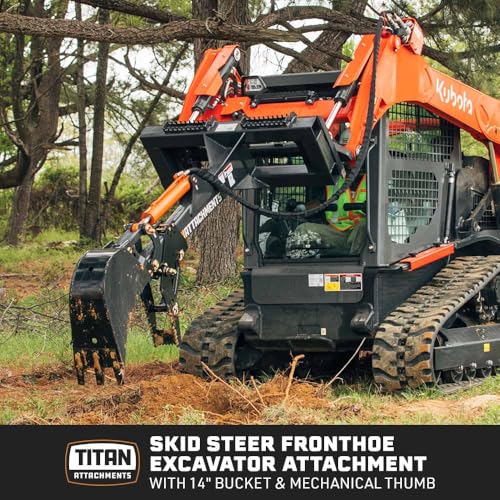

Key Features at a Glance
Built Tough: Materials, Welding, and Reinforcement
This fronthoe uses high-strength steel in the main structure and reinforced points where stress concentrates. The bucket and boom connections feature gussets and welded reinforcements to resist twisting and fatigue during repeated digging cycles.
Hydraulic Setup and Performance
The attachment is driven by a single hydraulic cylinder rated up to 3,000 PSI. That choice keeps the design simple and reliable, though it means some coordinated movements rely on the machine’s loader functions rather than multiple dedicated cylinders.
Compatibility & Mounting
I appreciated the SSQA (skid steer quick-attach) plate because it speeds changeovers on compatible machines. Still, you should confirm plate style and pin spacing with your loader before purchase.
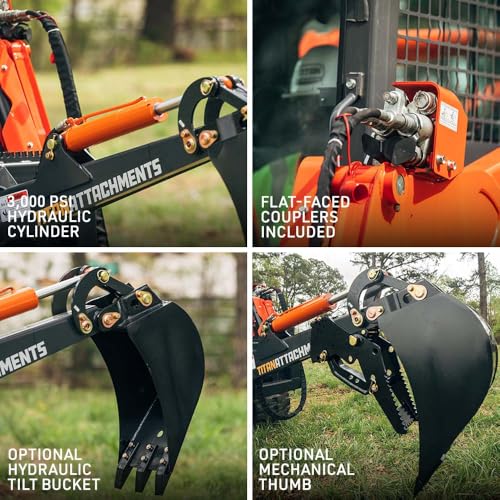

Bucket Options, Thumb, and Job Versatility
This model ships with a 14″ bucket, which is a compact yet effective choice for narrow trenching and utility work. For broader use, optional buckets (8″ to 24″) and a hydraulic-tilt bucket let you match the tool to the task.
Real-World Use Cases
I found the attachment especially useful in these scenarios:
Practical Installation & Safety Tips
Maintenance Checklist
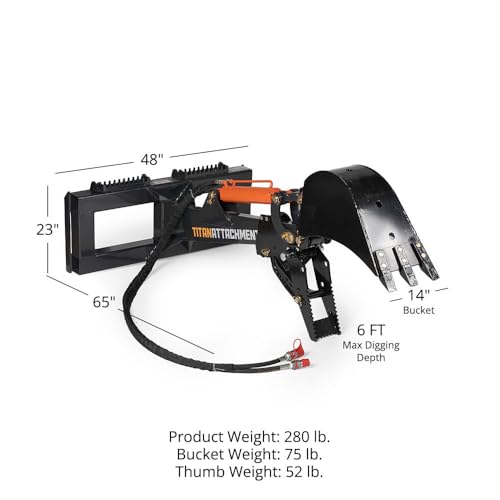

Quick Reference Table: Specs & What They Mean
| Spec | What I Care About | Practical Takeaway |
|---|---|---|
| Reach | 6 ft boom | Good depth for most residential and small commercial trenches |
| Cylinder | Single 3,000 PSI | Plenty of force; simpler plumbing but fewer independent motions |
| Bucket | 14″ bolt-on | Narrow trenching and working in tight spaces |
| Weight | ~397 lb | Durable construction, plan for safe mounting and transport |
| Mount | SSQA quick-tach | Fast swaps on compatible machines |
Who Should Consider This Attachment?
I recommend this fronthoe if you’re a landscaper, small contractor, or a farmer who wants a robust digging tool without the complexity of a full backhoe. It’s especially valuable when you already own a compatible skid steer or loader and need a low-cost way to add trenching and digging capability.
What I Wish Were Different
I would like to see a factory option with a second cylinder for independent bucket tilt or crowding, which would increase precision for grading tasks. Also, offering a package with a tilt bucket and thumb included would be useful for buyers who want an out-of-the-box, fully versatile kit.
Final Thoughts
Overall, this is a rugged, well-engineered attachment that brings meaningful digging capability to a loader platform. It’s not the lightest or the most feature-dense backhoe out there, but it excels at reliability and straightforward operation—qualities I value on a busy jobsite.
FAQs
I usually find compatibility if your machine uses a skid-steer style quick-tach (SSQA), but I always double-check first.
Before you buy, I recommend these quick checks:
If your loader uses a different quick-attach, adapters may exist. I always confirm adapter fit and the rated capacity before using one.
Yes—I treat this as a two-person lift because the unit weighs about 397 pounds.
When I mount it I do the following:
I always keep hands clear of pinch points and secure the attachment before operating.
Yes—the 14″ bucket and 6 ft reach work well for narrow utility trenches like irrigation, low-voltage conduit, and drainage lines.
A few practical tips I follow:
I avoid working near active gas or high-voltage lines and call professionals if utilities are nearby.
It’s straightforward if your machine has compatible couplers, but you should follow safe procedures.
My usual hookup steps are:
I also confirm my tractor’s hydraulic pressure and flow are compatible with the 3,000 PSI cylinder and set the machine’s relief valve accordingly.
I choose based on job type and budget.
If I’m moving lots of debris or palletizing material without leaving the seat, I prefer the hydraulic option.
I grease the pivots regularly to prevent premature wear.
My greasing schedule is:
I use a multipurpose NLGI #2 grease, wipe dirt off fittings before greasing, and avoid over-greasing—just pump until fresh grease appears.
It depends on what you need.
For routine trenching, digging, and general backhoe work I’ve found the single-cylinder setup to be perfectly adequate.
Yes—you can transport it, but you should plan for safe securing and weight handling.
Here’s how I handle it:
I also protect hydraulic hoses and cap couplers to keep debris out during transport.




Short and practical question: does the thumb come pre-installed or is it an add-on? The product title says “Include Backhoe Thumb” but sometimes sellers mean ‘available’ not ‘included’. Anyone confirm?
The listing title is a bit ambiguous. In my review I noted that some listings include the thumb while others list it as an option — always check the product specifics on Amazon and the package contents. If unclear, message the seller before purchase.
Bought a similar fronthoe last spring and this review lines up with my experience — solid, simple, and gets the job done. The 14″ bucket and 6 ft reach make short work of trenching around the barn.
A few things I appreciated from the review:
– No fancy electronics, so fewer failure points.
– Single 3000 PSI cylinder seems plenty for typical farm work.
– SSQA quick-tach is a huge time saver.
Only gripe: at ~400 lbs it’s a handful to mount by yourself. Would be great to see an add-on hoist option. Overall: recommended for small farms and landscapers.
Totally — I rigged a small davit on my trailer to help. Saved my back and the skid steer from awkward lifts.
+1 on the davit idea. Or at least get a couple of strong helpers and use the quick-tach to steady it while you bolt it on.
Thanks for sharing your hands-on take, Michael — glad the review matched your experience. Good point about mounting; I’ll see if I can add a note about safe mounting options and hoists in an update.
Curious about compatibility: the listing mentions SSQA Quick-Tach, but does that play nicely with all popular skid steer brands out of the box?
Also wondering about hydraulic hookups — the fronthoe has a single cylinder, but will I need extra hoses or fittings beyond my standard bobcat couplers?
I own a 2016 model where SSQA worked fine. I did have to get an adapter for the pressure line because my machine had a different thread. Nothing crazy though.
Good questions. SSQA is a common standard but you should double-check your machine’s quick attach style; some older machines use different plates. For hydraulics: because it’s a single cylinder, most standard two-panel couplers will work, but you may need adapter fittings if your skid steer uses different coupler sizes. The Amazon Q&A and Titan’s manual often list compatible couplers.
So it’s basically a backhoe attachment that doesn’t try to be your therapist. I like it. 😂
Jokes aside, does anyone know how the welds hold up after a season of rock-filled digging? My past cheap attachments flaked out at stress points within months.
The review noted solid construction and a good balance of strength and simplicity. For longevity in rocky soil, check for gusseting around the boom and bucket pins; users have reported decent durability but heavy rock work will wear faster than normal soil.
If you’re worried, grind and weld extra plates at stress points. Not pretty but it works. 😅
Thanks — might do the ‘ugly weld’ upgrade. Better than buying a new unit mid-season.
Had one for two seasons; mine’s held up but I avoid hammering big rocks. If you expect hard-rock work, reinforce or look for heavier-duty models.
I loved the pragmatic tone of the review. Not flashy, no hype — just “this works”.
A little more detail about maintenance schedule would be handy: grease intervals, recommended hydraulic oil specs, and whether replacement teeth are standard sizes. I didn’t see that in the listing.
Also, if anyone has photos of the thumb installed vs not installed, that would help decide if it’s worth the $ to get the thumb option.
Anyone tried this in clay? I do a lot of heavy clay digging and sometimes attachments pack up and become useless. The single cylinder design seems simple but will it hold up and provide enough force to dig compacted clay?
Also: shipping to rural addresses — did anyone get dinged with extra fees or long delays from Amazon? I’m 2 hours from a distribution center so that always complicates things.
TIA!
Thanks all — good advice. I’ll try to rent first and report back.
Clay can be tougher — single-cylinder units can be strong, but success often depends on bucket design and teeth. Narrow teeth and aggressive cutting edges help. Regarding shipping: Amazon sellers vary; some buyers report heavy freight shipping or pallet delivery notices — expect to coordinate. Check seller notes before purchase.
If clay’s your main issue, rent a mini-excavator first to compare. Attachments are ok for occasional tough spots, but they aren’t diggers by design like excavators.
I used a similar unit in dense clay last year. It worked but slower — had to do multiple passes and use a narrower bucket for ripping. No extra shipping fees to my rural spot, but pallet delivery requires someone to help unload.
Also, if you’re doing heavy clay regularly, consider tooth upgrades — aftermarket teeth can improve performance in sticky soils.
On shipping: my unit arrived on a pallet with a liftgate truck, scheduled pickup, all fine. Just make sure someone is there to help unload — the pallet was heavy.
Price vs rental math: at $2109.99, after 20 rentals at $150/day you’re breaking even — and you have the tool on-hand afterwards. For a small landscape crew, that kind of ownership makes sense.
That said, check warranty and return policy when buying from Amazon — heavy attachments can get dinged in transit and some sellers are a pain about returns.
Also check your skid steer’s capacity — adding 397 lbs plus the weight of stored materials can affect lift ratings.
I’ll add a quick checklist to the article with capacity/weight and inspection reminders.
I found the seller on Amazon to be reasonable — they helped with a damaged pin once. YMMV though.
Good reminder about lift ratings. Don’t forget to factor in reach when calculating safe lift.
Solid calculation, Owen. The review points out it’s a good buy for frequent use. Agreed on inspecting on arrival and documenting any shipping damage immediately.
I’m torn. The price ($2109.99) looks good compared to rental costs, but 397 pounds — that’s heavy. For a small contractor who already has smaller loaders, is this overkill? Also the expert rating 8.3/10 feels generous if you’re doing constant heavy trenching.
Fair points. The 8.3 rating reflects value and simplicity for a broad audience (farmers, landscapers). If you’re doing continuous heavy-duty excavation, a purpose-built excavator is likely a better long-term choice. This attachment shines for intermittent digging and versatility.