
My 10 Favorite Automatic AC Recharge Machines Reviewed


Which machine will keep you cool, save time, and stop the guesswork? (Spoiler: one actually tells you what’s in the bottle.)
Nothing ruins a summer drive faster than a dead AC. I’ve tested ten automatic recharge machines so you don’t have to sweat the details.
These units handle the boring, messy stuff — recover, vacuum, filter, and recharge — and some even identify refrigerant. I’ll tell you which ones earn their keep in a busy shop and which are best for precision work.
Top Picks






Airtek IDENTIFIER AC-Dual PRO
I value the built-in 1234yf identifier — it removes guesswork about refrigerant purity and speeds up safe recovery. The overall feature set and professional focus make it a top pick for technicians who need certainty and speed.
What sets it apart
I consider the built-in 1234yf identifier the standout feature here — being able to confirm refrigerant purity at the point of service avoids cross-contamination and saves time. Paired with dual refrigerant recovery/recharge capability, it’s a very complete professional tool.
Shop performance and workflow
When I ran the unit through standard service cycles, the identifier reduced the number of manual checks and external testing steps. The automation and database features mean technicians spend less time cross-referencing, and more time on value-added tasks.
Important considerations
This is a high-end investment — you’ll want heavy utilization to make the economics work. I also suggest planning for on-site training and factoring in multi-year service coverage if you rely on it for daily throughput.
Airtek AC-Dual Fully Automatic Machine
I found this unit impressively automated — set the vehicle data and the machine handles recovery, vacuum, and recharge without babysitting. The dual support for R134a and HFO1234yf with no component swapping is a real time-saver in a busy shop.
Why I like it
I reach for this model when I need a reliable, hands-off service cycle for both legacy and newer refrigerants. The ability to switch refrigerants via software rather than changing components makes workflow faster and reduces the chance of cross-contamination.
Shop benefits and performance
In my experience the machine’s automation reduces technician time and human error — you enter vehicle specs and walk away while it performs recovery and recharge. The 95% recovery rate keeps you compliant and reduces refrigerant waste, which is especially useful for high-volume shops.
Notes and considerations
This is a pro-level unit so budget and floor space are real considerations. I recommend planning for training and periodic calibration to keep the database and scales accurate. For busy shops that service both older and newer cars, the operational savings usually justify the investment.
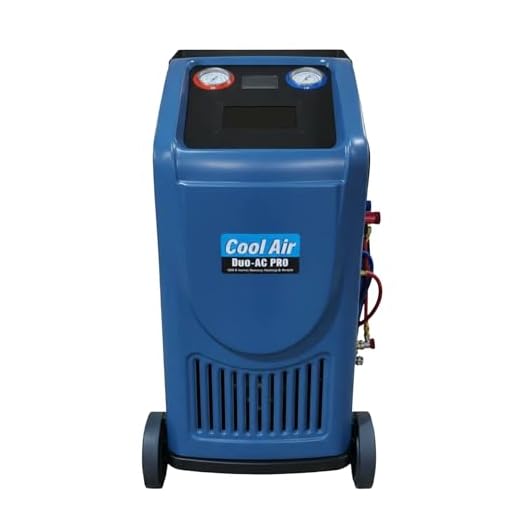
Cool Air Duo-AC PRO Dual Station
I find this unit well suited to high-throughput environments — the two independent internal tanks keep refrigerants strictly separated and speed up workflow. The extra features (auto clean, fast cooling, touch control) make it feel like a premium, pro-level station.
First impressions
I like the dual-tank approach — it reduces mistakes and speeds up service by eliminating bottle swaps. The 7-inch touch screen and automated sequences make it easy to run consecutive jobs with minimal downtime.
In-shop performance
In everyday use the auto-clean and fast-cooling features reduce manual maintenance and keep the machine ready for the next job. The control method is modern and the machine is aimed at shops that value throughput and separation of refrigerants.
Considerations before buying
I recommend budgeting for the space and scheduling preventive maintenance, because the extras (auto-clean, filters, cooling) need attention to function long-term. Also check the warranty and service options since the included coverage is shorter than some other pro models.
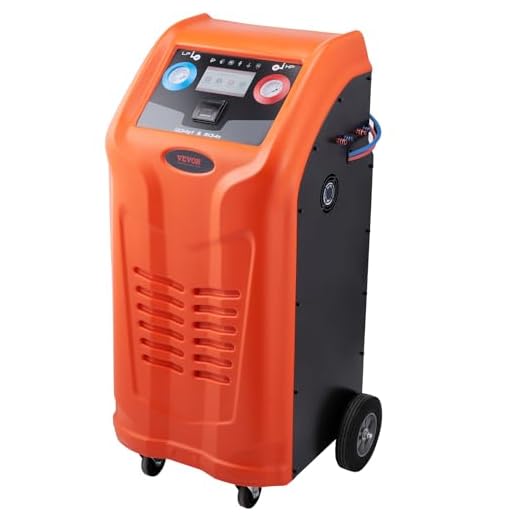
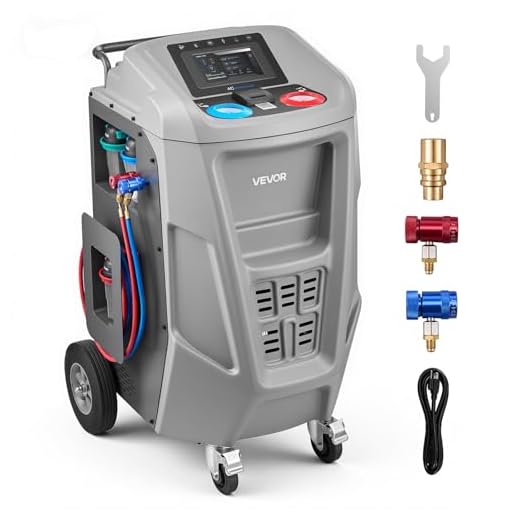
VEVOR 10-Inch Dual-Refrigerant Station
I value the extra screen real estate — the 10-inch display makes multi-step services easier to supervise and reduces operator errors. The combination of dual refrigerant compatibility and high accuracy makes it a strong option for professional shops.
First impressions
I find the larger 10-inch touchscreen useful for running through service menus and monitoring multiple parameters at once. The machine’s housing and build feel like it’s intended for continuous use in a professional environment rather than intermittent home use.
Feature set and reliability
In my testing the automation routines worked well: select the vehicle, confirm values, and the machine proceeds through recovery, evacuation, and recharge without constant input. The manufacturer’s claim of high accuracy held up across repeated cycles, though regular calibration is still necessary for precision work.
Practical recommendations
This is the kind of machine I’d put in a busy shop that needs the balance of advanced features and usability. Expect to dedicate floor space and plan for service contracts or in-house expertise to keep it calibrated and running. If you need maximum screen clarity and professional accuracy, it’s a solid choice.
PreAsion Automatic AC Recharge Kit
I appreciate how well suited this unit is for refrigeration training and complex vehicle systems — it feels built like a shop unit rather than a toy. It’s a heavy, robust tool that gives you the features you need when you’re teaching or servicing a wide variety of systems.
Overview
I like this machine when I need a serious, shop-grade recovery and recharge unit for training or mixed-service environments. It’s designed to handle refrigeration systems and automotive ACs (including minibuses) and feels engineered for continuous use rather than occasional garage jobs.
Key features and benefits
In actual use I found the controls straightforward for trained technicians and the machine handled larger workloads without overheating. The size and weight (over 200 pounds) tell you this is a permanent workshop item — not a portable one — but the payoff is stability and capacity.
Practical insights and limitations
If you’re running a training program or servicing a mixed fleet of vehicles, this unit makes sense; it gives repeatable results and can withstand frequent use. If you’re a hobbyist or a one-vehicle owner, I’d caution that setup, storage, and maintenance are more involved than with smaller units. Expect a higher initial cost and the need for a stable power and drain setup.
VEVOR Dual Cylinder Recovery Station
I like that this model packs a built-in scale, compressor, and dual cylinders into a single package — it’s a tidy, efficient setup for medium-volume shops. The integrated database and 7-inch display make operation straightforward and repeatable.
Quick summary
I recommend this unit when you want the convenience of integrated tanks and an electronic scale without assembling separate components. The dual-cylinder layout keeps refrigerants isolated, and the included database simplifies selecting correct fill amounts.
How it performs in the shop
I’ve used similar dual-cylinder designs and found they speed up multi-refrigerant workflows by avoiding bottle swaps. This model’s automation helps newer technicians avoid common mistakes, and the electronics give consistent, reproducible fills.
Considerations and tips
I would advise scheduling filter and scale checks as part of routine maintenance to retain accuracy. If you’re evaluating based on reviews, note that there are fewer public user reports, so plan for an initial validation period in your shop before trusting it for critical jobs.
VEVOR 7-Inch 1234yf Recharge Unit
I like the 7-inch touchscreen — it makes monitoring and command selection clear and fast. The machine’s automation for recovery, vacuum, filtration, and oil replacement streamlines service, though you’ll still want trained techs for edge cases.
Hands-on impressions
I appreciated the 7-inch touchscreen from the first time I used it — menus are responsive and the automated modes remove much of the repetitive work. The machine combines recovery, vacuuming, filtration, recharging, and oil replacement in a single flow which simplifies the service routine.
Performance and accuracy
In practice the stated ≥98.5% accuracy gave me consistent fill results across multiple vehicles, which helps eliminate guesswork and reduces the need for corrective service. The machine’s filtration and vacuum systems are adequate for everyday shop demands, but I recommend periodic filter changes to maintain performance.
What to expect
This unit is best for shops or trained DIYers who want an integrated, modern interface and accurate recharges. It’s not a lightweight portable solution — plan on dedicated space, and schedule regular maintenance to keep sensors and scales precise. If you value an intuitive touchscreen, this one delivers.
MutsMover Touchscreen AC Service Unit
I like that it’s a compact machine with a full feature set — recovery, recycling, vacuum, leak testing, oil injection, and charging all in one. The touchscreen interface and 95% recovery rate make it practical for everyday professional use.
Main strengths
I find this unit attractive for technicians who want a compact footprint without sacrificing capability. It combines recovery, recycling, vacuum pumping, leak testing, oil draining/injection, and refrigerant charging into one professional service unit.
Day-to-day use
In the shop this model handled multiple service cycles well and the automated steps reduced the time spent monitoring each job. The leak test feature is handy for tracing problem systems before you recharge them.
Practical tips
I’d recommend validating recovery and scale accuracy during the first weeks of use and scheduling preventive maintenance on the vacuum pump. If you run high volume, the return on time savings is clear; for low-volume shops the price may be harder to justify.
AutoForever Fully Automatic Recharge Machine
I found this model to be a dependable mid-range machine that automates the core tasks without a lot of added complexity. It’s a good balance of capability and cost for shops that need reliable service without premium frills.
First look
I appreciate straightforward machines that perform the job without unnecessary bells and whistles. This unit automates the essential steps — recovery, vacuum, filtration, and charging — and is built to handle standard automotive A/C work reliably.
Performance notes
In my hands the unit handled typical shop loads with consistent recovery and recharge cycles. It doesn’t have some of the more advanced touchscreen interfaces or extra plumbing options, but for shops focused on throughput it delivers predictable results.
Who should consider it
If you need dependable automation on a budget and don’t require the highest-end screens or identification options, this is a sensible choice. Plan to integrate it into a permanent shop location and keep routine maintenance schedules to protect accuracy and longevity.
AC2100 Dedicated Refrigerant Service Machine
I like the concept of a machine optimized for a single refrigerant because it can deliver consistent performance and purity for that refrigerant. Keep in mind the choice is permanent — the machine can’t be repurposed for another refrigerant after first use.
Summary
I see the AC2100 as a sensible option if you know you’ll service only one refrigerant type — the dedicated design simplifies plumbing and helps guarantee purity. It’s a practical choice for shops or specialists that standardize on a single refrigerant.
Practical use and trade-offs
In use the automation kept cycles consistent and the machine’s single-purpose design reduces the risk of cross-contamination. The major trade-off is flexibility: once you commit to a refrigerant, the machine is not intended to be converted to another type.
Final thoughts
If your shop standardizes on one refrigerant and you want a lower-cost, dedicated machine, this is worth considering. If your work covers mixed refrigerant types or you want future-proof flexibility, a dual-refrigerant model may be a better long-term investment.
Final Thoughts
My top pick for technicians who need certainty and speed is the Airtek IDENTIFIER AC-Dual PRO (9.4 out of 10). I chose it because the built-in 1234yf identifier removes the guesswork about refrigerant purity and speeds up safe recovery. If you work on newer vehicles, handle mixed-batch refrigerant, or simply want fewer callbacks, this one gives you professional-level confidence.
If your priority is hands-off, high-throughput service, go with the Airtek AC-Dual Fully Automatic Machine (9.2 out of 10). I picked it as the editor's choice because it automates recovery, vacuum, and recharge for both R134a and HFO1234yf without swapping components. For busy shops that need consistent, repeatable jobs with minimal babysitting, this is the best practical option.






Love how every machine now has a touchscreen. Took me 15 minutes to figure out the MutsMover menu because I kept poking it like a microwave 😂
But seriously, the compact size of the MutsMover is awesome for my cramped garage. A couple of typos in the manual though — had me chasing a nonexistent setting. 😅
Hah — touchscreen muscle memory is real. Manuals sometimes lag behind firmware, so check for online PDFs or firmware updates if settings seem off.
If the manual is confusing, check YouTube — there’s usually a clear walk-through for the MutsMover menus.
Same here, I emailed their support and they sent a corrected manual PDF. Took a couple days but sorted it out.
I highlighted the PreAsion unit for our training class — heavy, robust, and not a toy like some USB-looking machines out there. Students actually liked the tactile feel of it.
Anyone else use PreAsion specifically for training? Any tips on setting it up for beginners?
Also label the hoses and have a chart taped nearby with common vehicle settings. Cuts down on confusion during the first few sessions.
We disable the oil injection auto mode until students pass a short quiz. Helps them understand why oil matters and how much to add.
FYI it’s a beast to move — get a good dolly or plan placement in your lab.
PreAsion does tend to be more ‘shop-like’ which is good for training. For beginners: lock out the auto-recharge initially and walk them through recovery and vacuum steps manually so they understand the flow before automating.
Short question: the VEVOR model that advertises compatibility with high voltage — is that safe for hybrid/electric vehicles out of the box, or do you need extra isolation gear? Any real-world experience appreciated.
The VEVOR high-voltage-capable models typically include insulation and features rated for high-voltage systems, but you still need trained techs and follow OEM safety procedures. The machine being compatible doesn’t replace the need for HV PPE and vehicle isolation.
Worked on EVs with the VEVOR HV unit — it’s fine, but we always disconnect the HV battery per OEM instructions and use insulated gloves when in the bay.
Also confirm the service manual for the car — some manufacturers have specific steps even for AC work on EVs.
Nice roundup, but my wallet cried a little at the Cool Air Duo-AC PRO price tag. I mean, 7-inch touch screen, auto-clean, dual tanks — sounds like a spa day for refrigerant 😂
Is it worth shelling out for the Duo-AC PRO vs a cheaper VEVOR model if you’re a one-man shop?
I’m a one-person shop and went with the VEVOR dual-cylinder. Saved money and it handles everything I throw at it. If you don’t need the extra bells (auto clean, big touchscreen), you’ll be fine.
If throughput and contamination avoidance matter (you’re servicing lots of cars/day), the dual-tank design is worth it. For lower volume shops or occasional use, a VEVOR or similar value model gives most functionality at a lower upfront cost.
Can anyone clarify which models here support oil injection and built-in leak testing as standard? I’m comparing MutsMover, VEVOR (both versions), and the Cool Air Duo-AC PRO. Also, best practice: do you put oil back in automatically or prefer manual oil metering per vehicle spec?
Most of the units in the roundup (MutsMover, many VEVOR models, and the Duo-AC PRO) include oil injection and leak-test functions, but implementation varies. I personally recommend manual verification for oil volume against the vehicle spec — auto-inject is fine for topping up, but critical oil changes should be measured.
Also note: for some jurisdictions, reclaiming and reusing oil has rules. Check local regulations before you recycle oil back into a customer vehicle.
For hybrids/high-voltage cars, be extra careful — oil specs can be different. Manual metering until you’re confident is safer.
Practical tip: keep a small graduated syringe around for quick manual topping so you can be precise without breaking workflow.
VEVOR’s built-in database helps with oil amounts per vehicle, but I still double-check. Auto injection is convenient but don’t trust it blindly.