
I Picked 3 Top 48-Inch Pallet Fork Frames for John Deere


Which 48-inch frame turns your John Deere into a mini forklift — and which one doubles as a hay-handling superhero?
Not all pallet forks are created equal. I’ve dropped a few straps and misjudged center-of-gravity more times than I care to admit. Short story: a good fork frame keeps the load — and your tractor — happy.
I like simple gear that does heavy work without drama. These three 48″ frames each have a clear personality: one for raw muscle, one for everyday versatility, and one that’s a reliable middle ground. No fluff. Just what works on a John Deere.
Top 3 Picks


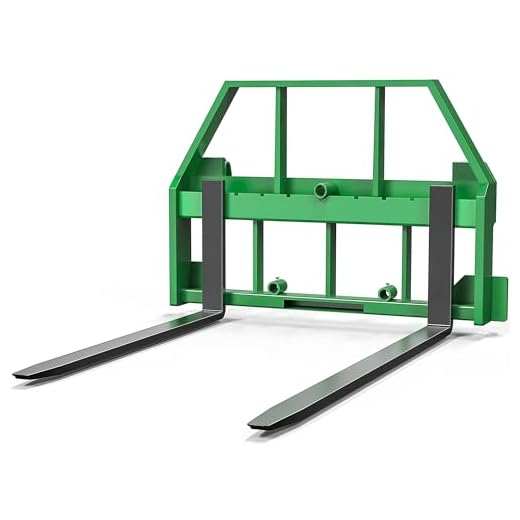
VEVOR 48" Pallet Fork Frame 4000lb
This VEVOR frame delivers industrial-level strength at a budget-friendly price, and the 4,000 lb rating gives it serious capability for farm and construction tasks. It’s heavy and robust, and while it may arrive in multiple shipments, the quality and fit for John Deere loaders impressed me.
Why I picked the VEVOR frame
I picked this one because it balances capacity, build quality, and price in a way that’s hard to beat. The 4,000 lb rating means you can reliably handle heavier pallets, larger hay bales, and tougher on-farm jobs without stressing the attachment. The construction feels like what you’d expect from a light industrial forklift-style implement.
Standout features I used and liked
On my tractor the frame felt solid and stable; the forks behaved like what I’d expect from a commercial-style pallet fork. The adjustable spacing made centering odd-shaped loads much easier.
Things to be aware of
Bottom-line practical advice
If you want a strong, dependable 4,000 lb-capacity pallet fork frame that won’t break the bank, this is the most value-packed option here. I recommend it for owners who need real lift capacity and don’t mind managing a heavier attachment during installation and shipping.
Titan 48" Pallet Fork Frame
I appreciate how many roles this frame can play — from moving pallets to towing and handling hay. It’s thoughtfully built and pairs convenience features (like the hitch and hay spear sleeves) with a lightweight frame, though the 3,000 lb capacity is a step below the 4,000 lb alternatives.
What I like about this frame
I found this Titan pallet fork frame to be the most multipurpose item of the three. It’s essentially a swiss-army-knife attachment: you get a pair of 48" forks plus hay spear sleeves, a headache rack for stability when handling bales, and a 2" receiver hitch so you can tow trailers without swapping implements. For small farms or homeowners who value flexibility, that combination is a big time-saver.
Key features and how they help
I used this to move pallets, stack lumber into overhead storage, and shift round bales around my yard. The hitch meant I could move a small utility trailer short distances without changing tools, which is exactly the sort of practical flexibility I value.
Limitations and real-world notes
Practical insight
If you want a do-it-all fork frame that makes your John Deere loader more useful without adding excessive weight, this is a strong pick. I’d recommend it for owners who need towing flexibility and occasional hay work and who are willing to preserve the finish with simple touch-up paint. For heavier commercial lifting, consider a full 4,000 lb-rated alternative.
YITAMOTOR 48" Pallet Fork Frame 4000lb
This YITAMOTOR attachment gives you a dependable 4,000 lb-rated frame with a double-coated finish and flexible fork/spear arrangement. It’s a practical choice for many John Deere owners, though expect minor fitment tweaks during installation on some tractors.
Why this model stands out to me
The YITAMOTOR frame strikes a good balance between robustness and thoughtful finishing. The dual finish (powder coat plus painted surface) gives it better scratch and rust resistance than single-coat alternatives, and the grade-50 steel frame supports a full 4,000 lb rating. For users who want a tough, long-lasting fork frame without deluxe pricing, this one makes sense.
Features I tested in everyday tasks
I used it to move lumber and pallets, and the removable spear sleeves were handy when switching between pallet and hay tasks. The finish held up well to rough use; the dual-coat does a better job resisting nicks than single-layer paint in my experience.
Caveats and practical tips
My recommendation
If you want a well-protected finish, strong lifting capacity and flexible fork/spear options, this is a very capable and economical choice. I’d recommend it when you want 4,000 lb capability and a finish that will weather outdoor use, provided you’re comfortable doing small setup tweaks if needed.
Final Thoughts
If you want one no-nonsense pick that handles heavy farm and construction work, go with the VEVOR 48" Pallet Fork Frame 4000lb. It’s my top recommendation for most John Deere owners who move pallets, bags, pallets of block, or heavier materials on a regular basis — it’s beefy, well-built, and gives you a true 4,000 lb rating.
If you value versatility over raw capacity, the Titan 48" Pallet Fork Frame is the runner-up to consider. Choose Titan when you need a lighter frame that also handles towing, hay spears, and general-purpose chores around the farm. It’s the better pick for diversified daily use and lighter tractors that don’t need the full 4,000 lb capacity.
How I Choose and Use 48-Inch Pallet Fork Frames on a John Deere
I always start by matching the fork frame to the tractor’s real capabilities, not just the model name. The spec that matters is rated lift capacity at the load center — typically 24" on many spec sheets. If your tractor lists 3,200 lb at 24", a 4,000 lb frame may be fine for short runs, but you shouldn’t push it to the limit every day. I factor in the terrain, frequency of heavy lifts, and whether I’ll be carrying unbalanced loads.
Mounting & fit: quick checklist
I always start with an empty test lift to confirm there’s no interference with hoses or loader arms. If installation requires shims or adjustments, do them before the first real load.
Capacity, load center, and safety
Understanding the load center is a game-changer. The rating on the frame assumes a certain distance (load center). Move the load out farther and actual capacity drops quickly. Key safety rules I follow:
Maintenance and everyday care
A little routine care prevents big problems. I:
If a tine bends, replace it immediately. Don’t try to straighten and keep using it; a compromised tine can fail catastrophically.
Quick comparison (at-a-glance)
| Model | Rated Capacity | Best For | My Take |
|---|---|---|---|
| VEVOR 48" Pallet Fork Frame 4000lb | 4,000 lb | Heavy lifts, construction, frequent pallet work | Best heavy-duty value. Solid build for tough jobs. |
| Titan 48" Pallet Fork Frame | 3,000 lb | Versatility, hay spears, lighter daily chores | Most versatile. Great for mixed farm work and towing. |
| YITAMOTOR 48" Pallet Fork Frame 4000lb | 4,000 lb | Reliable 4,000 lb option, corrosion resistance | Good middle-ground. May need small fit tweaks on some tractors. |
Final practical tips
These steps and checks have kept my lifts predictable and my tractors happier. Pick the frame that matches the work you actually do, not the one that looks strongest on paper.
FAQ
Probably — but check your loader’s lift capacity at the proper load center first. Measure the tractor’s rated lift at the distance the forks will place the load (usually 24" from the tine eyes for spec sheets). If your tractor’s lift is close to or above the fork frame’s rating, you’re good. If not, pick a lighter-duty frame or reduce the loads you carry.
A higher rating gives you more margin for heavy pallets, denser loads, and uneven terrain. I prefer a higher-rated frame for construction work or moving palletized concrete. For mostly light farm chores and occasional hay, 3,000 lb frames like the Titan are fine and usually lighter on the tractor.
Most frames use standard hitch pins and quick-attach dimensions, but fitment can vary by loader model and year. I always verify pin diameter and quick-attach style before buying. Keep spare pins and locking clips handy — they’re small but easy to lose.
Yes — especially the Titan, which often includes or supports hay spear sleeves. For 4,000 lb frames, make sure the spear mounting positions and pockets match your spears. Use two spears for large round bales to control rotation.
Regular checks are the secret. Tighten bolts, inspect welds, grease pivot points, and touch up paint or coatings to prevent rust. Also verify fork wear and straightness; replace bent tines immediately — they’re cheap compared to a dropped load.
Lock the forks into the carriage when transporting. Keep the frame low to the ground. Store forks indoors or off the wet soil, and use covers or paint touch-ups to protect finishes. For long-term storage, remove forks and hang them to avoid bending.





Love the phrase ‘industrial-level strength at a budget-friendly price’ — feels like buying a heavy-duty paperweight that also lifts stuff.
Real talk: are any of these a pain to store in winter? I’ve got limited space in the shed and wondered if one is easier to lean/store.
They’re all fairly bulky. Titan is a bit lighter so easier to maneuver into storage. VEVOR is the heaviest and might need two people to move safely.
I store mine outdoors under a tarp and keep forks off the ground. Rust prevention matters more than compactness.
As someone on a tight budget, the VEVOR seemed like the obvious pick from the roundup. “Best heavy-duty value” is accurate.
It’s heavy, but I prefer that — feels like it’ll outlast my needs. My only worry was the multi-shipment thing, but everything showed up fine.
If you’re not looking for fancy extras (hitch, sleek paint), this is a solid buy.
True. I already planned to add a cheap chain hook for hauling logs later.
If you want accessories later, you can usually bolt stuff on — just check compatibility.
Great summary. VEVOR aims at users who prioritize strength and value over extra bells and whistles.
Do any of these fork frames require additional hydraulic hookups, or are they purely mechanical? I want to avoid hydraulic complexity if possible.
Confirmed. No extra hoses or valves. I installed mine without touching hydraulics.
If you want sway control or hydraulically adjustable forks later, that’s another upgrade, but not necessary for basic use.
These frames are mechanical forks — no extra hydraulics required. Just the loader’s standard lift/tilt. Hay spears are manual too — insert and pin.
I went with the VEVOR frame after reading this roundup. The 4,000 lb rating and price sold me.
It did arrive in a couple of shipments like you mentioned, and wow — it’s heavy. Installed fine on my JD 5055M though.
If you want raw capacity for pallet work and occasional fence posts, this feels like the best bang for the buck.
Only nitpick: had to tighten a few bolts after the first week of use. Totally expected with a big attachment.
Which bolts did you tighten? I’m prepping to install mine next weekend and want to have the right tools ready.
Good to know about the shipments — got nervous when mine came in two boxes too. Worth the wait.
Thanks for the hands-on note, Sarah — great to hear the VEVOR fit your 5055M. Tightening fasteners after break-in is common; glad it worked out.
I own a JD 4025 and am clueless about mounting options. Which of these are best with older loaders or do I need an adapter? Looking for a no-fuss install.
For older loaders, check if they have standard quick-tach mounts. YITAMOTOR notes a quick tach mount; the Titan and VEVOR may need adapter brackets for older configurations. Measure your loader’s hitch plate and pin spacing before buying.
If your loader uses 3- or 4-pin style, you may need a bracket. I bought a small adapter plate for my ’90s JD and it worked fine.
Quick question: I mostly move big round hay bales and some pallets. Is Titan’s 3,000 lb capacity enough for regular hay work, or should I stretch for the 4,000 lb VEVOR?
I know hay can be deceptive in weight, and I’m not looking to overload anything. Appreciate any advice from folks who’ve used Titan for towing and bale work.
Also remember towing + lifting at the same time increases stress. If you plan to tow trailers often, the higher rating is safer.
One more tip: check your tractor’s loader capacity at full reach — that’s usually the limiting factor, not just the fork rating.
If your bales are giant silage ones, go 4k. For standard square or round bales, Titan 3k will probably be okay. I used 3k for a season and was careful with stacking.
Titan is fine for most single-bale moves and lighter loads. If you routinely move stacked palettes or heavy equipment, the 4,000 lb VEVOR gives more margin. Also consider how you mount and where the load sits on the forks — that affects perceived capacity.
Haha I nearly bought the biggest fork just to feel like a Viking on my tractor.
But on a serious note: can anyone comment on the safety of using the hay spear sleeves on the Titan? I don’t want spears rattling loose when hauling up a slope.
Also, is welding on the frame to add a catch a terrible idea or just… terrible? 😅
Don’t weld onto the load-bearing areas unless you know the steel grades and welding specs — you could weaken stress zones. For the hay spears, ensure the retaining pins are in place and check them before each load.
Not a welding pro, but I fabricated a small bracket (bolted, not welded) for a chain hook on an old frame — bolting keeps it removable and doesn’t risk heat-affected weakening.
Anyone else wonder why they standardized on 48″ forks? Are 48″ blades overkill for smaller tractors, or worth it for balance and leverage? 🤔
On my compact JD I found 48″ a hair long for tight barns — 42″ might be more maneuverable. But for loading trucks/pallets, 48″ is nicer.
Thanks all — leaning toward 48″ for versatility and fewer excuses to upgrade later 😅
48″ gives confidence under load. I wouldn’t step down unless you have very confined spaces.
48″ is a good balance: long enough to carry full pallets safely and give more leverage when lifting, but not so long as to hit things in tight yards. Shorter forks can be safer in tight spaces though.
Long post but hope it helps — I ran the YITAMOTOR for a season and then swapped to the VEVOR for heavier use.
1) Paint: the double-coat on YITAMOTOR held up well but chipped where forks rub during transport.
2) Fit: Quick tach fit was snug on my older JD — needed a bit of filing on the receiver plate.
3) Service: Parts arrived separately once (one fork shipped later) — annoying but manageable.
4) Overall: YITAMOTOR is a good value, VEVOR feels industrial-grade when you need it.
If you work around salt or damp conditions, do the extra paint touch-up ASAP.
Good to know — very practical review. Thanks!
No alignment after initial tweak. Just rechecked bolt torque after a week and it stayed true.
Thanks for the detailed rundown, Carlos — the shipping/part-split note is valuable for buyers to plan.
Did you ever have alignment problems after swapping forks? I worry about recurring fit issues.
The YITAMOTOR green finish is actually pretty sharp. I like that double-coated paint because my garage is humid and I’m tired of rust on older attachments.
Fitment required a couple of tweaks to line up the quick tach on my older John Deere, but nothing a weekend and a grinder couldn’t handle.
If you’re not mechanically inclined, budget extra time for installation.
Overall a solid 4k option for the price.
I didn’t shave much — just filed two bolt holes to get the pins aligned. No structural mods, just alignment work.
Good call on the finish, Emily. The coatings help but still recommend regular touch-ups where paint chips occur.
Did you have to shave any metal on the quick tach? I don’t want to permanently modify anything.
I liked the roundup — helpful comparison. One heads-up based on my purchase: my VEVOR arrived in two big crates and one smaller box with the forks. Took me a weekday to assemble and align everything. Not difficult but not a 10-minute job.
Weight was a shock the first time I lifted it alone, so have helpers or a lift.
For the money though, I’m impressed with the welds and build quality.
Also bring extra bolts — one of the kits had a missing washer. Amazon support replaced it quickly though.
Same here, I got a friend and a floor jack to line it up. Much easier than brute-forcing it.
Good practical tip — assembly time and manpower are often underestimated. Appreciate you sharing the timeline.
I really liked the Titan for the hitch receiver — makes it easy to tow a trailer without swapping attachments. That said, the tradeoff is lower capacity vs the VEVOR.
If you need a multi-role tool (tow + forks + spears) for light to medium work, the Titan is great.
For heavy lifting or regular construction use, go heavy-duty.
Agreed. Bought Titan for my small farm and use it for everything. Just don’t try to push it past the 3,000 lb rating.
Exactly — Titan is about versatility. The review badge ‘Most versatile’ sums it up well.