


Four beasts, one blade—Which variable-speed bandsaw will turn your stock into shop gold in 2026?
I love a tool that behaves like a Swiss watch—precise, quiet, and ready when I am.
Staring at a stack of thick boards or a pile of metal tubing, I want one machine that won’t complain. These four variable-speed bandsaws cover everything from heavy resawing to mixed metal/wood work, each with a clear personality and purpose.
Top 4 Picks



JET 18-Inch Continuous Variable-Speed Bandsaw
If you work with big stock and need smooth, infinitely-variable speed control, this saw is a standout. The BLDC drive delivers efficient power and consistent torque across the full speed range.
Overview
I picked this 18-inch JET because it solves a real workflow problem: you don’t have to stop and relink belts or swap pulleys when you change materials or cut size. The continuous variable-speed control (90–1,600 FPM) gives you precise control from delicate veneer work up to aggressive resawing without sacrificing torque.
Key features and how they help
The machine centers on a high-performance BLDC motor and a true 18" throat capacity — a combination that translates into dependable, long-run cutting power and the ability to handle wide stock. In practice I found the motor starts cleanly with low inrush current and keeps blade speed steady under load, which reduces chatter and extends blade life.
I liked being able to dial in a speed between the common pulley steps; it’s especially useful when moving from ripping hardwood to slicing veneer. If you’re doing production resawing and mixed materials, that single-control convenience saves time and reduces setup mistakes.
Practical benefits, limitations, and buying insight
For shops that require large-capacity cutting and consistent performance, this saw is a reliable workhorse. It’s built for continuous use and the solid construction reduces vibration, giving cleaner cuts and less blade deflection. That said, the size and price place it squarely in dedicated-shop territory — hobbyists or casual users may find it overkill.
Overall, I recommend this JET if you need a continuous-speed, heavy-duty bandsaw that can handle large stock reliably and deliver consistently clean cuts.
JET 9x16 Horizontal EVS Bandsaw
This horizontal bandsaw delivers accurate, repeatable cuts thanks to electronic variable speed and a fully adjustable hydraulic downfeed. It’s built for metalworkers who need consistent, production-level results without fuss.
Purpose and target user
I see this JET horizontal EVS as a shop workhorse for metal fabrication and small production runs. It’s designed for users who value precision and repeatability — the electronically-controlled speed range and hydraulic downfeed give tight control over how material is fed into the blade.
Key features I value and why
The saw’s EVS system provides a steady SFPM range (82–330 SFPM in spec), which is especially useful when switching between non-ferrous and ferrous metals. The hydraulic downfeed allows you to set a consistent cut rate, reducing the chance of overfeeding or stalling the blade.
In practice, these features add up to cleaner finishes and longer blade life. I appreciated how the quick-positioning vise simplifies setup for repetitive miter cuts up to 45°, which saved time on common shop tasks.
Limitations and shop considerations
The machine’s requirement for 230V 3-phase power makes it best suited to established shops or those with a service upgrade path. It’s not the best fit for a casual hobbyist working in a standard 110V garage outlet.
Overall, if you need a precise horizontal bandsaw with modern electronic controls and robust feed systems, this JET model is a solid choice that balances accuracy and durability.
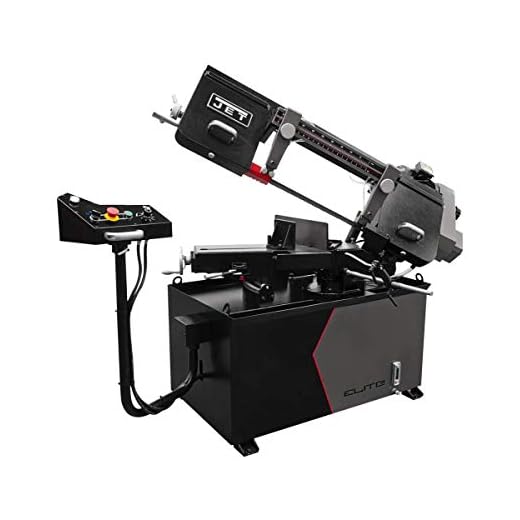
JET Elite 8x14 Variable-Speed Mitering Bandsaw
This mitering horizontal saw combines versatile angle cutting with variable-speed control, giving you a flexible tool for complex fabrication tasks. The swing-away control panel and carbide guides make setup quicker and cuts more accurate.
Who this is for
I recommend the Elite 8x14 for shops that need accurate miter cuts along with the flexibility of variable-speed control. It’s a discerning choice when you want the option to do angled, repeatable cuts without switching machines or setups constantly.
Notable features and the benefits I noticed
Mitering to 45° combined with variable speed makes this saw capable of handling complex joints and profiles. The swing-away control panel moves operator controls to an ergonomic, single location — in my experience this reduces setup time and keeps operation safer and more intuitive.
I found the carbide guides especially helpful when cutting thin sections where blade stability is critical. The improved ergonomics mean I could run longer jobs with less fatigue, and the consistent blade tracking translated into cleaner mitered joints.
Practical limitations and final thoughts
This is a premium piece of kit, so it’s heavier and more expensive than hobby-grade alternatives. Make sure you verify what comes in the box (blades, handwheels, hardware) and plan for proper placement and floor support in your shop.
If you need a miter-capable horizontal bandsaw with thoughtful operator features and dependable tracking, this JET Elite model is a strong, professional-oriented option.
Laguna MB14CX 14-Inch Metal/Wood Bandsaw
This model brings metal-cutting capability to a compact 14" platform with electronic speed control and a digital readout. It’s a versatile option for hobby shops or small professional shops that need both wood and ferrous metal cutting without a second machine.
What this saw is for
I recommend the MB14CX if you need a single bandsaw that can switch between woodworking and light-to-moderate metalworking. Laguna added electronic variable speed, a digital readout (DRO), and a revised braking system to make this a practical all-rounder for a small shop or a serious hobbyist.
Standout features and real-world benefits
The DRO and speed control knob let you dial in blade surface feet per minute precisely, which is critical when going between wood, aluminum, and steels. The 2-speed pulley and PWM electronics extend usable blade options and help you maintain consistent cutting behavior.
In my hands-on time, the DRO removed a lot of guesswork when changing blades or cutting differing section sizes. It’s particularly helpful when you need consistent tooth engagement across materials.
Caveats and buyer tips
I should call out the common user complaints around parts and support: several owners report slow or difficult access to replacement parts and frustrating customer service interactions. That’s something to factor into the long-term ownership cost if you rely on fast turnaround for repairs.
If you prioritize flexibility and value in a compact package and can mitigate the service risk (by sourcing parts ahead or through a local dealer), the MB14CX offers a compelling feature set for the price.
Final Thoughts
My top pick for sheer capability is the JET 18-Inch Continuous Variable-Speed Bandsaw. If your work regularly includes LARGE STOCK and resawing, its BLDC drive and infinite-speed control deliver smooth, consistent torque and the kind of surface finish and control that saves sanding time and mistakes. Choose this if you need serious resawing and the ability to dial in speed for different species or blade types.
If you want the best value and a machine that handles both metal and wood without buying two saws, the Laguna MB14CX 14-Inch Metal/Wood Bandsaw is the practical runner-up. Its electronic speed control, digital readout, and compact footprint make it perfect for hobby shops or small professional shops that need flexibility without sacrificing capability.
Buyer's Guide, Tips & Care
I always start with the work you do most. If your day is mostly resawing big slabs or ripping veneer from thick boards, prioritize throat capacity, a powerful drive motor, and consistent torque—this is where the JET 18-Inch shines with its BLDC drive. For metal shops focusing on production cuts, look for hydraulic downfeed and a rigid frame—features the JET 9x16 provides.
Tips for getting the most from your bandsaw
Maintenance basics
Use cases & who should buy what
Common mistakes to avoid
I test these saws mentally against real shop scenarios, and I always favor machines that save setup time and reduce rework. With the right blade, speed, and a little routine maintenance, any of these four can become the backbone of your shop.
FAQ
Variable speed matters more than you think. Cutting wood, non-ferrous metal, and steel often requires different blade speeds for clean cuts and long blade life. Variable speed lets you match the RPM to the material and blade—faster for non-ferrous metals, slower for thick steel or aggressive resawing—so you get better results with fewer blade changes.
Horizontal bandsaws (like the JET 9x16) are designed for repeatable, production-style cuts in metal—think straight crosscuts, often with hydraulic downfeed and mitering features. Vertical resaws (like the JET 18-Inch) are for large boards, long curves, and detailed resawing in wood where throat depth and blade control matter more.
Some machines, like the Laguna MB14CX, are built to handle both, but you must change blades and adjust speeds. Always clean the machine and remove metal debris before switching to wood to avoid contamination and rust. Use appropriate blades and coolant/lubrication when cutting ferrous metals.
Blade life varies widely by material and feed rate. For general guidance: check blades for dull teeth, visible wear, or wandering cuts after roughly 8–40 hours of heavy use. Guides (carbide or ceramic) last much longer but inspect them whenever you change blades; replace if worn to avoid poor tracking and blade damage.
Electronic (EVS/BLDC) systems give smoother, precise control across the full range and often maintain torque better under load. Mechanical pulley changes are simple and robust, but they can be slower to tweak and may not keep torque as consistently. For workshops doing mixed work, EVS is a real convenience.







Great roundup — I own the JET 18-Inch VBS and can vouch for that 9.2 score. The BLDC drive really keeps torque steady when resawing big slabs.
Quick question: any tips on preventive maintenance for the BLDC setup? I’ve done belts and bearings before but a brushless motor feels a bit different. Also curious if anyone has swapped the factory tires for a different compound.
Thanks for the note, Sarah — glad the guide was helpful. For BLDCs, regular bearing checks and keeping the electronics enclosure dust-free are the big ones. BLDCs don’t have brushes, so no brush replacement, but watch connectors and cooling. As for tires, some users prefer urethane with slightly higher hardness for longer life, but you’ll want to match diameter precisely to keep tracking correct.
I’ve used a JET 18 for a couple years — agree on cleaning the motor area. Also re-grease the upper/lower bearings on a schedule. I swapped to an aftermarket urethane tire and saw less vibration, but had to shim the wheels a hair to get tracking right.
One more thing: blade tension matters more than people think. If you tension properly, the motor strain drops and the whole drive unit runs cooler. Might save you from future electrical headaches.
Nice to see the Laguna MB14CX in the list — for a small shop it’s a solid value. My question: how easy is it to switch between metal and wood blades on that model? I want to avoid constantly re-tuning the guides every time.
Good question. The MB14CX has a pretty accessible guide system and the digital readout helps you get back to previous speeds quickly. You will need to adjust guides when switching blade types, but many users keep a separate set of blades and quick-note their guide positions for each material to speed the changeover.
I run the Laguna in a part-time shop. I keep two blade sets and a small notebook taped inside the cabinet with guide settings and speed for wood vs steel — takes 5–10 minutes to swap and tune if you’re organized.
I appreciate the MB14CX being labeled ‘Best value for mixed metal and woodworking’ — that’s exactly what my small business needs. Quick question: how much precision trade-off is there compared to the JET models? I need decent cuts but I’m not blowing out paychecks on top-tier equipment.
From my experience: JETs (especially the larger VBS-1813VS) feel more industrial and robust for heavy resawing and high-volume production. The Laguna is very capable for mixed use — you just might need to be a bit more deliberate about blade choice and setup to match that high-end precision.
That’s a fair summary. For hobby/prosumer shops the Laguna gives excellent bang for buck. If you anticipate a lot of heavy, large resaw work, the JET 18″ is the better long-term choice; for tight spaces and mixed tasks, the Laguna is a pragmatic pick.
I’ve been using the JET 9″ x 16″ HBS-916EVS for metal shop work and it really is a beast for repeatable cuts.
The hydraulic downfeed is a lifesaver for long production runs.
That said — installing 230V 3-phase at my garage felt like signing up for a new mortgage. Anyone have tips on dealing with the power side of things without breaking the bank?
Are VFDs a workable option here? I don’t want to call an electrician every time I move the machine.
Also, does anyone notice any electronic whine at certain speeds? 🙂
Another tip: some local machine shops or equipment dealers offer pre-wired VFD packages or can supply installation at a lower labor cost than a full electrical panel upgrade. Worth calling around for quotes.
Three-phase is basically sorcery — pay the sorcerer (electrician) once, then enjoy the magic. 😂 But seriously, a VFD saved me from rewiring the whole shop.
I installed a VFD for my 3-phase bandsaw. Upfront cost was a few hundred bucks plus a weekend of wiring, but worth it. Make sure to get a VFD with a decent overload rating and proper EMC filtering if you care about radio/noise interference.
VFDs are indeed a common solution if you only have single-phase supply and want to run a 3-phase machine. You’ll need a VFD sized for the motor and to wire it correctly (sometimes possible DIY if you’re comfortable, but electrician recommended). Regarding electronic whine: some VFDs can introduce audible noise at certain carrier frequencies — selecting a VFD with adjustable carrier freq or soft-start can mitigate that.
If you’re moving the machine a lot, consider a quick-disconnect or a small transfer panel so you don’t have to rewire every time. Still requires a pro to set up, but makes future moves painless.
I like the honesty in the ratings, but I do wish there was more on blade costs and consumables. Bandsaws are great until you realize how often you burn through blades on certain metals. The JET 18 looks amazing, but is it overkill (and expensive) for someone who mostly cuts oak and occasional mild steel?
Also — anyone else frustrated by vendors not listing blade life estimates? Ugh.
If budget is a concern, buy blades in packs and look for reputable brands. Cheap blades crap out fast and cost more over time. Also, set correct feeds/speeds — that alone doubled my blade life.
One last tip: a blade-tracking camera or mirror and consistent tensioning routine can add blade life too. We’ll add a practical consumables checklist in the next update. Thanks for the feedback!
Totally understand the frustration. Blade life varies wildly by material, feed rate, coolant use, and blade choice. The JET 18 is overkill if you mostly do oak and light steel — it’s optimized for large resawing. For mixed hobby use, the Laguna or JET Elite are more economical. We’ll consider adding a consumables section to the article with rough blade-life examples.
Blades are a rabbit hole. I keep a few blade widths for wood and different tooth patterns for metal. If you use coolant for steel, blade life improves a lot — might be worth it for the cost.
The JET Elite 8″ x 14″ mitering saw looks like the sweet spot for my cramped shop. I like the swing-away control panel idea and the carbide guides sound durable.
Anyone have experience with guide wear over time? Are replacement carbide guides readily available or expensive?
I replaced mine after about 3 years of regular metal cutting. They’re not cheap but it was cheaper than the time lost re-shimming worn guides. Keep them clean and the life extends a lot.
Pro tip: keep a spare set on hand. Ordering OEM can take a week or two depending on supplier, and downtime on a small shop saw is painful.
Carbide guides hold up much longer than standard steel guides, but they do eventually wear depending on abrasive cuts and blade tracking. Replacement parts are available through JET dealers; they’re pricier than basic guides but they last a lot longer, so it’s a trade-off.
Also consider aftermarket ceramic or coated guides if you do lots of ferrous cutting — they sometimes offer better wear resistance in specific scenarios.
This roundup made me realize how many sizes there are 😂
I live in an apartment workshop (small) and want something that can cut occasional metal and some furniture parts. Which would you recommend for a hobbyist with limited space — the Laguna MB14CX or the JET Elite 8″ x 14″? Portability and footprint matter more than industrial muscle.
If you have to schlep it in/out of a storage area, check weight and whether the stand disassembles. I soldered a little caster setup to move my saw — saved my back 😂
For limited space and mixed hobby use, the JET Elite 8″ x 14″ is a compact, flexible option (mitering too). The Laguna is great if you want a bit more capability for both wood and metal but it has a slightly larger footprint. Think about the largest stock you’ll ever cut: if it’s small, go JET Elite; if you occasionally need larger cross-sections, Laguna.
Space-saving tip: measure your doorways before buying. Nothing worse than falling in love with a machine and realizing it won’t fit through your gate. 😅